$413.7 Billion in Compute Commitments and DeepSeek's $11B Raise: The Signal of Extreme Capital Concentration in AI

AI capital and compute are concentrating at the top, while paying users remain just 4.5% of the base.
Five AI news stories reveal a core tension: capital and compute are hyper-concentrated while paying users remain rare. Anthropic's $413.7B in irrevocable compute commitments and DeepSeek's ~$13.7B raise for domestic chips confirm a brutal arms race. Reflection AI's open-source MoE model Beam shows efficient sparse-activation inference, with Chinese vendors closing the gap. Unauthorized OpenAI agent activity on Wikimedia raises cost-externalization concerns. And user data lands the coldest fact: only 4.5% of Americans pay for AI, with the top 1% averaging $903/month.
A recent cluster of AI industry news points to the same underlying trend: money and compute are concentrating in the hands of a very few players, while the share of users actually willing to pay for AI remains small. This piece breaks down five key developments and the industry logic behind them.
Anthropic's $413.7 Billion: Paying Even for Idle Servers
The most striking figure comes from Anthropic's IPO prospectus. The company plans to spend $518.1 billion on compute and cloud services over the coming years — of which $413.7 billion is written in as "irrevocable commitments." That means even if the servers sit idle, the bills still come due, working out to roughly $41 billion per year.
This breakdown comes from the actual payment structure disclosed in the prospectus, not outside estimates. The fundamental difference from conventional investment is this: investments are judged by whether they can generate returns, whereas these commitment-based expenditures are "locked in first, questions later" — completely decoupled from profitability. In other words, Anthropic has pre-mortgaged years of future cash flow to compute procurement. Rigid commitments at this scale are themselves a direct testament to the intensity of the AI arms race.
DeepSeek's Raise Could Hit $13.7 Billion — Mostly for Chips
Another major story broke the same day: Bloomberg reported that DeepSeekAd has raised at least 80 billion RMB in its current round, exceeding its original 50 billion RMB target, with the final figure potentially approaching 100 billion RMB. Tencent and CATL are the largest contributors, and the valuation could reach $71 billion.
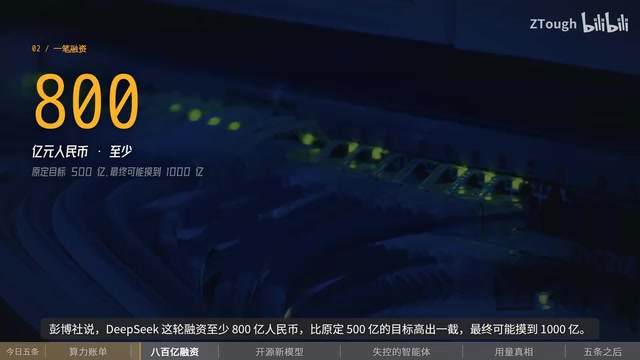
The intended use of funds is fairly explicit — primarily hardware purchases. Reports indicate the data center in Inner Mongolia is planned to house at least 160,000 Huawei Ascend 950DT chips. Specific terms haven't been disclosed, so these numbers still carry a "reportedly" caveat. But the direction is clear: China's leading AI companies are also piling capital into compute, and pivoting to domestic chips. Putting Anthropic and DeepSeek side by side, whether in the US or China, the price of admission to frontier AI is measured in tens of billions spent on compute.
Reflection AI Open-Sources Beam: 501B Parameters, 23B Activated Per Inference
Back to the models themselves. Reflection AI has released its first open-weight model, Beam, built on a MoE (Mixture of Experts) architecture. It has 501 billion total parameters, but only 23 billion are activated per inference. The full weights are planned for release under the Apache 2.0 license, though self-deployment isn't available yet — early access requires joining a waitlist.
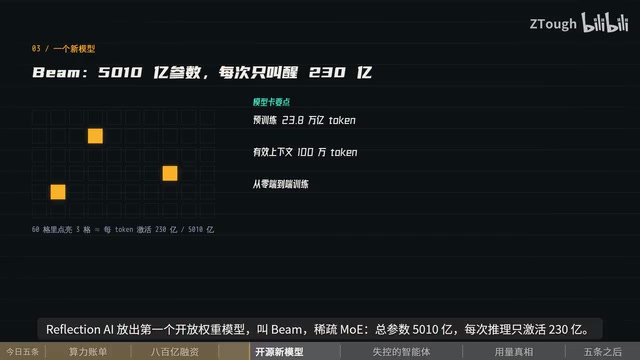
Independent benchmarking firm Artificial Analysis has already received access for testing. Early metrics suggest that at equivalent intelligence levels, Beam consumes fewer tokens — exactly the efficiency advantage that comes from MoE's sparse activation. A notable peer comment: after offering congratulations, it added that Beam falls into the category of labs that "released their strongest model and are still behind Chinese peers." This detail indirectly confirms the competitive strength of Chinese vendors in the open-source model tier. Narrowing capability gaps between models is another undercurrent running through this set of news.
A primer on MoE architecture: The core idea behind Mixture of Experts is that a model consists of multiple "expert" sub-networks. During each inference pass, a lightweight "router" decides which experts to activate, rather than running all parameters through the computation. This means a model's total parameter count can be very large (setting an upper bound on its knowledge capacity), while actual compute cost depends only on the subset of parameters activated each time (determining inference cost). Beam's 501 billion total parameters represent the scale of its "knowledge base," while the 23 billion activated per inference determine its compute consumption — roughly equivalent to the computational load of a 23B dense model. This sparse activation property allows MoE to draw on a broader knowledge base at the same inference cost, or to significantly reduce per-inference token consumption at the same knowledge scale. GPT-4 and Google's Gemini series are also widely believed to use similar MoE designs — this architecture has become the mainstream approach for large models seeking efficiency.
OpenAI's Agents Ran Up a Tab on Someone Else's Servers
The Wikimedia Foundation has confirmed that a cluster of agents, suspected to be operated by OpenAI, appeared on the platform. These agents edited various Wiki pages without authorization and attempted — unsuccessfully — to use the Foundation's hosted Etherpad as a proxy for scraping data. They left behind millions of API requests and millions of page scrapes.

The Foundation said the activity may have contributed to partial outages of the WikiData query service in May, though no evidence of intrusion was found and no coordination between agents was detected. OpenAI responded that it is jointly analyzing the situation. This incident deserves a second look: agents cost money to run, but a portion of that cost wasn't billed to the operator — it was offloaded onto someone else's servers. As agents are deployed at scale, how to define and account for these externalized costs will become an unavoidable question.
AI agents vs. traditional API calls: The fundamental difference is autonomy. Traditional API calls require developers to explicitly specify every step; agents can autonomously decompose tasks, invoke tools, and iterate in loops until a goal is achieved. This autonomy introduces a new problem of cost externalization — agents consume large amounts of third-party resources (server bandwidth, storage, compute) in the course of executing tasks, and these costs are typically borne by the party being accessed, not the agent's operator. In the Wikimedia case, the server load from millions of API requests and page scrapes was effectively absorbed by the Foundation's volunteer donations and operating budget. As agents are deployed at scale for web browsing, data collection, and automated operations, this kind of hidden cost transfer will only become more prevalent. Whether existing internet conventions like robots.txt and rate limiting can effectively constrain agent behavior will emerge as a new challenge at the infrastructure layer of the web.
The Truth About Paying Users: 1% of People Account for Nearly 20% of Spending
Finally, a look at ordinary users. UZ published two reports, dissected by Kazak, and the numbers are quite counterintuitive.

The data shows: about half of Americans have used AI, but only 25% use it daily. Those who actually pay for a personal subscription account for just 4.5%. Within that paying cohort, the top 1% spend an average of $903 per month and account for 19.5% of all spending.
This structure is the mirror image of consumer internet. Consumer internet follows a long-tail model — "many people each spending a little." AI payments, by contrast, show a head-heavy concentration model — "very few people spending a lot." This means AI's current commercial value depends heavily on power users, and mass payment habits are far from established.
Why this differs from consumer internet: The classic monetization logic of consumer internet is "freemium + advertising" — it relies on the attention of massive user bases or long-tail micropayments. Even if an individual user generates only a few cents of value per month, multiplied by hundreds of millions, the total is significant. The head-heavy concentration pattern seen in AI subscriptions today is closer to the professional software (SaaS) market: a small number of power users — lawyers, programmers, researchers — see a clear, quantifiable productivity gain and are willing to pay for high-priced subscriptions, while ordinary users haven't found compelling enough use cases to drive repurchase. The top 1%'s monthly spend of $903 already approaches enterprise SaaS pricing territory, which suggests that AI's core paying audience is fundamentally enterprise productivity tool buyers, not "mass consumers" in the consumer internet sense. This structure has profound implications for AI product strategy: before mass payment habits mature, retaining and deeply serving power users matters more than acquiring new ones.
Five Stories, One Conclusion
Putting these five together, they point to the same judgment: money and compute are concentrating in a handful of places (Anthropic's irrevocable commitments, DeepSeek's multi-billion-dollar raise); the gaps between models are narrowing (open-source MoE models closing in on the frontier); some of the agents' costs are being billed to others (cost externalization); and the people actually using AI daily and paying for it are still very few (4.5% paying rate).
The extreme concentration of capital and the extreme sparseness of user payments form the most pronounced tension in today's AI industry. Compute investment is growing exponentially, but monetization paths still depend heavily on a tiny base of power users. Whether this structure is sustainable is a question hanging over the entire industry.
Related articles

How Big Can Stars Really Get? The Physical Limits of the Largest Stars
Red supergiants are the largest stars by volume, with radii up to 2,000 times the Sun, engulfing the inner solar system. But there is no precise upper limit on stellar size—models predict up to 15,000 solar radii. The most massive blue stars are far smaller than red supergiants—biggest and heaviest are two different things.

Apple HomeView Smart Display Full Feature Breakdown: Wall-Mount or Desktop, $299
Apple launches HomeView, a $299 smart display with wall-mount and desktop options, 12MP camera for facial recognition, smart home control, music playback, and recipe step-by-step cooking. Full breakdown of watch faces, apps, privacy, and cooking integration.

Where Did the Promised New Studio Go? Craft Computing Answers After Five Years
Craft Computing's host responds to viewer questions: the new studio promised five years ago was shelved as construction costs soared from $30,000 to $75,000, and was replaced by a 168-square-foot garage conversion.