421M-Parameter Laya Model Plays Flappy Bird: OpenVINO INT8 Inference on CPU

421M-parameter Laya model runs Flappy Bird on a consumer CPU via OpenVINO INT8 quantization.
A developer converted a 421M-parameter Laya model to OpenVINO format and quantized it to INT8, enabling real-time Flappy Bird gameplay on an Intel i7 12th-gen desktop CPU. The approach combines OpenVINO's hardware-level instruction set optimizations with INT8 quantization's ~4× reduction in memory and compute — making medium-scale model deployment viable without a GPU. Though lacking detailed accuracy and performance metrics, the project validates that consumer CPUs can handle real-time inference on hundred-million-parameter models, with direct implications for GPU-less servers, edge inference, and local AI assistants.
An AI Game Agent Running on a Ordinary CPU
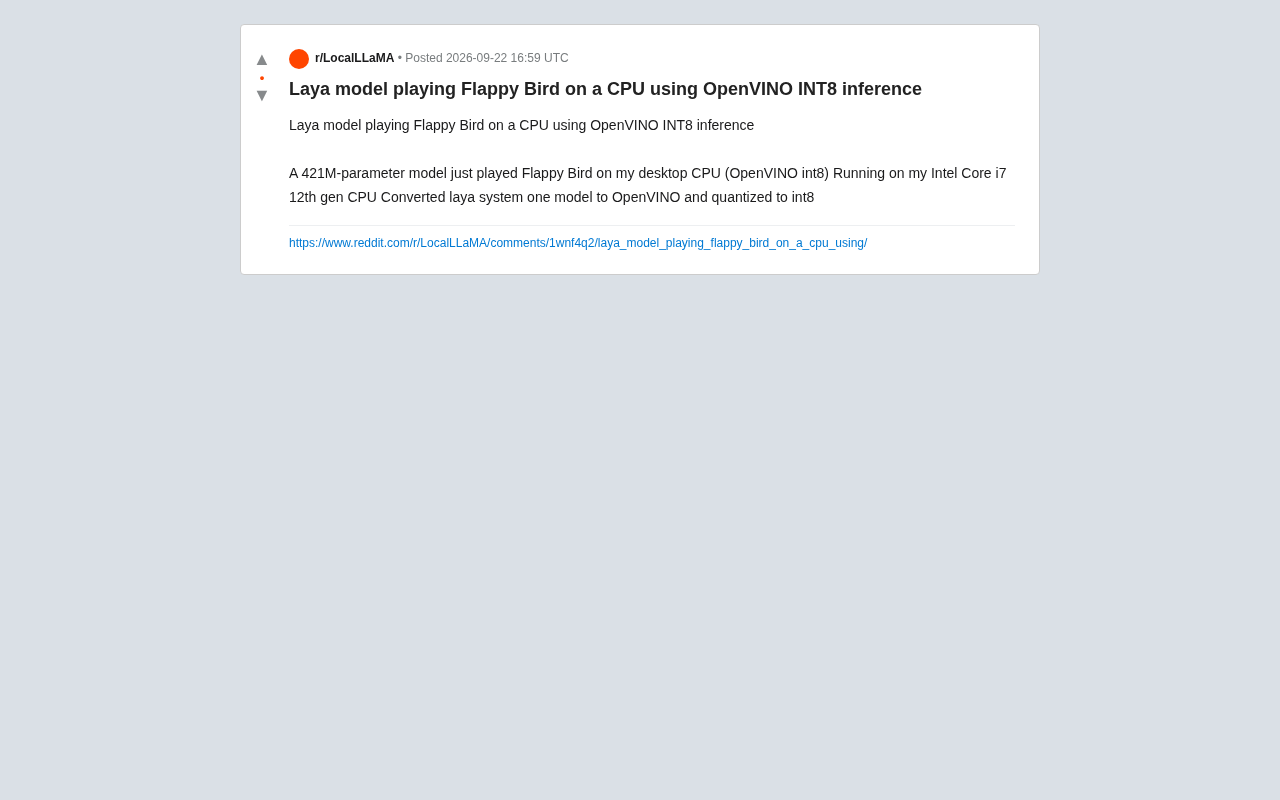
A Reddit developer recently shared a technically impressive hands-on project: he converted a 421-million-parameter Laya model to OpenVINO format, quantized it to INT8 precision, and successfully ran it on a desktop machine with an Intel Core i7 12th-gen processor — playing the classic game Flappy Bird in real time.
What makes this noteworthy isn't the game's difficulty, but the clear technical path it demonstrates: how to compress and optimize a model with hundreds of millions of parameters until it runs smoothly on a consumer-grade CPU. For edge inference and local AI deployment, this is a genuinely useful reference case.
Technical Breakdown: From Raw Model to CPU-Ready
OpenVINO: Intel's Inference Optimization Toolkit
The core tool in this project is OpenVINO (Open Visual Inference and Neural Network Optimization) — Intel's inference optimization framework, purpose-built to accelerate workloads on Intel CPUs, integrated graphics, and other Intel hardware. The developer converted the "Laya system one" model to OpenVINO's Intermediate Representation (IR) format, which is the essential first step toward running the model efficiently on Intel hardware.
For models originally trained in PyTorch or TensorFlow, converting to OpenVINO format means inference can fully leverage Intel hardware instruction set optimizations — delivering solid inference performance even without a discrete GPU.
OpenVINO's IR format consists of two files:
.xmldescribes the network topology, and.binstores the weight data. Conversion is typically done via themo(Model Optimizer) command-line tool, which supports importing from major frameworks including PyTorch (via ONNX), TensorFlow, and PaddlePaddle. During conversion, the tool automatically applies graph optimizations such as operator fusion (e.g., folding BN layers into convolutions) and constant folding — static optimizations that yield additional speed gains at inference time. At runtime, OpenVINO's Inference Engine automatically selects the optimal execution backend for the target hardware: on CPU, it dispatches to code paths optimized for AVX-512, AVX2, and similar instruction sets; on integrated graphics, it switches to the GPU backend. Developers don't need to maintain separate codebases for different hardware.
INT8 Quantization: Putting the Model on a Diet
Format conversion alone isn't enough. A 421M-parameter model running at FP32 (32-bit floating point) precision places considerable demands on memory bandwidth and compute. The developer went further and quantized the model to INT8 (8-bit integer) precision.
Quantization essentially approximates the original floating-point weights using lower-bit integers, which brings several direct benefits:
- Dramatically reduced memory footprint: INT8 theoretically cuts storage requirements by roughly 4× compared to FP32;
- Faster inference: Integer operations are generally faster than floating-point on CPUs, especially with dedicated acceleration instructions;
- Lower power consumption: Particularly valuable for edge devices and long-running workloads.
The trade-off is potential accuracy loss. But for a task like Flappy Bird — which is fairly tolerant of imperfect model outputs — the INT8-quantized model retains more than enough accuracy for the agent to make correct decisions.
INT8 quantization comes in two main flavors: Post-Training Quantization (PTQ) and Quantization-Aware Training (QAT). PTQ requires no retraining — you just need a small calibration dataset (typically a few hundred samples) to profile the activation distribution of each layer and determine the float-to-integer mapping. It's low-effort. QAT simulates quantization error during training itself, resulting in smaller accuracy loss, but requires a full training pipeline. OpenVINO's built-in NNCF (Neural Network Compression Framework) supports both approaches; for an already-trained model like the one in this case, PTQ is the practical choice. Quantization granularity also matters: per-layer quantization is simpler to implement, while per-channel quantization is more fine-grained for convolutional weights and typically results in smaller accuracy degradation.
Why This Case Deserves Attention
Consumer Hardware Can Carry Models with Hundreds of Millions of Parameters
For a long time, running large models was practically synonymous with "you need a GPU." This project ran a 421M-parameter model on a 12th-gen Core i7 desktop CPU and achieved real-time game interaction — demonstrating that with proper engineering optimization, medium-scale models can absolutely be deployed in a CPU-only environment.
For individual developers without a dedicated GPU, or scenarios requiring inference on GPU-less servers, this approach offers a genuinely low-cost path forward.
The Real-World Case for Edge AI and Local Deployment
As data privacy, offline availability, and deployment cost become increasingly important considerations, running AI inference locally on-device — rather than relying on cloud APIs — is becoming a clear trend. The OpenVINO + INT8 quantization stack is a textbook example of technology serving that trend.
The Flappy Bird demo may be lightweight in form, but the capability it validates — running a model with hundreds of millions of parameters on an ordinary CPU, in real time, for a decision-making task — can transfer to far more practical use cases: local intelligent assistants, edge vision recognition, real-time inference on industrial equipment, and more.
The core difference between edge inference and cloud inference lies in data flow and latency characteristics. With a cloud API approach, input data must be uploaded to a remote server, constrained by network bandwidth and round-trip latency — and sensitive data carries privacy compliance risks. Edge inference keeps data entirely on the local device; latency is determined solely by local compute, and the system works normally even offline. In a game AI scenario, real-time performance is critical: Flappy Bird requires the model to complete a full perception → decision → output cycle within every single frame. The network round-trip latency of cloud solutions (typically 50ms or more) directly causes input lag. This explains why, even on a CPU that underperforms a GPU, local deployment remains competitive for latency-sensitive tasks.
Some Reflections on Going from Demo to Practice
To be objective: this is still a personal demo project. The original post doesn't provide quantitative metrics like accuracy comparison before and after quantization, specific frame rates, or memory usage. It's more of a proof-of-concept that demonstrates feasibility rather than a production-ready blueprint you can copy directly.
For developers looking to reproduce or build on this work, some directions worth exploring include: the accuracy vs. speed trade-offs of different quantization strategies (such as INT4 or mixed precision), multi-threaded CPU parallelism optimization, and the robustness of quantized models on more complex tasks.
Regardless, the signal this small project sends is encouraging: the maturation of model optimization tools and inference frameworks continues to lower the hardware barrier for deploying AI — making it possible for more developers to build interesting things with the hardware they already have.
Related articles

Chain of Thought Isn't Just for AI: How Humans Can Use CoT to Improve Thinking Quality
Chain of Thought isn't just a prompt trick for large models. Starting from a Hacker News discussion, this article analyzes why CoT works for human thinking too, breaks down actionable ways to transfer it, and highlights the key differences between human CoT and machine CoT.
Cloudflare Teams Up with OpenAI: Closi…
Cloudflare Teams Up with OpenAI: Closing the Loop from Vulnerability Discovery to Defense with AI
Cloudflare uses OpenAI Daybreak to investigate security vulnerabilities and generate reviewable remediation plans, while developers use Codex to boost coding efficiency and quality.

Orca Multi-Agent Orchestration in Practice: A Guide to Parallel Collaboration with Claude and Codex
Orca is Stable AI's free open-source agent workbench supporting 34 agents like Claude Code and Codex in parallel. Learn its Git worktree isolation, multi-model orchestration, and mobile management.