47.6K Star Open Source Project: Auto-Matching 2000+ MCP Skills, Say Goodbye to Agent Skill Trial-and-Error

An open source project with 47.6K Stars proves AI auto-matching MCP skills beats manual haystack hunting.
The article introduces a GitHub open source project with 47.6K Stars that solves the pain point of choosing among 2000+ MCP skills in AI Agent development through automatic matching. It analyzes a project across architecture, functionality, data, and deployment, then matches suitable skill combinations, labels each skill's use cases and boundaries, and offers role-based skill packs. The tool is essentially an index and matching layer for the MCP ecosystem, improving selection efficiency—not the Agent's performance ceiling, which still depends on prompts, data quality, and debugging, making it useful for agent developers, AI teams, and MCP newcomers.
The Biggest Headache When Building an Agent: 2000+ Skills, Which One Do I Install?
If you're working on AI agent development, you've probably been through this: you want your agent to complete a specific task, you open the MCP skill library, and there are 2000+ options staring back at you. Each one seems vaguely relevant, but which one should you actually pick?
So you try them one by one.
Install, run, fail, uninstall, try the next... and just like that, an entire afternoon is gone. This isn't development—it's manual labor.
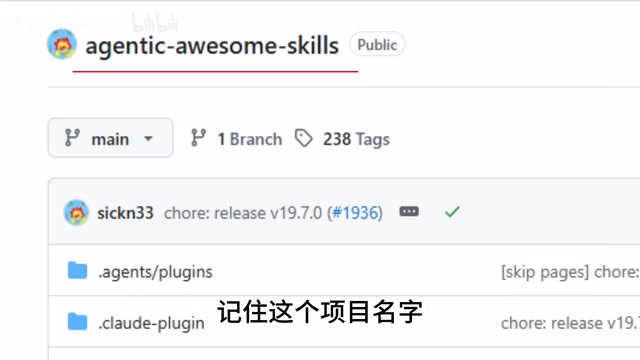
According to a Bilibili creator, an open source project is tackling exactly this pain point. It has already racked up 47.6K Stars on GitHub, and its core capability boils down to one thing: letting AI automatically match the most suitable MCP skill for the current task, instead of making humans hunt through a haystack.
MCP (Model Context Protocol) is an open protocol introduced by Anthropic at the end of 2024, aiming to unify how large language models interact with external tools and data sources. You can think of it as the "USB-C port of the AI world": in the past, every tool integration required custom code, but with MCP, as long as you follow the protocol standard, models can invoke various capabilities in a unified way. Around this protocol, the community quickly accumulated a large number of reusable "skills" (Skill)—from reading local files and querying databases to calling third-party APIs and driving browsers. The number of skills exploded from a few dozen in the early days to 2000+, and while the ecosystem flourished, it also brought a new problem: faced with a massive number of options, developers find it hard to judge from names and descriptions alone which one truly fits their scenario, and the cost of selection rises along with the scale of the skill library.
Skill in the MCP context usually refers to an encapsulated capability unit, including clear input/output definitions, invocation methods, and applicable boundaries. It can be an officially maintained basic capability or a contribution from community developers. The quality of skills varies widely: some have complete documentation and clear boundaries, while others are just enough to run a demo. This is also the fundamental reason why the article later emphasizes "skill scenario labeling" and "role-based skill packages"—skills themselves aren't lacking; what's missing is metadata that makes them quickly understandable and accurately matchable.
How Does It Do It?
The project's approach isn't complicated, but it's clever: understand your project first, then go find the answer in the skill library.
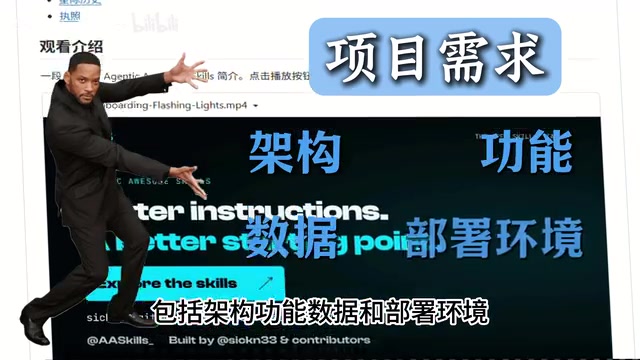
Specifically, it analyzes your project requirements across four dimensions:
- Architecture: What form does your agent take, and how is the invocation chain designed?
- Functionality: What task needs to be completed, and what capabilities are needed to support it?
- Data: Where does the data come from, how does it flow, and does it need persistence?
- Deployment environment: Does it run locally, in the cloud, or in a hybrid environment?
After the analysis, the system automatically matches a suitable skill combination from the 2000+ skill library. You don't need to know what the skills are called—you just need to clearly explain what you want to do.
The value of this step lies in turning "skill selection" from a matter of human experience and judgment into structured system matching.
From an implementation perspective, this kind of "auto-matching" system usually includes two core components: requirement parsing and semantic retrieval. In the requirement parsing stage, the system breaks down the project goal described by the developer in natural language (for example, "I want to build an agent that can read PDFs and answer questions") into structured capability tags corresponding to the four dimensions mentioned in the article: architecture, functionality, data, and deployment. In the semantic retrieval stage, these tags are compared for similarity against the description vectors of each skill in the skill library, returning the Top-K candidate combinations. Compared with keyword matching, vector retrieval can capture skills that are "semantically similar but literally different"—for example, "document parsing" and "PDF extraction" can be recognized as the same type of requirement.
It's worth noting that the quality of matching results depends heavily on the granularity and accuracy of skill descriptions. If a skill's description is too vague, even if it's actually a good fit, it may rank lower in retrieval. Therefore, such systems often also combine manually curated category tags, usage frequency, and other signals for secondary ranking, making truly validated skills more likely to be recommended.
Every Skill Is Labeled with Its Use Cases, No More Repeated Testing
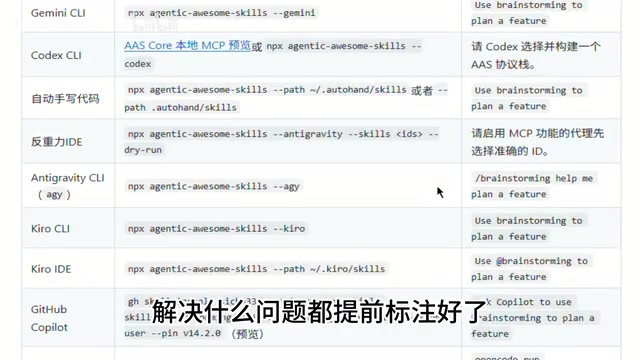
Beyond automatic matching, this project also does something very practical—it labels each skill with its applicable scenarios and the problems it can solve.
What does that mean? Before choosing, you can already see: what task types this skill suits, what specific problems it solves, and where its boundaries are.
This is especially valuable for team collaboration. In the past, skill selection relied heavily on individual experience, and when a different person took over, they had to step into the same pitfalls again. Now the basis for selection is documented and structured, so new members can get up to speed quickly.
Of course, the quality of "labeling" depends on the maintainers' investment. Whether the scenario descriptions for 2000+ skills are all accurate and updated in a timely manner is an issue that requires ongoing observation.
The value of "skill labeling" can be compared to interface documentation in software engineering or metadata in package managers. Take npm as an example: whether a package can be widely adopted often depends not only on its functionality, but also on metadata such as the README, type definitions, and maintenance activity. The MCP skill ecosystem is currently in a similar "metadata-building period": the number of skills is already large enough, but descriptions, categories, and applicable boundaries—these "instruction manuals"—are far from standardized. A project that proactively fills in this layer of metadata is essentially lowering the retrieval and trust costs for the entire ecosystem.
This also explains a common phenomenon: many teams maintain private lists of "we only use these few skills." Such private lists are actually a self-rescue solution when there is no public labeling system. When public labeling becomes sufficiently complete, teams can shift their energy from "maintaining the list" to "optimizing combinations," and this is the real source of the project's value for team collaboration.
A Blessing for the Lazy: Role-Based Skill Packages Can Be Directly Combined into Workflows
If you're too lazy even to do matching, it also offers another layer of solution—professional skill packages organized by role.
For example, if you're building a customer service agent, a code assistant, or a data analysis pipeline, you can directly find the corresponding role-based skill package and combine it into your workflow.

This design lowers the barrier for two types of people:
- People just getting started with agent development: They don't need to first understand the full picture of 2000 skills—starting from role packages is enough to get running.
- Experienced developers: They save repeated selection time and can devote their energy to business logic and performance tuning.
What Does 47.6K Stars Say?
An open source project getting 47.6K Stars usually means it has hit a pain point that is common enough.
The MCP ecosystem has expanded rapidly over the past year, with the number of skills growing from a few dozen to 2000+. Abundance is a good thing, but the cost of choice is also rising exponentially. Once supply exceeds a certain threshold, "how to find the right one" becomes more important than "whether one exists."
This project is essentially building the "index layer" and "matching layer" of the MCP ecosystem. It doesn't produce skills, but it makes existing skills usable.
For people exploring AI agent development, this can indeed save a lot of time. But be clear-eyed: automatic matching solves "selection efficiency," not the "performance ceiling." Even if the right skills are installed, whether the agent runs well still depends on your prompt design, data quality, and debugging effort.
The tool saves you the time of flipping through the catalog; the rest of the road is still yours to walk.
Who Is It For?
- Developers currently building agents: When you don't know what skills to install, let it run an analysis first.
- AI application teams: Need to quickly validate multiple skill combination plans.
- Newcomers just entering the MCP ecosystem: Starting from role-based skill packages is much faster than browsing the catalog from scratch.
If you've also been trying skills over and over in agent development until you're about to break down, this project is worth adding to your toolbox.
One-line Summary
An open source project with 47.6K Stars proves that AI auto-matching MCP skills is more efficient than manual haystack hunting.
Paragraph Summary
The article introduces an open source project on GitHub with 47.6K Stars that addresses the pain point in AI Agent development of "not knowing how to choose among 2000+ MCP skills" by providing an automatic matching solution. The system first analyzes a project across four dimensions—architecture, functionality, data, and deployment environment—and then matches suitable skill combinations from the skill library. It also labels each skill with applicable scenarios and boundaries, and provides professional skill packages organized by role for both newcomers and experienced developers to use quickly in combination. The article emphasizes that such tools are essentially the "index layer" and "matching layer" of the MCP ecosystem—they solve the problem of selection efficiency, not the performance ceiling of the Agent. After the right skills are chosen, actual performance still depends on prompt design, data quality, and debugging ability. It is suitable for developers building agents, AI application teams, and newcomers just entering the MCP ecosystem.
Related articles

Workbuddy for Absolute Beginners: How a Desktop AI Agent Fits Into Real Workflows
A beginner's guide to the Workbuddy desktop AI agent: installation, claiming credits, file management, and building automated workflows—compared with CodeX for fit and cost, helping professionals shift from AI question-askers to AI managers.

OpenAI's New Agent Stack: Computer Use, Decisions API, and Ultra-Fast Workflows
OpenAI Dev Day unveiled a new agent stack: Computer Use outperforms humans, Decisions API delivers ultra-low-latency classification via Luna, Agents API opens the same Computer Use capabilities, and GPT-6.1 Sol costs only one-seventh of Astra. Core updates, benchmark data, and developer insights.

Liang Wenfeng Open-Sources DeepInfo Inference Framework, Takes On U.S. Ban
DeepSeek open-sources its DeepInfo inference framework after its models, featuring GPU/CPU cross-pipelining, small-model prediction with large-model verification, and full Huawei Ascend and NVIDIA chip support—facing the U.S. federal ban head-on. This article analyzes its significance for AI deployment and open-source strategy.