$48 Fix for a Months-Long Bug: Lessons from a Developer Who Ditched Cursor for Claude

Developer spends $48.62 with Claude Fable to fix a months-long bug, showing transparency is key in AI coding tool selection.
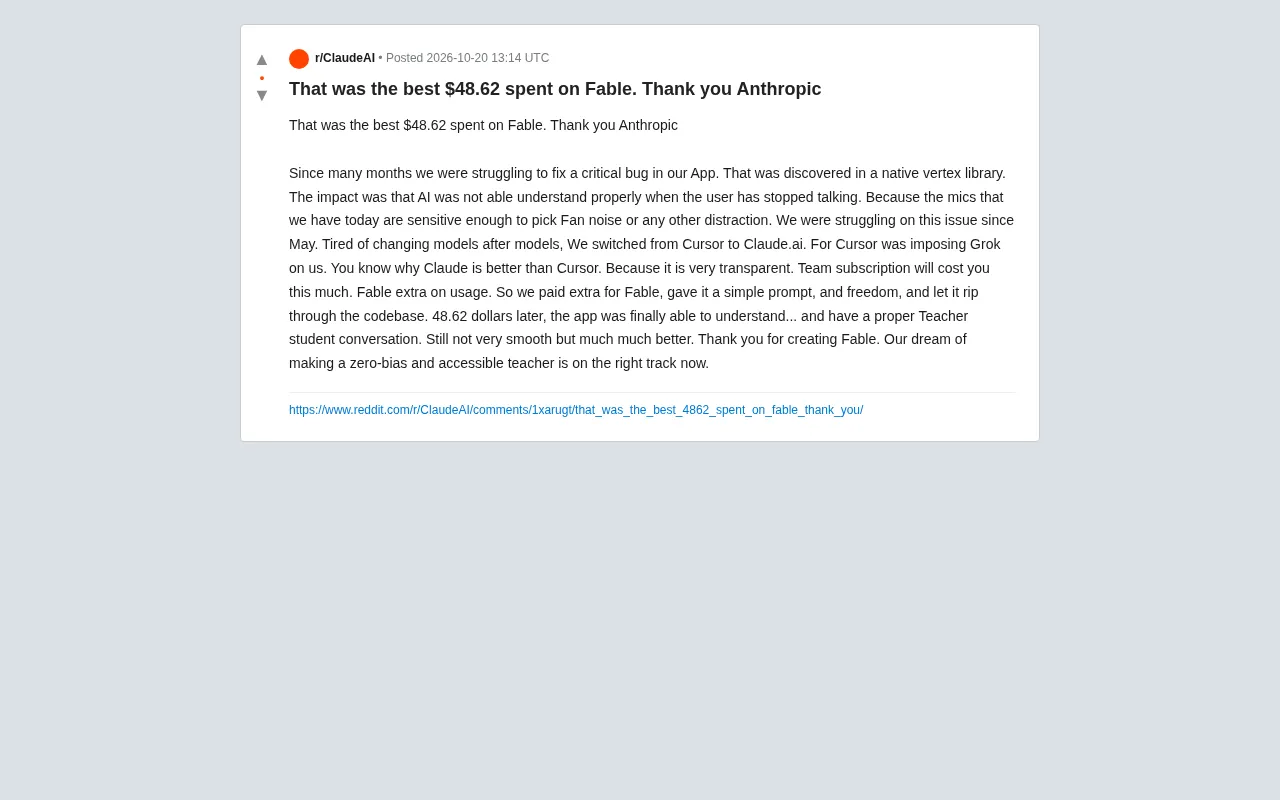
A developer shares that his team spent $48.62 on Anthropic's Fable to fix a voice interaction bug that had troubled them for months—the AI couldn't accurately detect when the user stopped speaking. After cycling through models without success, they switched from Cursor to Claude.ai due to transparency: Cursor pushes Grok and has unclear billing, while Claude.ai offers transparent, predictable pricing. The fix required only a simple prompt and letting Fable freely explore the codebase. The case sparked community discussion: price transparency matters more than absolute price, simple prompts plus free exploration can outperform fine-tuning in complex codebases, and trust and transparency are becoming core competitiveness.
From Months of Struggle to a One-Click Fix: A $48 Bug
As competition among AI coding tools heats up, one developer's real-world experience has sparked discussion in the community. He spent $48.62 using Anthropic's Fable feature to fix a critical bug that had plagued his team for months—a bug that had them cycling through multiple models with no success. More importantly, they switched from Cursor to Claude.ai, citing the transparency of tool selection as the key reason.
The Root Problem: When AI Can't Tell When the User Stops Talking
According to the developer's Reddit post, the bug stemmed from a flaw in a native vertex library: the AI couldn't accurately determine when the user stopped speaking. Modern microphones are extremely sensitive, and fan noise or other ambient sounds are easily misclassified as voice input, causing interaction interruptions or false triggers. The problem had troubled the team since May; they tried various models and approaches but never fully resolved it.
Such issues are not uncommon in voice interaction applications, yet they are extremely hard to pin down—they involve the intersection of audio signal processing, model inference, and real-time interaction, where traditional debugging methods often fall short. The developer described the team as "tired of switching models one after another" until they turned to Claude.ai and found a breakthrough.
VAD (Voice Activity Detection) is a key component in voice interaction systems, responsible for determining when there is speech versus silence or noise in a continuous audio stream. Traditional VAD relies on energy thresholds or statistical models and performs well in quiet environments, but is prone to false triggers when high-sensitivity microphones pick up background noise such as fan sounds or keyboard clicks. Modern systems often use deep learning-based VAD, but it still needs to work in concert with downstream speech recognition (ASR) and dialogue management modules. The "native vertex library flaw" mentioned in the article likely lies in VAD's endpoint detection logic—it fails to distinguish speech endings from ambient noise, causing the system to mistakenly think the user is still speaking or to cut off prematurely. Such issues are difficult to locate because they span the audio front end, model inference, and the interaction state machine; a tiny deviation in any one link gets amplified in the final experience.
Why Claude Over Cursor? Transparency Is Key
The developer clearly stated the core reason for switching to Claude: transparency. He noted that Cursor "pushes Grok hard," while Claude.ai's pricing model is clearer—the team subscription fee is explicit, and the Fable feature is billed additionally based on usage. This transparency allows the team to estimate costs and make decisions.
"You know why Claude is better than Cursor? Because it's very transparent," he wrote in the post. This transparency is reflected not only in pricing but also in the tool's behavioral logic: developers can more clearly understand what the model is doing and why they are being charged, thereby building trust.
Cursor is an AI coding editor based on VS Code that integrates multiple large models (such as GPT-4, Claude, etc.) and allows users to switch between them. Its business model is mainly subscription-based, but the model invocation strategy and billing details are not fully transparent to users—for example, certain advanced features may default to specific models, making it hard for users to precisely control costs. Claude.ai, on the other hand, is Anthropic's conversational AI product, adopting a subscription plus pay-as-you-go model (e.g., the Fable feature), with clear billing details. This difference is especially critical in team collaboration: when multiple developers share an account, transparent billing prevents budget overruns. Moreover, transparency also involves the explainability of model behavior—users can more clearly know which model is currently being invoked and how many tokens are consumed, thereby building trust.
A Simple Prompt + Free Rein: How Fable Solved a Complex Bug
After paying the extra fee, the team gave Fable a simple prompt and plenty of freedom, letting it "rip through the codebase." As a result, after $48.62, the app could finally correctly understand the user's intent to stop speaking, achieving fluid interaction akin to a "teacher-student dialogue."
The developer emphasized that the result is "still not very smooth, but much better." This shows that Fable is not magic, but its ability to locate and fix a specific problem in a highly complex codebase is itself proof of its code understanding and reasoning capabilities. Interestingly, the whole process required no complex configuration or fine-tuning—just a simple prompt and enough freedom.
Fable is an AI coding assistance feature launched by Anthropic that allows users to describe problems in natural language and lets the model autonomously explore, locate, and modify code within the codebase. Unlike traditional code completion or single-file editing, Fable emphasizes an "agentic" workflow: the model can read multiple files, run tests, and iterate on modifications until the problem is solved. Its billing is based on actual computational resources consumed (such as token count), so a complex task can generate costs of tens of dollars. The phrase "let it rip through the codebase" in the article vividly describes this high-freedom mode—users only need to provide the goal, and the model plans its own path. The advantage of this approach is that it can handle hidden bugs across files and modules, but the cost is that expenses cannot be precisely estimated in advance, and the model needs strong code understanding and reasoning capabilities.
Multiple Perspectives: The Transparency and Cost Debate in AI Coding Tools
This case is not isolated. On Reddit and in multiple developer communities, discussions comparing Cursor and Claude continue to heat up. According to some user feedback, Cursor's model switching strategy sometimes lacks clear explanation, while Claude.ai's usage-based billing model, although it may incur higher costs, offers clear and predictable bills. This transparency difference is influencing developers' tool choices.
On the other hand, some argue that Cursor's integrated experience and automation features remain advantages, especially for users who want to reduce manual operations. However, for teams that need fine-grained cost control and understanding of model behavior, Claude.ai's transparency is clearly more attractive.
A Bigger Vision: A Zero-Bias and Accessible AI Teacher
Fixing this bug is more than a technical victory. The developer revealed that their app aims to create a "zero-bias and accessible teacher." The accuracy of voice interaction directly affects the experience in educational scenarios—if the AI cannot correctly determine when a student has finished speaking, conversational learning is impossible.
The $48.62 bought not just a bug fix but also a step toward this vision. The developer's gratitude to Anthropic reflects the value of AI tools in real production environments: not showing off, but solving specific problems.
Takeaways: The Logic of Choosing AI Coding Tools Is Changing
This case offers several insights for the developer community. First, price transparency may be more important than absolute price—$48.62 is not a small amount, but the team was willing to pay because the cost was predictable. Second, the simple prompt plus free exploration model may be more effective in complex codebases than fine-tuning parameters. Finally, the cost of switching tools cannot be ignored: migrating from Cursor to Claude requires readjustment, but the team considered it worthwhile.
As AI coding tools mature, developers' selection criteria are shifting from "how many features" to "is it transparent, is it controllable." Anthropic's Fable proved its value in this case, but more importantly, it reveals a trend: in the field of AI-assisted coding, trust and transparency are becoming core competitiveness.
One-line Summary
Developer spends $48.62 with Claude Fable to fix a months-long bug, revealing that transparency is key when choosing AI coding tools.
Paragraph Summary
A developer shared his experience: his team spent $48.62 using Anthropic's Fable feature to fix a voice interaction bug that had plagued them for months—the AI couldn't accurately tell when the user stopped speaking. After switching between multiple models without success, they moved from Cursor to Claude.ai, mainly due to transparency: Cursor pushes Grok hard and has unclear billing, while Claude.ai offers transparent pricing and predictable costs. The fix required only a simple prompt and giving Fable ample freedom to autonomously explore the codebase. The case sparked community discussion about the logic of choosing AI coding tools: price transparency matters more than absolute price, simple prompts plus free exploration may be more effective in complex codebases than fine-tuning, and trust and transparency are becoming core competitiveness.
Related articles

Chain of Thought Isn't Just for AI: How Humans Can Use CoT to Improve Thinking Quality
Chain of Thought isn't just a prompt trick for large models. Starting from a Hacker News discussion, this article analyzes why CoT works for human thinking too, breaks down actionable ways to transfer it, and highlights the key differences between human CoT and machine CoT.
Cloudflare Teams Up with OpenAI: Closi…
Cloudflare Teams Up with OpenAI: Closing the Loop from Vulnerability Discovery to Defense with AI
Cloudflare uses OpenAI Daybreak to investigate security vulnerabilities and generate reviewable remediation plans, while developers use Codex to boost coding efficiency and quality.

Orca Multi-Agent Orchestration in Practice: A Guide to Parallel Collaboration with Claude and Codex
Orca is Stable AI's free open-source agent workbench supporting 34 agents like Claude Code and Codex in parallel. Learn its Git worktree isolation, multi-model orchestration, and mobile management.