49agents IDE: Rebuilding the Development Workflow with a 2D Canvas
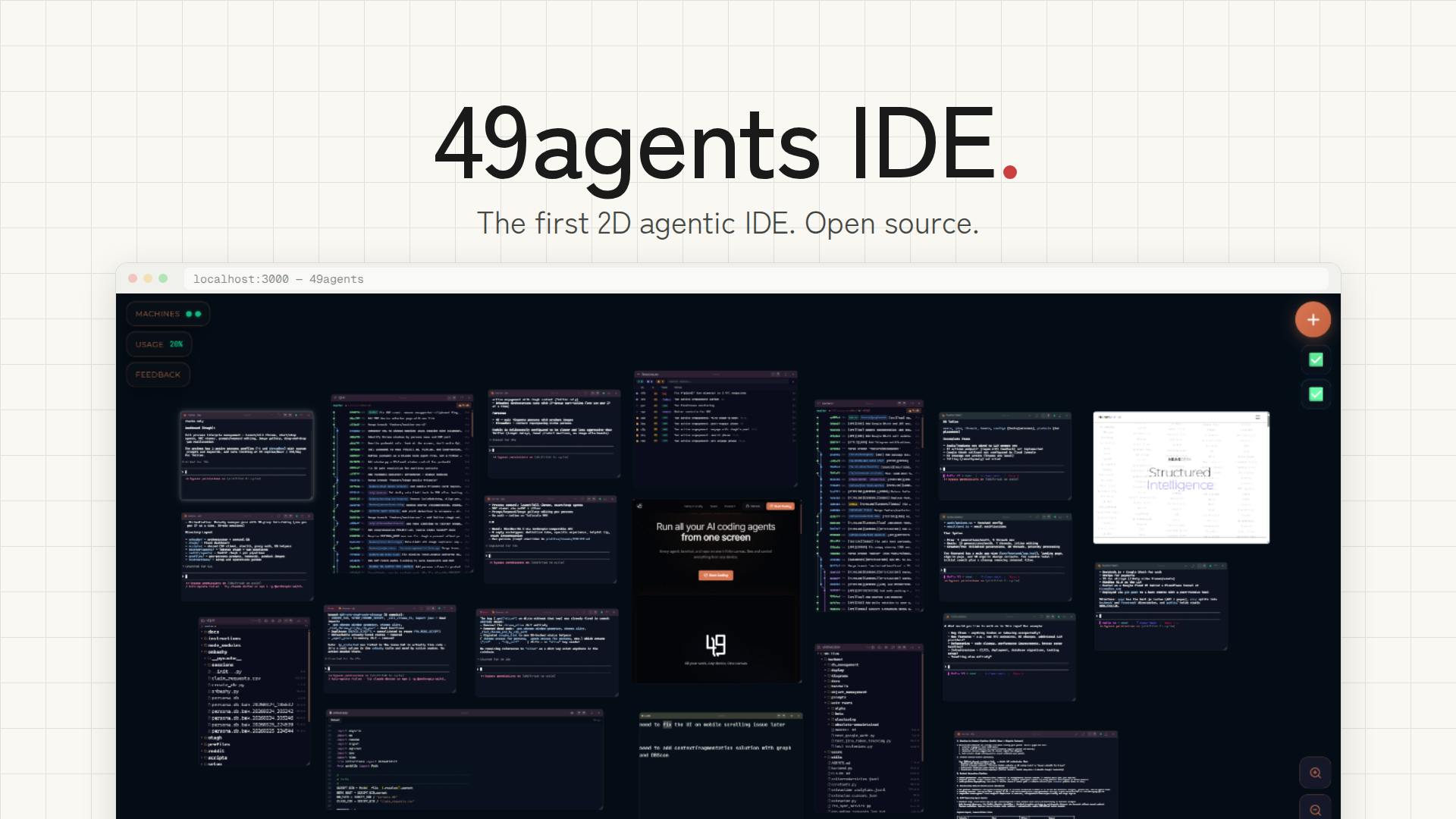
49agents IDE uses a 2D spatial canvas to replace tabs, reducing cognitive load for multi-project developers.
49agents IDE reimagines the development environment by replacing linear tab navigation with a 2D spatial canvas. Grounded in cognitive science — leveraging how the brain's spatial memory outperforms abstract sequence recall — it lets developers arrange Agents, terminals, and repositories like a city map. This approach tackles tab fatigue, supports the growing multi-Agent workflow trend, and positions the tool as a next-generation AI workflow orchestration center.
In an era where AI Agents and multi-project parallelism have become the norm, developers face unprecedented cognitive burden: dozens of tabs, multiple terminal windows, and context loss when switching between code repositories. 49agents IDE offers a counter-conventional solution — transforming the IDE from linear tabs into a 2D spatial canvas.
Redefining the Spatial Form of the IDE
The core philosophy of 49agents IDE is to place all development resources — Agents, terminals, code repositories, machine instances — onto a freely arrangeable 2D canvas. This design borrows interaction logic from city-building games, letting developers plan their workspace the way they'd plan a city.
This spatial design is far from a gimmick. Cognitive science research shows that the human brain is naturally better at remembering spatial locations than abstract sequences. This insight stems from the "Method of Loci" theory in cognitive psychology, traceable back to ancient Greek mnemonic practices. Modern neuroscience has further confirmed that "Place Cells" and "Grid Cells" in the hippocampus form the brain's built-in spatial navigation system — the 2014 Nobel Prize in Physiology or Medicine was awarded to John O'Keefe, May-Britt Moser, and Edvard Moser for discovering grid cells. This means that once information is assigned a spatial position, the brain can leverage this navigation system — refined over millions of years of evolution — to aid memory and retrieval, far more efficiently than processing abstract linear lists.
When you place your "user service terminal" in the upper-left corner of the canvas and your "database debugging window" in the lower-right corner, even if you return days later, you can quickly locate them through spatial memory. Traditional IDE tabs are arranged linearly and rely on text labels, resulting in significantly higher cognitive costs.
Solving Tab Fatigue for High-Performance Developers
The "tab navigation fatigue" mentioned in the product description is a real pain point for high-intensity developers. This phenomenon can be explained by "Cognitive Load Theory," proposed by cognitive psychologist John Sweller. Human working memory has extremely limited capacity — psychologist George Miller's classic research showed that working memory can only process 7±2 chunks of information at a time. When developers face 50+ browser tabs and 20+ editor tabs, each task switch requires reloading context in working memory. This "extraneous cognitive load" drastically crowds out the "intrinsic cognitive load" space needed for actual problem-solving.
When you're simultaneously maintaining 5 microservices, running 3 AI Agents, and monitoring 2 data pipelines, Chrome might have 50+ tabs open, and VS Code another 20+ file tabs. The cognitive cost of this information overload often drains more energy than the coding itself.
It's worth explaining the role of AI Agents here. Unlike traditional AI chatbots, AI Agents are artificial intelligence programs capable of autonomous decision-making and execution — they can perceive their environment, formulate plans, invoke tools, and iteratively execute complex tasks. Since 2024, as large language model (LLM) capabilities have leaped forward, AI Agents have rapidly proliferated in software development — from GitHub Copilot's code completion to Agents like Devin and Cursor that can independently complete coding tasks. The number of Agents in developer workflows is growing exponentially. This multi-Agent parallel work pattern places entirely new demands on an IDE's information organization capabilities, and 49agents' spatial approach is a direct response to this need.
49agents' solution uses space as the primary organizational dimension. You can:
- Cluster front-end project resources in one corner of the canvas
- Visually display AI Agent runtime status in another area
- Designate separate "zones" for different clients' projects
This organizational approach makes context switching intuitive: move your mouse to a particular area, and all related resources are visible at a glance — no need to hunt through tab bars one by one.
Open Source Commercialization Exploration
With 97 upvotes and a #8 ranking on Product Hunt, 49agents IDE has demonstrated differentiated competitiveness in the open-source developer tools space. Its category tags include Open Source, Developer Tools, and GitHub, suggesting the product may adopt an open source plus premium services business model.
This approach is known in the developer tools space as the Open Core model. Its core logic is: open-source the foundational features to earn community trust and user scale, while charging for enterprise-grade features (such as team collaboration, advanced security, and priority support). This model has numerous successful precedents — GitLab (valued at approximately $8 billion), Grafana Labs (valued at approximately $6 billion), and HashiCorp (acquired by IBM for $6.4 billion) are all prime examples. However, the key challenge of this model lies in drawing the boundary between open-source and commercial features: being too conservative loses community vitality, while being too aggressive makes it difficult to build a sustainable revenue model. For 49agents, open-sourcing the basic 2D canvas functionality while charging for enterprise collaboration and large-scale Agent orchestration capabilities may be a reasonable boundary choice.
From a product positioning perspective, 49agents targets high-performance engineers — developers who manage multiple projects simultaneously, frequently use AI Agents, and have an obsessive pursuit of workflow efficiency. While this group is niche, they have strong willingness to pay, making them a premium user segment for developer tools.
Technical Challenges and Opportunities
Expanding an IDE from 1D (tab bar) to 2D (canvas) is not simply a UI change — it involves numerous technical challenges:
State Management Complexity: Resource layouts in 2D space need to be persisted and support cross-session restoration. Efficiently serializing and restoring an entire "workspace map" is critical. This means the system needs to record the 2D coordinates, zoom level, connection relationships, and runtime state of each resource node, and precisely restore the entire spatial topology when the user reopens the IDE.
Performance Optimization: When the canvas has dozens of active terminals and Agents, rendering performance and memory usage require careful optimization. Techniques like virtual scrolling and lazy loading may be necessary. The core idea of virtual scrolling is to render only elements visible within the user's viewport, rather than rendering everything at once; lazy loading further delays resource initialization until the user actually accesses them. Both techniques have been widely validated in map applications (such as Google Maps' tile loading) and design tools (such as Figma's vector canvas), forming the foundational architecture for smooth large-scale canvas interactions. 49agents needs to solve an additional challenge on top of this: the nodes on the canvas are not static graphics but actively running terminal and Agent processes that continuously produce output and consume computing resources.
Collaboration Scenarios: If team collaboration is supported, sharing and conflict resolution mechanisms for a 2D canvas become even more complex. Real-time collaborative editing similar to Figma may be the future direction. Figma's collaborative editing is based on CRDT (Conflict-free Replicated Data Types) — a distributed data structure that can automatically merge concurrent modifications across multiple replicas without conflicts. Compared to traditional OT (Operational Transformation) algorithms, CRDTs don't rely on a central server for conflict arbitration, making them naturally suited for P2P and offline scenarios. However, if 49agents IDE introduces collaboration features, the complexity would far exceed Figma's: because what needs to be synchronized isn't just 2D coordinates and visual layouts, but also terminal session states, Agent runtime contexts, and real-time output streams, placing extremely high demands on the underlying synchronization protocol design.
That said, these challenges also serve as product moats. Once developers establish their own spatial workflows, migration costs become high, and user stickiness increases accordingly.
Industry Insight: Tools Should Adapt to the Human Brain, Not the Other Way Around
49agents IDE's design philosophy deserves reflection across the entire developer tools industry: have we become overly reliant on traditional paradigms (tabs, file trees) while ignoring the real needs of human cognition?
From Notion's Block-based approach and Obsidian's knowledge graphs to 49agents' 2D workspace, more and more tools are exploring non-linear ways of organizing information. The consensus behind these efforts is: in an age of information explosion, simply adding features can't solve the problem — restructuring the information architecture is the way forward. Notion deconstructs documents into nestable, referenceable Blocks, giving information LEGO-like combinatorial power; Obsidian builds knowledge graphs through bidirectional links, transforming linear notes into networked knowledge webs; and 49agents elevates the workspace from a one-dimensional tab bar to a two-dimensional canvas. These three products validate the same hypothesis across documents, knowledge management, and development environments respectively: the closer information organization dimensions align with the natural structure of human cognition, the higher the efficiency ceiling of the tool.
For scenarios with intensive AI Agent usage, spatial management is particularly critical. In the future, a single developer might simultaneously run over a dozen specialized Agents (code review, documentation generation, test writing, security scanning, performance analysis). Visualizing their states and easily switching control will become essential. Traditional list-based or tab-based management becomes chaotic once Agent count exceeds 5, whereas a 2D canvas naturally supports grouping, zoning, and visual hierarchy — allowing Agents to be spatially organized by function, by project, or by workflow stage. 49agents IDE's exploration in this direction may foreshadow the evolutionary path of next-generation IDEs — evolving from "code editors" into "AI workflow orchestration centers."
Related articles

Muse: An AI Agent That Actually Gets Things Done
Muse is a personal AI agent that goes beyond conversation to autonomously complete tasks like financial management, health tracking, and shopping. Learn how AI Agents are evolving from advisors to executors.
AlphaGenome Atlas: An AI Genomic Map Covering 9 Billion DNA Mutations
Google DeepMind launches AlphaGenome Atlas, pre-computing impact predictions for all 9 billion single-base mutations in the human genome across a 1PB dataset covering both coding and non-coding regions.
GoModel: An Open-Source Self-Hosted AI Gateway Solution
GoModel is a lightweight open-source AI gateway offering a unified OpenAI-compatible interface for multiple LLM APIs. Features budget control, smart caching, load balancing in a 20MB Docker image.