5 Cloud Services Just to Hear a Doorbell? The Over-Engineering Crisis in Smart Homes

A doorbell signal traversing five clouds reveals the absurd over-engineering of modern smart homes.
A single doorbell press can travel through five independent cloud services before you hear it — exposing the fragmented, cloud-dependent architecture plaguing smart homes. This article breaks down the reliability, latency, and privacy costs of over-engineering, and explores how local-first solutions like Home Assistant, the Matter protocol, and Thread networking offer a simpler, more robust path forward.
What Happens in the Cloud When Your Doorbell Rings
A seemingly simple action — pressing a doorbell — should be as straightforward as an electrical current driving a speaker to produce sound. Yet in today's smart home ecosystem, that single moment can involve up to five independent cloud services. This article, which sparked a lively discussion on Hacker News, uses a deeply ironic case study to expose the over-engineering problem plaguing modern IoT architecture.
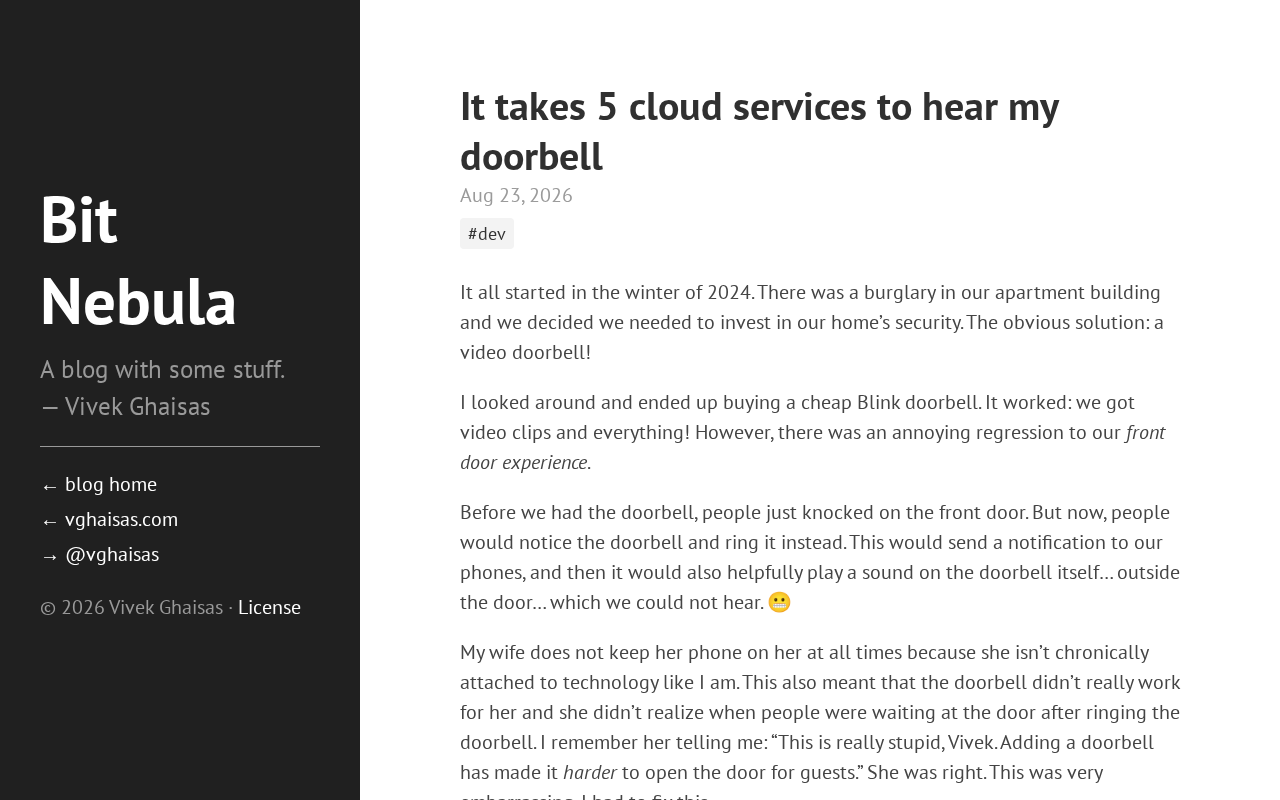
The author's core argument cuts right to the heart of the matter: for a homeowner to "hear" the doorbell, the signal must travel through the doorbell manufacturer's cloud, the voice assistant platform's cloud, a push notification service, and cross-device orchestration middleware — a chain of remote services. If any single link experiences latency or goes down, you might miss a visitor entirely. The contrast with a traditional doorbell's direct physical connection is nothing short of absurd.
Why Does a Smart Doorbell Need So Many Cloud Services?
The Fragmented Vendor Ecosystem
The smart home industry has long lacked unified standards, and every manufacturer tends to build its own walled garden. The doorbell maker has its own cloud platform for video storage and event detection; the smart speaker belongs to another company's voice ecosystem; and phone notifications rely on OS-level push services. When a user wants cross-brand automation like "announce on the speaker when the doorbell rings," the signal must bounce back and forth between these mutually untrusting clouds.
This fragmentation has deep technical roots. Over the past decade, the smart home space has simultaneously hosted multiple communication protocols — Zigbee, Z-Wave, Wi-Fi, Bluetooth Low Energy (BLE) — each with different strengths in frequency bands, power consumption, range, and network topology, yet completely incompatible with one another. Zigbee uses the IEEE 802.15.4 standard's mesh network, making it ideal for low-power sensor networks; Z-Wave operates on sub-GHz frequencies for better wall penetration; and most smart doorbells and cameras rely on Wi-Fi's high bandwidth to transmit video streams. These protocols have no native interoperability. Manufacturers either pick one and lock users in, or use their own cloud platform as a "universal translator" — the latter clearly serving their business interests better. It's precisely this Tower of Babel effect at the protocol layer that turned cloud-based relay from an "option" into a "necessity."
The Cloud-First Design Inertia
For manufacturers, putting logic in the cloud has clear business motivations: easier data collection, push updates, subscription service lock-in, and lower hardware costs for local devices. But this "cloud-first" mindset transforms what could be a millisecond-level local event into a distributed task dependent on network round-trips. Users gain the convenience of remote access but sacrifice reliability and privacy.
From a technical architecture perspective, "cloud-first" and "edge computing" represent two fundamentally different design philosophies. The core idea of edge computing is to push data processing and decision logic closer to the data source — in smart home scenarios, this means letting the home gateway or the device itself handle computation. Processing a doorbell press event locally requires only a few milliseconds of inter-process communication, but once it hits the cloud, it must go through DNS resolution, TLS handshake, HTTP requests, server-side processing, message queue distribution, and more — each step potentially introducing tens to hundreds of milliseconds of latency. The reason manufacturers still choose cloud-first is largely driven by the subscription economy model: Ring's Protect Plan, Nest Aware, and similar monthly services essentially lock users' video storage and advanced detection features in the cloud to generate recurring revenue. Devices can be sold near cost, with profits coming from long-term cloud subscriptions — a "razor and blades" business model where the cost is that every single doorbell event must pass through the manufacturer's servers.
The Real Cost of Over-Engineered Smart Homes
The Collapse of Reliability
From a systems engineering perspective, the more services chained together in series, the lower the overall availability. Assuming each cloud service has 99.9% uptime, five services in series yield a theoretical availability of roughly 99.5% — meaning your doorbell notifications could be in some state of failure for nearly two days per year. In reality, cloud service outages tend to cluster: a single regional outage can simultaneously render countless homes "deaf."
This involves a fundamental principle in reliability engineering: the total availability of a series system equals the product of each subsystem's availability. The formula is A_total = A₁ × A₂ × A₃ × ... × Aₙ. Each additional dependency causes overall availability to drop exponentially. And the 99.9% (so-called "three nines") assumption above is actually quite optimistic — many consumer-grade IoT cloud services fall well short of this level. Real-world incidents are even more alarming: in December 2020, Google's global services experienced a roughly 47-minute major outage, instantly rendering all smart home devices dependent on Google Home and Nest ecosystems unresponsive — users couldn't view doorbell camera feeds, control lights, or adjust thermostats. In December 2021, an hours-long failure in AWS us-east-1 directly crippled Ring doorbells, iRobot vacuums, and countless other IoT devices. These incidents repeatedly prove a harsh reality: when basic functionality is hosted in the cloud, a single point of failure can affect millions of homes.
Latency and Privacy Risks
Every cloud round-trip adds cumulative latency. By the time you walk to the door, the notification may have only just arrived. Even more concerning is the privacy issue: footage of your doorstep, visitor information, and your at-home status are all uploaded to multiple third-party servers. Users often have no way of knowing — let alone controlling — where this data flows or how it's used.
From a network layer perspective, a typical cloud round-trip time (RTT) consists of multiple components: local network latency from device to router (typically 1-5ms), access latency from router to ISP (10-30ms), backbone transmission latency from ISP to cloud server (20-100ms, depending on geographic distance and network congestion), plus server-side processing time. When five cloud services are chained together, even if each round-trip adds only 100ms, the cumulative latency can exceed half a second — for a scenario like "someone pressed the doorbell" that demands instant awareness, this delay is clearly perceptible.
The privacy concerns are equally severe. In Europe, GDPR (General Data Protection Regulation) requires data controllers to explicitly inform users about the scope of data collection, processing purposes, and third-party sharing, while granting users the right to data deletion and portability. But in actual smart doorbell usage, when video streams are uploaded from the device to the manufacturer's cloud, then shared via API with a voice assistant platform, then trigger a push notification service, the data passes through multiple data processors, each potentially governed by different privacy policies and data retention periods. In 2023, Amazon was fined $5.8 million by the FTC for Ring doorbell privacy violations, including employees accessing user videos without authorization and using video data to train algorithms without adequate user disclosure. These incidents demonstrate that the longer an IoT device's data flow chain, the larger the attack surface for privacy breaches.
Local-First Is the Way Forward for Smart Homes
Facing this predicament, the tech community consensus is increasingly tilting toward "local-first" smart home architecture. Open-source solutions like Home Assistant, along with the Matter protocol's push for local interoperability standards, are working to pull control logic back from distant clouds into the home LAN.
Home Assistant is an open-source smart home platform built with Python, typically running on low-power devices within the home (such as a Raspberry Pi or dedicated Home Assistant Green/Yellow hardware). Its core architecture consists of two main modules: "Integrations" and "Automations." Integrations handle interfacing with various protocols and devices (supporting over 2,700 integrations), while the automation engine locally executes user-defined rule logic. When Home Assistant connects a Zigbee doorbell sensor to a local speaker, the entire process — event detection, rule matching, and playback command dispatch — happens entirely within the LAN, with trigger-to-response latency typically under 100 milliseconds.
The Matter protocol drives localization from the industry standards level. Matter is led by the Connectivity Standards Alliance (CSA, formerly the Zigbee Alliance), with Apple, Google, Amazon, Samsung, and other major players co-developing the specification. Its technical core features two key designs: first, Matter runs on the IP protocol stack and supports Wi-Fi, Thread, and Ethernet as transport layers, meaning devices can communicate directly within the LAN using standard internet protocols without needing a vendor cloud as intermediary; second, Matter's device pairing and control are designed as local-first, only routing through the cloud when the user explicitly needs remote access.
Particularly noteworthy is Thread protocol's critical role in local-first architecture. Thread is a low-power mesh networking protocol based on IEEE 802.15.4, purpose-built for IoT devices. Unlike traditional Zigbee, Thread natively supports IPv6, meaning every Thread device has its own IP address and can be directly addressed by other IP devices on the LAN without requiring a dedicated gateway for protocol translation. Thread networks are self-healing — when a node fails, the network automatically reroutes, greatly enhancing local network robustness. Devices like Apple HomePod mini and Google Nest Hub already have built-in Thread Border Router functionality, meaning the infrastructure for local communication is quietly making its way into homes everywhere.
Under a local-first architecture, doorbell event processing never needs to leave your home: devices communicate directly, rules execute on the local gateway, and notifications are instant without depending on external networks. Cloud services are only invoked when you genuinely need remote access, rather than bearing the weight of every basic function. This not only improves reliability and response speed but also returns data sovereignty to the user.
An Industry Reflection, Sparked by a Doorbell
The reason this article resonates so widely is that it uses an everyday scenario everyone can relate to, puncturing the smart home industry's myth that "smarter is always better." Technical complexity should be encapsulated where users can't see it, serving the experience; instead, that complexity is exposed in the most fragile way possible on the most basic of functions.
Truly excellent engineering design pursues just the right amount of simplicity — not layer upon layer of dependencies stacked up for commercial gain. When we reexamine the absurdity of "one doorbell requiring five cloud services," perhaps the question we should be asking is: are we using cloud computing to solve problems that never needed the cloud in the first place? The future of smart homes shouldn't be built on blind dependence on remote services, but should return to its roots: local, reliable, and respectful of privacy.
Related articles

Workbuddy for Absolute Beginners: How a Desktop AI Agent Fits Into Real Workflows
A beginner's guide to the Workbuddy desktop AI agent: installation, claiming credits, file management, and building automated workflows—compared with CodeX for fit and cost, helping professionals shift from AI question-askers to AI managers.

OpenAI's New Agent Stack: Computer Use, Decisions API, and Ultra-Fast Workflows
OpenAI Dev Day unveiled a new agent stack: Computer Use outperforms humans, Decisions API delivers ultra-low-latency classification via Luna, Agents API opens the same Computer Use capabilities, and GPT-6.1 Sol costs only one-seventh of Astra. Core updates, benchmark data, and developer insights.

Liang Wenfeng Open-Sources DeepInfo Inference Framework, Takes On U.S. Ban
DeepSeek open-sources its DeepInfo inference framework after its models, featuring GPU/CPU cross-pipelining, small-model prediction with large-model verification, and full Huawei Ascend and NVIDIA chip support—facing the U.S. federal ban head-on. This article analyzes its significance for AI deployment and open-source strategy.