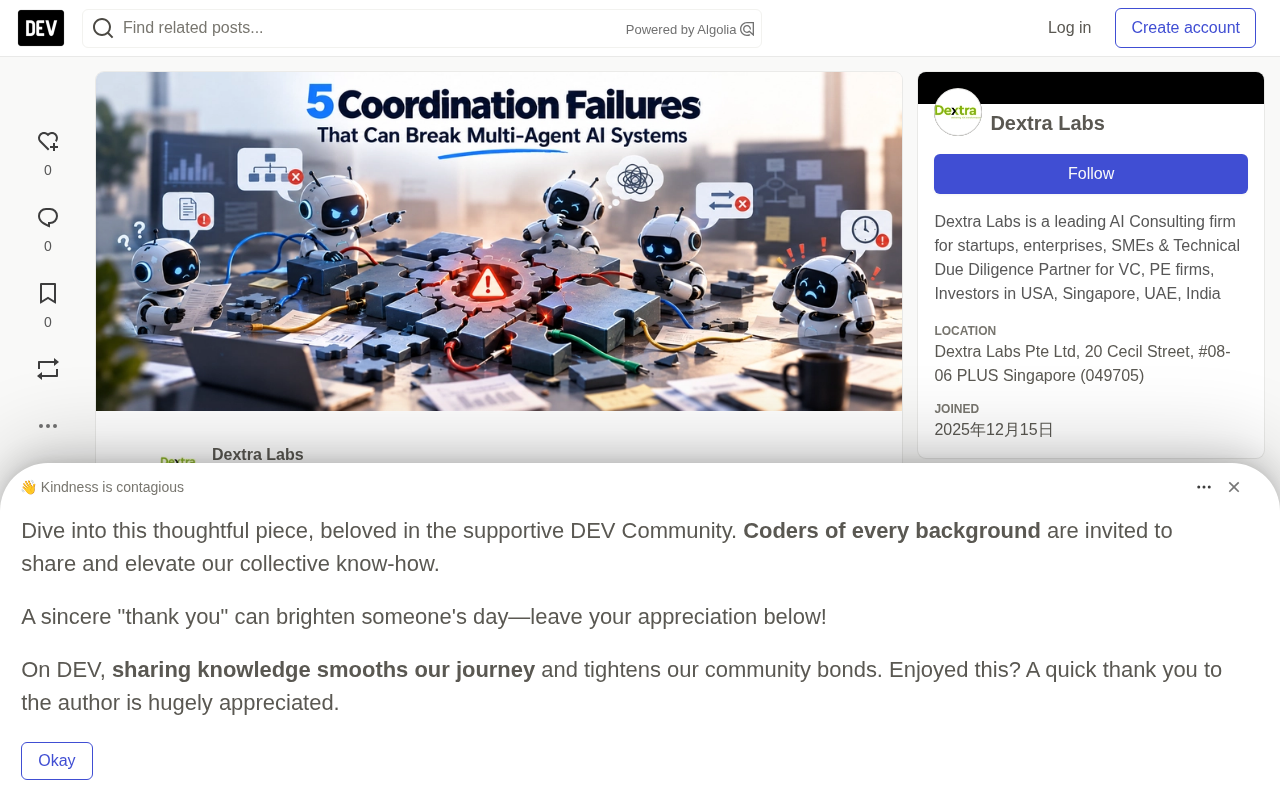
5 Coordination Failures in Multi-Agent AI Systems: The Fatal Traps Hidden Between Agents

The real challenge of multi-agent AI is not agent intelligence but five classic distributed coordination failures between agents.
Using a small business loan approval pipeline as a case study, this article dissects five core coordination failure modes in multi-agent systems: context decay across handoffs, overlapping authority causing unprincipled decisions, cascading contamination from silent upstream failures, infinite loops and deadlocks between agents, and race conditions on shared mutable state. The central argument: none of these failures stem from individual agent intelligence — all are classic distributed systems problems that require well-established concurrency engineering solutions, not AI-specific fixes.
A single agent's failure is visible. In a multi-agent system, failure happens in the gaps between agents — quietly, strangely, and at a steep cost.
The pitch for multi-agent systems is genuinely compelling: instead of one massive agent doing everything, assemble a team of specialists. One agent pulls data, one assesses risk, one checks compliance, one makes the decision. Each is simpler, easier to reason about, easier to test. Divide and conquer.
It's a great idea — right up until the agents actually need to work together. Because the moment you have more than one agent, you've introduced an entire class of failures that simply don't exist in single-agent systems: failures that happen between agents. Not "this agent got it wrong," but "both agents were individually correct, and the system did something insane."
This article uses a single running example to make the problem concrete: a small business loan approval system. Because it involves money, compliance, and real consequences, it makes every failure mode impossible to hand-wave away.
The Setup: A Five-Agent Lending Pipeline
Imagine this architecture — five agents working together:
- Intake — reads the application, extracts fields.
- Data — pulls credit reports, bank statements, and business records.
- Risk — scores creditworthiness based on the data.
- Compliance — checks fair lending rules, sanctions lists, and policy limits.
- Decision — the orchestrator, weighing everything to approve, reject, or escalate.
On the happy path, this system runs beautifully. Now let's break it five different ways.
Failure 1: The Telephone Game (Context Decay)
In a single-agent system, all context lives in one place. In a multi-agent system, context has to be passed — and every handoff is an opportunity to lose or distort information.
In the lending system, Intake extracts "loan amount: $50,000" and passes a summary to Risk. But in the process of summarizing — because agents often pass natural-language summaries rather than structured data — "applying for $50K against $200K annual revenue" gets compressed into "revenue strong relative to request." Risk scores based on that phrasing. Compliance never sees the raw numbers, only Risk's conclusion. By the time Decision acts, the actual data has been abstracted three times into a kind of vibe.
Every agent did its job correctly given what it received. The failure is that the input decayed at every hop, like a game of telephone. The output is confidently wrong — and worse, no single agent's logs show an error, because no single agent made one.
The fix is discipline about what gets passed between agents. For anything decision-critical, pass structured, verifiable data — real numbers with provenance — not prose summaries. Agents can generate readable summaries for humans, but the orchestrator must be able to see the actual facts. The rule: when a downstream agent can have the fact itself, it should never be forced to trust an upstream agent's interpretation of it.
Failure 2: Overlapping Authority (Whose Call Is This?)
This is the subtlest one — a design flaw masquerading as a runtime bug.
Reasonably enough, both Risk and Compliance have a say in whether to reject a loan. Risk rejects for creditworthiness; Compliance rejects for policy. That's fine — until an edge case arrives: Risk says "approve, score is decent," and Compliance says "reject, exceeds sector exposure limit."
Who wins? If you never explicitly decided, the answer depends on incidental details — which agent the orchestrator happened to query last, how their outputs were merged, whether one agent's text overwrote another's. The system produces an answer, but not a principled one. The same application might get a different result depending on execution order. In lending, this isn't just a bug — it's a fair lending problem. Inconsistent decisions on similar applicants is exactly what regulators look for.
The fix is explicit decision authority. For every decision the system makes, exactly one agent (or one rule) must have final say. Priority among agents must be defined by design, not allowed to emerge from circumstance. Compliance always overrides Risk — that should be written down, not left to query ordering. If you can't articulate which agent wins in a conflict, you don't have an architecture. You have a race condition with opinions.
Failure 3: Cascading Contamination (One Bad Agent Poisons the Chain)
In a pipeline, agents trust their inputs. And that trust is the vulnerability.
Suppose the Data agent is having a bad day: a bank statement API times out. Rather than failing loudly, it returns partial data — three months instead of twelve — without flagging it. Risk scores based on those three months, sees no red flags (because the problematic months aren't in the window), and passes a clean score downstream. Compliance sees a clean score. Decision approves.
One silent degradation at the top cascades through every downstream agent, each of which performs perfectly on the contaminated input it received. The error goes uncaught because every agent trusted the one before it, and the bad data looked reasonable the whole way down.
This is the most dangerous multi-agent failure because it's invisible. No errors are thrown. Everything "works." The loan just shouldn't have been approved.
The fix is that agents must be skeptical of their inputs, and failures must be loud. Every agent should validate what it receives against expectations — is this a full 12 months? Does the data look complete? — and critically, every agent must fail loudly. An upstream timeout should produce a clear "data incomplete, cannot proceed," never a silent partial result. Confidence and completeness must travel with the data. In a chain, the most important thing an agent can say is "I'm not sure."
This failure pattern has a well-known analogue in distributed systems: silent failure. Unlike "loud" failures that throw exceptions or return error codes, a silent failure is when a system returns a seemingly reasonable result despite an error — leaving the caller with no way to know something went wrong. The standard defense in traditional software engineering is mandatory return-value validation (checksums, record-count verification) with forced termination rather than graceful degradation when data doesn't meet expectations. For multi-agent systems, this means every agent needs built-in input assertions: before processing data, verify that it meets the minimum preconditions for the agent to function correctly. If it doesn't, terminate with a clear error state and bubble the problem upward — don't generate a confident output from incomplete inputs.
Failure 4: Infinite Handshaking (Deadlocks and Loops)
When agents can call each other, they can also get stuck calling each other.
The Decision orchestrator hits an edge case and asks Risk to re-evaluate with more weight on cash flow. Risk says "I need Compliance to confirm the industry classification first." Compliance says "I need Data to re-pull with the corrected business type." Data re-pulls, Risk re-evaluates, Decision is still uncertain, and asks Risk to evaluate again. The cycle repeats. The application never settles, tokens keep burning, and no human notices until a latency alert fires — or the bill arrives.
The more insidious version: two agents each wait for the other to act first — a classic deadlock — and the case just hangs.
Multi-agent systems, especially those where an orchestrator can loop, are prone to the same pathologies distributed systems engineers have battled for decades: livelocks, deadlocks, infinite retries. Every agent is behaving "reasonably." The system as a whole is stuck.
The fix is hard limits and circuit breakers. Every workflow needs a maximum number of agent round-trips, a maximum total duration, and a maximum cost — beyond which it escalates to a human with whatever information is available. No loop runs forever. An agent asked the same question twice should escalate, not answer again. Treat "agents failed to converge" as a first-class outcome, routed directly to a human — because an unresolvable case handled by a person in five minutes is better than a system spinning for an hour before producing a wrong answer.
Livelock and deadlock are related but distinct concurrency pathologies. Deadlock means all parties are waiting and completely frozen. Livelock means all parties are continuously acting, but their actions cancel each other out — the system appears "alive" while making zero progress. Think of two people in a hallway, each stepping aside to let the other pass, only to keep blocking each other. In multi-agent systems, livelock is especially insidious: tokens are burning, logs are growing, latency alerts may not trigger — but the business goal is never reached. The Circuit Breaker pattern, borrowed from microservices architecture, addresses this by actively "tripping" a call chain when consecutive failures or timeouts exceed a threshold, returning a predefined fallback result rather than letting requests pile up indefinitely. Applied to agent round-trips, it effectively prevents edge cases from consuming unbounded resources.
Failure 5: Shared State Collisions (Two Agents, One Truth, No Lock)
The last failure is pure distributed systems gravity. The moment your agents share any mutable state, it will bite you.
Suppose the same business submits two applications nearly simultaneously — a renewal and a new credit line. Both workflows touch a shared "total exposure to this borrower" record. Agent A reads exposure (currently $0), determines there's room, approves $50K. Agent B runs concurrently, also reads exposure ($0, because A hasn't written back yet), also determines there's room, approves another $50K. Now you've committed $100K against a $60K limit — and each agent was individually correct. They just both read stale state before either wrote back.
This is the oldest bug in distributed computing — a race condition — and multi-agent AI systems enthusiastically reintroduce it, because agents act concurrently and the shared "state" they touch (exposure ledgers, inventory counts, rate limits) is exactly the kind of thing two agents will read-then-write without coordination.
The fix, as ever, is to treat shared state as shared state. Anything multiple agents can read and modify needs proper concurrency controls — locks, transactions, atomic updates — not hope. If two agents can operate on the same record simultaneously, assume they will do so at the worst possible moment. The LLM parts of your system are new. This part is a solved problem, and the solution is to stop pretending agents are exempt from fifty years of concurrent engineering.
Race conditions are among the most common bugs in concurrent programming. Two or more processes access and modify the same resource without coordination, and the final result depends on their execution order — which is nondeterministic at runtime. Classic solutions include: mutexes (mutual exclusion locks) that ensure only one execution unit modifies a resource at a time; database transactions that provide atomicity, making a read-decide-write sequence indivisible; and optimistic locking (compare-and-swap) that checks whether data has been modified before writing. In multi-agent scenarios, since each agent is fundamentally a stateless remote procedure call (an individual LLM invocation), these controls must be implemented at the layer above the agent calls — the orchestration framework or backend storage layer — rather than relying on the agents' own "awareness" to avoid conflicts.
The Thread Running Through All Five
Step back and look at what they have in common. Not one of these is "the AI isn't smart enough." Every failure is a coordination failure — context lost in handoffs, authority left undefined, bad data trusted, loops left unbounded, shared state left unlocked. The intelligence of any individual agent is nearly irrelevant to whether the system works.
This is the uncomfortable lesson at the heart of building real multi-agent systems: the agents are the easy part. Making several of them work together reliably under real load with real consequences is a distributed systems problem wearing an AI costume. This field spent decades learning how to make independent processes cooperate without corrupting shared state or deadlocking each other. Multi-agent AI doesn't get to skip that curriculum just because the processes now happen to reason in natural language.
So if you're building one of these systems — or evaluating one someone else built — don't start by asking how smart the agents are. Ask the five coordination questions first: How is context passed, and does it decay? Who owns each decision when agents disagree? What happens when one agent receives bad data? What terminates a loop? What locks shared state?
Answer those well, and you have a system that can survive production. Skip them, and you have a very impressive demo that will do something inexplicable on its first busy Tuesday in the real world. The distance between those two outcomes is the work itself — and it's where serious AI agent builders spend most of their time. Not on the agents. On the coordination between them.
Related articles

Chain of Thought Isn't Just for AI: How Humans Can Use CoT to Improve Thinking Quality
Chain of Thought isn't just a prompt trick for large models. Starting from a Hacker News discussion, this article analyzes why CoT works for human thinking too, breaks down actionable ways to transfer it, and highlights the key differences between human CoT and machine CoT.
Cloudflare Teams Up with OpenAI: Closi…
Cloudflare Teams Up with OpenAI: Closing the Loop from Vulnerability Discovery to Defense with AI
Cloudflare uses OpenAI Daybreak to investigate security vulnerabilities and generate reviewable remediation plans, while developers use Codex to boost coding efficiency and quality.

Orca Multi-Agent Orchestration in Practice: A Guide to Parallel Collaboration with Claude and Codex
Orca is Stable AI's free open-source agent workbench supporting 34 agents like Claude Code and Codex in parallel. Learn its Git worktree isolation, multi-model orchestration, and mobile management.