50 AI Research Job Applications to FAANG, 0 Replies? Unpacking the Truth Behind the Job Search Struggle

Why 50 FAANG AI research applications got 0 replies — and the real strategy that works.
A skilled AI research engineer from Africa sent 50 applications to FAANG roles and got zero replies. This article unpacks the hidden barriers behind top-tech AI hiring: ATS screening, the top-conference paper signal, LinkedIn ghost jobs, and H-1B visa hurdles — plus practical strategies to fix role positioning and amplify your signals.
A Real Job Search Dilemma
Recently, an AI research engineer from Africa with 3 years of experience posted on Reddit, striking a chord with many AI professionals. Specializing in reinforcement learning (RL) and large model post-training (SFT, GRPO, LoRA), he had submitted around 50 applications over the past six months for Research Engineer (RE), Applied Scientist (AS), and Machine Learning Engineer (MLE) positions at FAANG-level companies — even with internal referrals and repeatedly optimized résumés, he received almost no responses.
Technical Background: The Three-Layer Architecture of the LLM Post-Training Toolchain
The three technologies mentioned here form the core toolchain of current LLM post-training, each addressing a different dimension of the problem.
SFT (Supervised Fine-Tuning) is the foundational layer of post-training. It uses human-annotated "prompt-response" pairs to directly optimize the model's output distribution, transforming a pretrained model from "text continuation" to "instruction following." Early instruction-tuning works such as InstructGPT and Alpaca were built around SFT. Notably, the quality of SFT training data has a far greater impact on the model's final behavior than the quantity of data — even a few thousand carefully annotated samples may yield better instruction-following performance than hundreds of thousands of low-quality examples. This phenomenon is known as the "Less is More" effect and has been empirically validated in projects like Stanford Alpaca and Open Hermes.
GRPO (Group Relative Policy Optimization) is a policy gradient algorithm proposed by the DeepSeekAd team in 2024, an improved variant within the RLHF (Reinforcement Learning from Human Feedback) paradigm. Its core innovation lies in replacing the independent value network (Critic) that estimates the advantage function with "intra-group relative rewards," thereby eliminating dependence on a separate reference model and significantly reducing the memory footprint and computational cost of alignment training. Understanding GRPO requires first understanding the limitations of its predecessor, PPO (Proximal Policy Optimization): in RLHF scenarios, PPO must simultaneously maintain four neural networks — the policy model, reference model, reward model, and value model. For models larger than 70B parameters, this means memory overhead several times that of a single inference pass. GRPO simplifies the four-model paradigm to two models (policy model + reward model) by sampling multiple responses for the same prompt and using the intra-group average reward as a baseline to compute relative advantages, making RLHF training feasible at the billion-parameter scale under limited computational resources. In the training of reasoning-enhanced models such as DeepSeek-R1, GRPO has been shown to offer outstanding sample efficiency on math reasoning and code generation tasks.
LoRA (Low-Rank Adaptation) addresses the problem of parameter-efficient fine-tuning. Its theoretical premise is that the parameter update matrix of a pretrained large model on a specific task has a low intrinsic rank. Based on this, LoRA decomposes the parameter matrix ΔW — which would otherwise require full updating — into the product of two low-rank matrices B·A, compressing the trainable parameter count to 0.1% to 1% of the original model, making it possible to fine-tune 70B-scale models on a single consumer-grade GPU. This assumption is not arbitrary — its theoretical support comes from the Intrinsic Dimensionality research proposed by Aghajanyan et al. in 2020, which showed that the parameter space of pretrained language models during downstream fine-tuning is essentially low-dimensional. QLoRA further combines 4-bit quantization to lower the memory threshold even further, while subsequent variants such as DoRA and LoRA+ continue to push the performance ceiling of parameter-efficient fine-tuning through decomposing magnitude and direction components, differentiated learning rates, and other techniques.
Being able to master all three layers of this toolchain — from data alignment (SFT) and policy optimization (GRPO) to parameter-efficient fine-tuning (LoRA) — while also possessing low-level CUDA operator optimization capabilities is indeed a rare, composite skill combination in the current market.
His question hit right at the pain point: "Are these jobs on LinkedIn a scam?" The deeper question: to pass FAANG's initial screening, must you have a top-tier PhD degree or papers at premier conferences like NeurIPS or ICML?
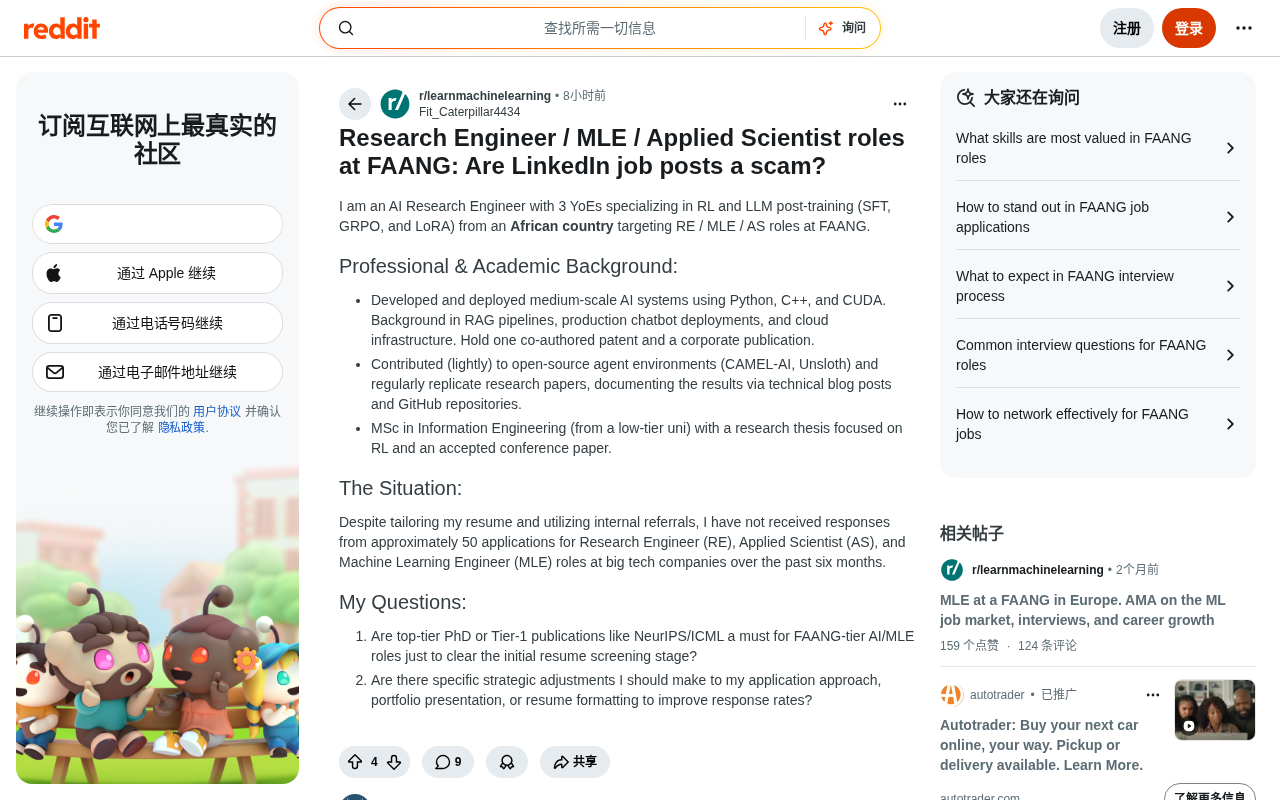
This case is worth examining in depth, because it reflects a harsh structural reality in the current AI talent market.
This Candidate's Background Is Actually Not Weak
Let's objectively assess the poster's résumé. From a technical stack perspective, his abilities are far from lacking:
- Developed and deployed medium-scale AI systems using Python, C++, and CUDA
- Experience with RAG pipelines, production chatbot deployment, and cloud infrastructure
- Holds one joint patent and one corporate publication
- Lightly contributed to open-source projects (CAMEL-AI, Unsloth)
- Regularly reproduces research papers and documents results through technical blogs and GitHub
- Holds a Master's degree in Information Engineering with a research focus on RL, and has one accepted conference paper
This background would qualify him as a competent or even outstanding candidate at many companies. Mastering cutting-edge post-training techniques like GRPO and LoRA while also being able to write CUDA for low-level optimization is not common in the market. So where exactly is the problem?
The Hidden Barriers of FAANG Research Positions
Degrees and Top-Conference Papers: Are They Hard Requirements?
For FAANG's Research Engineer and Applied Scientist positions, the answer is often brutal: top-tier PhDs and premier conference papers (NeurIPS, ICML, ICLR, CVPR, etc.) are, in practice, nearly hidden hard requirements.
This is not because these papers themselves are magical, but because recruiters need a low-cost screening signal. When popular positions receive thousands of applications, the Applicant Tracking System (ATS) and initial screeners need to filter quickly.
The ATS: An Underestimated First Gate
The ATS (Applicant Tracking System) is the core infrastructure of modern large enterprise recruitment processes, and also the system that the vast majority of job seekers have never directly interacted with, yet which is the first to make a judgment about them.
At the technical implementation level, mainstream ATS platforms (such as Workday, Greenhouse, and Lever) automatically rate résumés across dimensions like keyword semantic matching, degree weighting scores, and years-of-experience verification, then decide whether to enter the human review queue based on score thresholds. Popular FAANG research positions often receive thousands of applications within 24 to 48 hours of posting, and the ATS automatic filtering rate for some positions is as high as 75% or more, meaning that more than three-quarters of applicants are silently eliminated before any human reviewer ever sees their résumé.
The reason top-conference papers and prestigious degrees become hidden barriers is partly that these labels are systematically encoded into the ATS's keyword weightings — strings like "NeurIPS," "ICML," "Stanford," and "MIT" carry significant positive weighting in some systems, while "non-English institution names" and "non-mainstream conference abbreviations" often cannot be correctly recognized, placing candidates at a disadvantage at the algorithmic level. This mechanism imposes a systematic penalty on excellent candidates from underdeveloped regions that has nothing to do with their technical abilities.
It's worth noting that in recent years, some companies have begun introducing large-language-model-based résumé evaluation tools (such as Paradox's Olivia and HireVue's AI evaluation systems) to replace or supplement the keyword-matching logic of traditional ATS. In theory, such systems can understand semantic similarity rather than relying on exact string matching, but the historical bias in their training data can equally entrench or even amplify existing regional and institutional biases — this is one of the core controversies currently being continuously scrutinized by academia and regulators in the field of AI-assisted recruitment.
The Signal Logic of Top-Conference Papers and Their Inherent Limitations
Why do top-conference papers hold such a central signaling position in AI research job recruitment? To understand this, we need to first understand the acceptance mechanisms of premier AI conferences. Conferences like NeurIPS, ICML, ICLR, and CVPR typically have acceptance rates between 15% and 25%, with the review process led by hundreds of senior researchers in the field (Area Chairs and Reviewers) in a double-blind manner. The review cycle usually lasts 2 to 3 months, and the intensity of competition keeps rising each year — NeurIPS 2023 received over 13,000 submissions.
For recruiters, a top-conference paper represents that the candidate possesses a complete closed loop of research capabilities: independently identifying problems worth researching, designing rigorous experimental protocols, completing large-scale computational experiments, writing professional academic documentation, and passing anonymous review by domain experts — a composite capability signal that is harder to fake and more predictive than a skills list.
However, this mechanism also has systematic biases that cannot be ignored. First, it structurally favors the prestigious-university PhD cohort with ample GPU compute, senior advisor guidance, and top-conference academic networks; second, non-native English writers face additional barriers in paper writing quality; and most critically, researchers from regions lacking top-conference resources (such as sub-Saharan Africa and parts of South Asia), even with equivalent technical ability, struggle to enter this publication pathway due to a lack of support from local academic ecosystems. This means that top-conference papers, as a recruitment signal, actually amplify existing regional and institutional inequalities rather than objectively reflecting the true distribution of technical talent worldwide.
A noteworthy counterexample: some technologies that have had a profound impact on industry — such as Meta's LLaMA series, Google's original Transformer paper, and OpenAI's GPT series technical reports — were not themselves published at traditional top conferences (the Transformer was published at NeurIPS, but LLaMA, GPT-3, etc. were released as technical reports). This to some extent demonstrates that there is no inevitable one-way correspondence between top-conference publication and engineering impact.
Top-conference papers and prestigious doctoral degrees become the most direct "quality proxy indicators." The poster's "Master's from an ordinary university" plus a non-top-conference paper is likely filtered out at this automated gate.
The "MLE" Position May Be Another Path
Interestingly, the three job categories RE/AS and MLE differ significantly in nature:
- Research Engineer / Applied Scientist: Research-oriented, valuing publication records and academic reputation
- Machine Learning Engineer: Engineering-oriented, valuing system design, production deployment, and scalability
The poster applied to all three categories simultaneously, indicating that his target positioning was not clear. With his CUDA, production deployment, and cloud infrastructure background, the MLE route actually matches better than pure research positions, and the success rate is likely higher. Using a research-focused résumé to apply for engineering positions, or using engineering experience to compete for research positions, dilutes competitiveness in both cases.
ML Infra: An Emerging Job Category Between MLE and Systems Engineering
In recent years, a rapidly growing subcategory has emerged on top of MLE — the ML Infrastructure Engineer, sometimes also called ML Platform Engineer or MLOps Engineer. The technical requirements of these positions differ markedly from those of traditional MLE: they place greater emphasis on distributed training system design, GPU cluster scheduling (such as Kubernetes + SLURM hybrid scheduling), model serving optimization (inference frameworks such as TensorRT, vLLM, TGI), observability of training/inference pipelines (Prometheus, Grafana, W&B integration), and low-level CUDA kernel optimization.
For the poster, his CUDA development experience and production deployment background align closely with the core requirements of ML Infra positions. In comparison, ML Infra positions have far lower requirements for top-conference papers than Research Engineer positions, and recruitment decisions depend more on whether the candidate can demonstrate real, verifiable system optimization results — which is precisely what open-source project contributions (such as submitting CUDA optimization PRs to vLLM or Unsloth) can provide. Against the backdrop of persistently high large-model training and inference costs, the supply-demand gap for ML Infra talent is actually more pronounced than for pure research positions.
Are LinkedIn Jobs a "Scam"?
The poster's question actually points to an open secret in the industry. Many positions on LinkedIn do indeed fall into several categories of "non-genuine recruitment":
- Ghost jobs: Companies post positions to maintain an image of expansion or to build a talent pool, without any immediate hiring plans.
- Compliance postings: Some positions have already been internally decided, but must be publicly posted due to process or visa compliance requirements.
- Long-term listings: Positions that have already been filled but not removed in time.
Ghost Jobs: An Industry Phenomenon Driven by Multiple Institutional Motives
Ghost jobs are not a recent phenomenon, but they became especially prominent during the tech industry's layoff waves and hiring contraction cycles of 2022 to 2024. According to surveys of HR professionals by organizations such as Greenhouse and Resume Builder, over 40% of companies admit to having posted positions they did not intend to fill immediately, with the tech industry's figure even higher than average.
The motives driving the existence of ghost jobs are diverse and mutually reinforcing: market expectation management — continuously posting hiring signals to convey a growth narrative to investors and media, avoiding downward pressure on stock prices due to "hiring freeze" news; talent pool building — collecting résumés for future hiring needs while observing candidate quality in the market; H-1B visa compliance — the US Department of Labor requires employers to demonstrate a "good faith effort" at local recruitment when applying for PERM labor certification (a prerequisite step in the green card process), which institutionally requires publicly posting and maintaining a job advertisement for a period of time, even if an internal candidate has essentially already been decided; and system inertia — large enterprises' recruitment management systems lack automatic delisting mechanisms, so positions often continue to be publicly displayed for weeks or even months after being filled, due to process delays.
This phenomenon severely distorts a job seeker's application conversion rate data. Candidates often cannot distinguish whether they were filtered out due to insufficient technical strength, or whether they were competing for an opportunity that never truly existed — and these two situations require entirely different response strategies. "50 applications, 0 replies" therefore does not statistically necessarily mean the candidate lacks ability; a considerable proportion of those applications may have had no corresponding real position from the start.
A practical signal for identifying ghost jobs is the posting duration: LinkedIn data shows that the median time to fill for genuinely valid recruitment positions is about 30 to 45 days; positions listed continuously for more than 60 days without any updates have a significantly higher-than-average probability of being ghost jobs. Additionally, contradictions between the job description and a company's publicly signaled business contraction (such as recent layoff announcements or hiring freeze statements in quarterly earnings reports) are also worth examining as a screening dimension.
So rather than calling it a "scam," it's better described as the information asymmetry that pervades the recruitment ecosystem. 50 applications with 0 replies is very likely not because you lack ability, but because you may be competing against a large number of vacant or pre-decided positions, while also being stuck at the signal threshold of automated initial screening.
More Realistic Strategy Adjustments
1. Reposition Your Target Roles
Don't cast a wide net applying to RE/AS/MLE simultaneously. With your existing engineering strength, prioritize MLE and ML Infra positions, and your hit rate will improve significantly. Research positions can be a long-term goal, but the short-term return on investment is quite low.
2. Amplify Your Existing Differentiating Signals
Open-source contributions are this candidate's most easily underestimated asset. Currently he is only a "light participant" in CAMEL-AI and Unsloth — but if he can become a core contributor to these popular projects, making his PRs and star counts on GitHub verifiable proof of ability, its value may exceed that of a mid-tier conference paper.
The Verifiable Signal Value of Open-Source Contributions
To understand why open-source contributions have unique signal value for engineering-oriented positions, we need to first understand the magnitude of influence of their respective ecosystems.
Unsloth is an open-source project focused on efficient LLM fine-tuning. Its core innovation lies in accelerating the fine-tuning of mainstream models like Llama and Mistral by 2 to 5 times, while reducing memory usage by about 60%, all without loss of numerical precision, through hand-written CUDA kernels and Flash Attention optimization. The project has considerable influence within the Hugging Face ecosystem, with over 20,000 GitHub stars, and is adopted in real-world engineering by a large number of AI practitioners and researchers. Being able to contribute reviewed CUDA-level optimization PRs to Unsloth is itself a public verification of a candidate's low-level system capabilities. Unsloth's technical stack involves deep system-level work such as Triton kernel writing, Flash Attention 2 integration, and low-precision computation optimization of RoPE positional encoding — the technical complexity of such contributions is far higher than typical Python-layer code submissions, giving them high distinctiveness.
CAMEL-AI is an important open-source project in the field of multi-agent frameworks. Its Role-Playing communication framework provided an early systematic abstraction for the autonomous collaboration of LLM agents, influencing the design ideas of several subsequent mainstream Agent frameworks. With the rapidly growing demand for large-model Agent engineering, core contributor status in CAMEL-AI can establish a candidate's professional label in the emerging subfield of multi-agent systems.
Core contributor status (rather than peripheral participation) can bring quantifiable public records including: the number and complexity of merged PRs, the quality of issue resolution, code review participation, and community influence (GitHub star count, fork count, downstream citation volume). These metrics can all be independently verified by recruiters through public channels, giving them credibility unmatched by résumé claims. Some FAANG engineering team leads and AI startup hiring managers have explicitly stated that when screening MLE and ML Infra candidates, they incorporate GitHub activity and substantive contributions to well-known open-source projects into their initial screening criteria, and its signal value on engineering-oriented positions can even, to some extent, substitute for top-conference papers.
Unsloth already has considerable influence in the LLM fine-tuning field, and deep contributions can bring real industry visibility.
3. Start from Geographic and Visa Realities
As a candidate from an African country, directly targeting FAANG's US headquarters will face multiple frictions such as visa issues, time zones, and regional bias.
The H-1B Visa: A Structural Barrier Unrelated to Technical Ability
The US H-1B work visa is the primary legal channel for international tech talent to enter the US market, but its institutional design creates significant structural barriers for international candidates.
In terms of numbers, the H-1B has an annual cap of only 85,000 slots (including 20,000 master's exemption quotas), while recent application volumes have consistently exceeded 500,000 — meaning that even if an employer is willing to sponsor, the candidate must still pass a random computer lottery to gain application eligibility, with an overall selection rate of about 15% to 20%. In terms of cost, the employer must bear government application fees (ranging from $1,710 to $6,460 depending on company size) plus legal fees, totaling typically between $3,000 and $8,000, with an approval cycle lasting 6 to 12 months (premium processing can shorten this to 15 working days, but requires an additional $2,805).
This institutional structure means that, all else being equal, FAANG significantly prefers local candidates or applicants who already have work authorization (such as OPT/EAD holders, green card holders, and US citizens) — hiring an international candidate who requires H-1B sponsorship means the employer must bear thousands of dollars in additional costs, months of administrative waiting, and the uncertainty risk of not being selected in the lottery. For a large enterprise with hundreds of positions to fill within a hiring season, this cost is manageable; but for an international applicant who is already on par with local candidates in technical evaluation, these friction factors — entirely unrelated to technical ability — have a real adverse impact on hiring decisions.
For candidates from Africa, another path worth considering is the UK's Global Talent Visa and Canada's Global Skills Strategy. The former is designed specifically for top international technical talent, with Tech Nation responsible for qualification assessment in the AI/ML field; the application does not depend on employer sponsorship and has no numerical cap. The latter provides Canadian employers with a two-week fast-track approval mechanism, significantly reducing the administrative friction of cross-border recruitment. Both markets are home to numerous FAANG divisions (Google DeepMind London, Amazon AWS Toronto, etc.) and are more visa-friendly than the US H-1B system.
A more pragmatic path might be: first join an AI startup with a remote culture, or a big-tech division with an African or European office, to accumulate the signal of "big-tech experience," then seek lateral job-change opportunities.
4. Get Referrals from the Right People
The effectiveness of referrals depends heavily on the referrer's seniority and willingness. A referral casually submitted by a junior employee may be even worse than none; while a senior professional willing to directly connect you with the hiring manager makes a world of difference in value.
Final Thoughts
The value of this case lies not in one person's experience, but in how it reveals the true picture of the AI job market: between technical ability and job search results, there exists a filtering net composed of signal strength, geographic constraints, role positioning, and the recruitment ecosystem.
Each component of this filtering net — automated ATS screening, the signal logic of top-conference papers, the ghost jobs phenomenon, the H-1B visa barrier — has its own rationale when viewed in isolation, but under their combined effect, they systematically shut out a large number of genuinely capable candidates, regardless of their actual technical level.
For professionals also targeting top AI positions, rather than anxiously asking "is it a scam," it's better to calmly ask yourself three questions: Is my job search signal strong enough? Is my role positioning precise? Am I competing against genuinely existing hiring needs? Thinking through these three points may be more valuable than blindly submitting another 50 applications.
Key Takeaways
Key Takeaways
Related articles

Felix Rieseberg Personal Homepage
Felix Rieseberg's personal homepage sparks attention on Hacker News. This article covers the Slack engineer's technical background, the rise and fall of nativefier, and the value of a developer homepage as a tech calling card.

@ai-sdk/vue 3.0.306 Patch Release Syncs with [email protected] Update
@ai-sdk/vue 3.0.306 released, synced with [email protected]. A routine patch release for the Vercel AI SDK ecosystem with no public API changes; the Vue adapter layer stays version-aligned with the core package.

Gemini 4 Argon API Launches: The Era of Million-Token Output Begins
Google launches Gemini 4 Argon with sparse MoE architecture, up to 1M output tokens, and a 68.90% Vals Index score, available across API, AI Studio, and the Gemini app.