500 Hours to "Exhaust" a Mysterious Game: The Complexity and Fatigue of 'Order of the Sinking Star'

Indie game Order of the Sinking Star draws controversy over its 500-hour playtime and extreme complexity, called "complex and exhausting."
Order of the Sinking Star is an indie game selling itself on extreme scale and mechanical complexity, reportedly boasting up to 500 hours of playtime. Media called it "as complex and exhausting as it sounds," sparking discussion on Hacker News and other tech communities. The article argues that complexity should be a source of depth, but when it exceeds what players can absorb, it shifts from fun to burden. The game throws out masses of rules at once, forcing players to piece together logic through trial and error, creating a steep learning curve that makes flow states hard to reach. At 2 hours a day, 500 hours means over 8 months of commitment, making "is it worth it" replace "is it fun" as the focus of discussion. The article concludes that extreme playtime and complexity can generate buzz, but also easily shut potential players out—complexity should be an invitation, not a barrier.
In the indie game scene, works that sell themselves on "extreme scale" occasionally appear—challenging not just players' reflexes, but their patience and comprehension. Recently, a case that sparked discussion on Hacker News and other communities is Order of the Sinking Star—reportedly boasting a full playtime of 500 hours, with media verdicts cutting right to the point: it is "as complex and exhausting as it sounds."
What Kind of Game Is This?
Order of the Sinking Star is described as a work with an astonishing scale and mechanical complexity. It doesn't win through visuals or narrative, but rather builds a unique barrier through layer upon layer of stacked systems, obscure rules, and an extremely long playthrough.
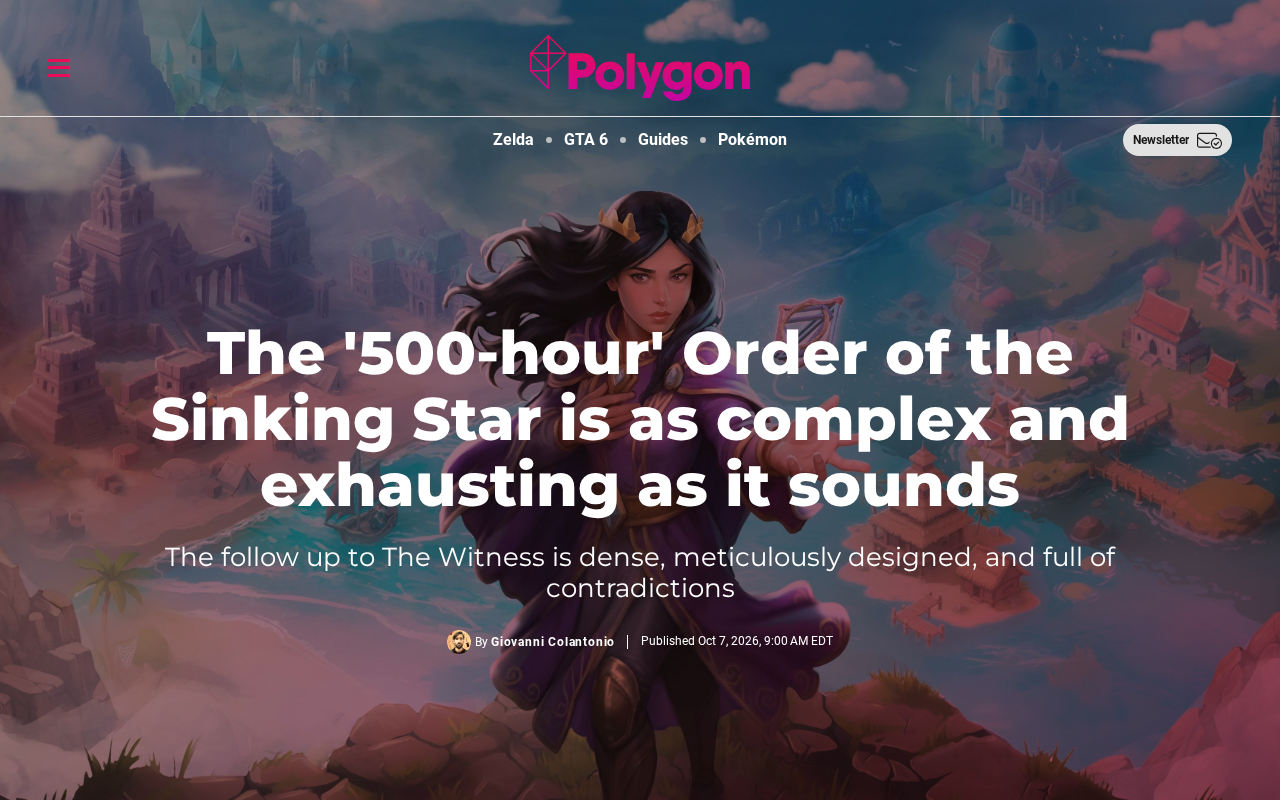
Judging from community discussions, players and reviewers alike respond to its "500-hour" claim with both curiosity and skepticism: some see it as evidence of deep content, while others worry it's a fatigue-inducing pile of redundant mechanics. Either way, it successfully turned "complexity" itself into a talking point.
Why Does "Complexity" Turn Into Fatigue?
In modern game design, complexity is usually seen as the source of depth. But when complexity exceeds the threshold players can naturally absorb, it shifts from fun to burden. This is precisely the core of the controversy surrounding Order of the Sinking Star.
Learning Curve and Flow
Good complex games (such as certain hardcore strategy or simulation titles) slice the learning curve into manageable segments, letting players feel a sense of accomplishment each time they grasp a new mechanic. Order of the Sinking Star seems to have chosen a different path: a flood of rules arrives all at once, and players must piece together the logic through repeated trial and error. This design appeals to a specific group, but also deters many others.
"Flow," proposed by psychologist Mihaly Csikszentmihalyi, refers to the state of being fully immersed in an activity, losing track of time. The key to entering flow is a dynamic balance between challenge difficulty and personal skill: when challenge far exceeds skill, anxiety arises; when skill far exceeds challenge, boredom sets in. Excellent hardcore games use progressive tutorials and phased mechanic unlocks to let player skill and challenge climb in tandem, repeatedly returning players to the flow channel. Order of the Sinking Star throws out a mass of rules all at once, making the initial challenge curve shoot sharply above most players' skill starting point. Players remain stuck in the anxiety zone for extended periods—this is the psychological mechanism by which "complexity" transforms into "fatigue."
What Does 500 Hours Mean?
At 2 hours of play per day, 500 hours equals 250 days—more than 8 months. For most adults, this is practically a "commitment" rather than entertainment. When a game requires such an enormous time investment to be "exhausted," discussions about whether it's "worth it" become more common than discussions about whether it's "fun."
The figure "500 hours" needs to be understood within a frame of reference. Taking mainstream AAA single-player games as an example, completing the main story typically takes 20–60 hours, and achieving "full completion" usually lands around 100 hours; even works renowned for their massive content, such as The Witcher 3 plus its two expansions at roughly 150–200 hours, or Elden Ring at approximately 100–150 hours for full exploration. The titles that truly reach hundreds of hours are mostly infinitely replayable strategy games like Civilization or Europa Universalis, where the playtime comes from the variability of repeated playthroughs rather than a single linear campaign. If Order of the Sinking Star's 500 hours represent a mandatory single-playthrough campaign, its content density per unit time and player retention rate will face severe scrutiny.
Community and Media Attitudes
The game's discussion thread on Hacker News (ID 50072119) attracted attention from tech-oriented players. This demographic typically has a natural interest in complex systems, but even so, the comments reveal reservations about "complexity for complexity's sake."
The media verdict "as complex and exhausting as it sounds" has been widely quoted, indicating this isn't an isolated complaint but a repeatedly validated experience. It reminds developers: scaling up is a choice, but making scale serve the experience is the real skill.
Hacker News is a tech and startup community operated by Y Combinator, with users primarily consisting of engineers, entrepreneurs, and researchers. While its discussion topics cover a wide range, its core community generally has a natural affinity for systematic, composable complexity—from programming languages to strategy games. Precisely because of this, the group's reaction to Order of the Sinking Star carries more reference value: even people who appreciate complex systems hold reservations about "complexity for complexity's sake," suggesting the game's complexity may not stem from the inherent necessity of its systems, but from unrestrained external accumulation. This criticism from within the target audience speaks more to design orientation issues than complaints from general players.
Lessons for Indie Games
Regardless of its final reception, Order of the Sinking Star provides a valuable sample: in an era of scarce attention, extreme playtime and complexity can generate buzz, but they can also easily shut potential players out.
For creators, the question was never "can we make 500 hours," but "will players want to stay for hour one." Complexity should be an invitation, not a barrier.
Related articles

Workbuddy for Absolute Beginners: How a Desktop AI Agent Fits Into Real Workflows
A beginner's guide to the Workbuddy desktop AI agent: installation, claiming credits, file management, and building automated workflows—compared with CodeX for fit and cost, helping professionals shift from AI question-askers to AI managers.

OpenAI's New Agent Stack: Computer Use, Decisions API, and Ultra-Fast Workflows
OpenAI Dev Day unveiled a new agent stack: Computer Use outperforms humans, Decisions API delivers ultra-low-latency classification via Luna, Agents API opens the same Computer Use capabilities, and GPT-6.1 Sol costs only one-seventh of Astra. Core updates, benchmark data, and developer insights.

Liang Wenfeng Open-Sources DeepInfo Inference Framework, Takes On U.S. Ban
DeepSeek open-sources its DeepInfo inference framework after its models, featuring GPU/CPU cross-pipelining, small-model prediction with large-model verification, and full Huawei Ascend and NVIDIA chip support—facing the U.S. federal ban head-on. This article analyzes its significance for AI deployment and open-source strategy.