500M Token Test: DeepSeek-V4.1's Animation Capabilities Challenge GPT-6

DeepSeek-V4.1-flash beats closed-source flagships in real-world coding tests, with 500M tokens costing only 28 yuan.
DeepSeek quietly released v4.1 (flash-1017), and Bilibili creator "Hua Shu" ran a 500-million-token multi-task test. Results show the model surpasses closed-source models like Claude Opus 5 and GPT 5.6 Sol on real-world coding metrics and achieves Pareto-optimal performance and cost. With Skills, it can produce 30-second animations and 3D scenes at just 2.4–3 yuan per task, though aesthetics and long-horizon coding still trail top closed-source models. The 500M tokens cost only 28 yuan total, mainly thanks to 8B input/16B output asymmetric activation and cache-hit pricing as low as 0.02 yuan per million tokens. Official demos are Harness-optimized, so bare runs are weaker.
Recently, DeepSeek quietly rolled out its v4.1 update (flash-1017), sparking heated discussion across technical communities at home and abroad. Bilibili creator "Hua Shu" invested 500 million tokens in a multi-task hands-on test, and the conclusions are striking: on animation generation and specific programming tasks, the model can already match or even surpass top-tier closed-source models like GPT-6 and Claude Opus 5—at a jaw-droppingly low cost of just 28 yuan.
Performance Leap: Real-World Coding Ability Surpasses Leading Closed-Source Models
According to the creator's testing and community feedback, DeepSeekAd-V4.1-flash has already surpassed Claude Opus 5, GPT 5.6 Sol, and a host of domestic open-source models on core metrics measuring real-world programming ability. Across multiple Harness evaluation environments, the model achieved the "Pareto optimum" in performance and cost—meaning that compared to every other model, it is both cheaper and more capable.
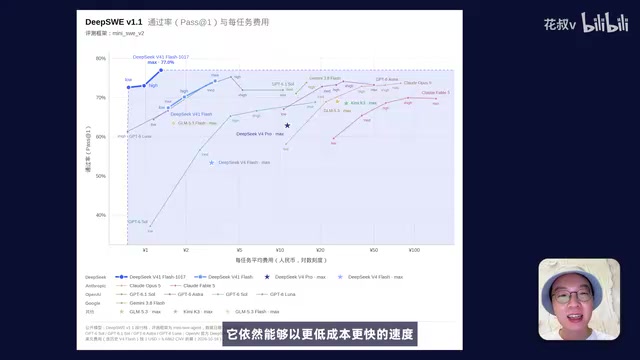
This improvement isn't simply a matter of piling on more compute. While shortening task runtime and output length, the model still maintains lower cost and faster speed. In the video, the creator describes it as the "kill line" for large models, meaning it delivers a decisive blow to competitors on the cost-performance dimension. That said, he objectively notes that on more aesthetics-oriented capabilities and long-horizon programming tasks, DeepSeek-V4.1 still lags somewhat behind GPT-6, Astral, and Opus 5.5.
Harness is the "scaffolding framework" used in model evaluation—the full set of prompts, tool calls, code execution environments, and scoring scripts built around the model under test. The same model can perform very differently under different Harnesses, because tool definition styles, context organization, and retry strategies all affect the final score. The "multiple Harness evaluation environments" mentioned in the article mean the evaluation isn't based on a single leaderboard but cross-validated across multiple scaffolding configurations, making the conclusions relatively more robust. This also explains the gap between official demos and developers running the model bare: part of the demo effect comes from dedicated tuning at the Harness layer.
Pareto optimum is a concept from economics and multi-objective optimization: when no other solution can improve at least one metric without worsening any other, the current solution sits on the Pareto frontier. In model selection, it means "no other model can be both cheaper and stronger at the same time." The article uses it to describe DeepSeek-V4.1-flash's position in the performance–cost two-dimensional space, emphasizing relative competitive advantage rather than absolute top performance.
Animation and 3D Generation Testing: Stunning Results with Skill Support
One of the core scenarios in this test was animation and 3D content generation. The creator used Claude Code to connect to the DeepSeek API and completed more than a dozen tasks, including PPT generation, a 30-second animated short, 3D game scenes, knowledge explainer videos, and an animation based on "A Thousand Li of Rivers and Mountains."
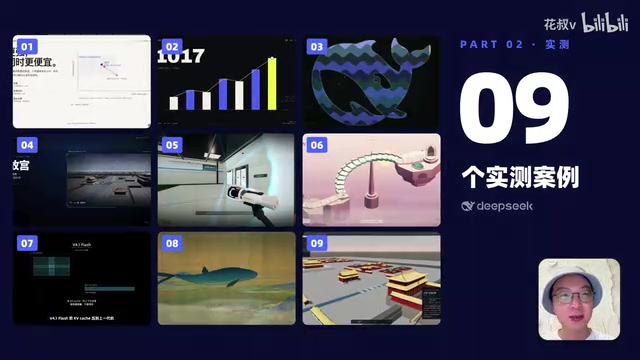
With Skills (such as the Hua Shu Design Skill), the model can produce motion graphics and sound effects of quite high completeness. For example, a 30-second animation cost only 2.4 yuan, with very little back-and-forth communication in between, and the vast majority of requests hit the cache. Another animation based on "A Thousand Li of Rivers and Mountains" cost only 3 yuan in total. In comparative tests, although Opus 5.5 still has the edge in visual aesthetics and animation refinement, DeepSeek-V4.1, supported by good Skills, can already produce "very good" results.
Interestingly, the official demo cases were specially optimized at the Harness level, so running the model bare without Skills will be noticeably weaker than the official showcase. The creator reminds developers to have reasonable expectations about this.
Skill here refers to a pluggable capability pack or skill module, typically composed of prompt templates, examples, tool functions, and design specifications, used to constrain a general-purpose model to a specific task workflow. It doesn't change model weights but injects domain knowledge and operational steps at inference time, essentially equipping the model with a "work instruction manual." The "Hua Shu Design Skill" mentioned in the article is a skill pack customized for visual design scenarios. This also explains the obvious gap between running with Skills and running bare: Skills fill in the model's priors on aesthetic standards, layout structure, and motion rhythm, making outputs more stable and closer to professional deliverables. For developers, the Skill system is the primary means of compensating for a model's weaknesses at low cost.
Cost Breakdown: 500M Tokens for Only 28 Yuan, Caching Mechanism Is Key
At the end of the video, the most shocking figure is revealed: the total cost of the 500-million-token test was only 28 yuan, corresponding to over 2,000 API calls. This extremely low cost is mainly thanks to two design choices.

First is the asymmetric activation parameter feature: only 8B parameters are activated on input and 16B on output, while KV Cache and memory footprint are significantly reduced compared with the previous generation. Second is the extreme reduction in cache-hit pricing—the input price when the cache is hit is as low as 0.02 yuan per million tokens, while idle-period input pricing is 1 yuan and output is 4 yuan, consistent with before.
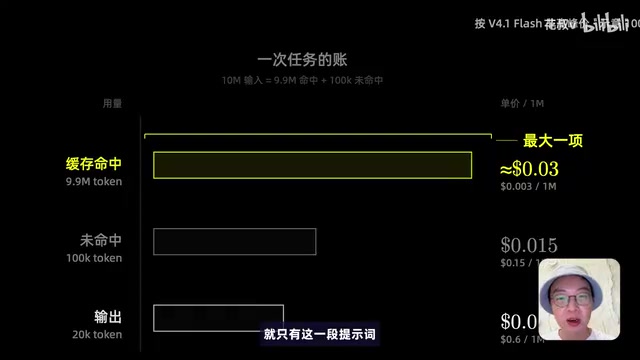
This means that in Agent workflows with long contexts and multiple rounds of calls, the vast majority of tokens can reuse the cache, compressing costs to "one-fiftieth of the miss price." For complex tasks that require repeatedly reading on the order of 100,000 tokens, the economic advantage brought by this mechanism is decisive.
KV Cache (key-value cache) is a core optimization in Transformer inference: during autoregressive generation, the attention key-value vectors corresponding to already-processed tokens are saved and reused, avoiding recomputing the entire context each time a new token is generated. In long-context, multi-turn Agent scenarios, system prompts, tool definitions, and conversation history are often read repeatedly, so the cache hit rate is high. Vendors typically price "cache-hit input tokens" separately, far below the price of cache-miss input. In the article, the cache price of 0.02 yuan per million tokens versus the regular input price of 1 yuan per million tokens differs by about fifty times—exactly the source of the economic benefit from this mechanism.
Asymmetric activation parameters refers to the model activating different subsets of parameters during the input (prefill) and output (decode) phases. The input phase needs to process the entire context in parallel, so activating fewer parameters reduces compute and memory pressure; the output phase generates token by token, activating more parameters to ensure generation quality. The article's "8B input, 16B output" is this kind of design, and together with smaller KV Cache usage, it further lowers the unit cost of long-context tasks.
Ecosystem Integration and Usage Recommendations
DeepSeek has prioritized adaptation and integration with platforms such as CodeBuddy and WorkBuddyAd, and users can call it via API, the official website, or third-party coding tools. The API comes with built-in search capability by default, free when accessed through Claude Code or Codex, and billed at 5 yuan per thousand calls afterward—still very low cost. The model weights are also available for download on open-source platforms, continuing DeepSeek's consistent open-source strategy.
For developers who want to reproduce the creator's results, it's recommended to make full use of the Skill system to compensate for the model's shortcomings in aesthetics and fine-grained control. With the Claude Code + DeepSeek combination and suitable Skills, V4.1-flash may currently be one of the lowest-priced and most effective choices besides the native models of Claude Code and Codex.
Claude Code / Codex are terminal-oriented Agent-style coding tools that aren't tied to a single model but connect to different backends via API. After integrating a low-cost model like DeepSeek, the tool layer handles file reading and writing, command execution, and task decomposition, while the model layer handles reasoning and generation; the combination can significantly reduce the call cost of Agent workflows. Note that the effectiveness of such tools depends heavily on the backend model's instruction-following and tool-calling stability, so before integration it's advisable to verify compatibility with small-scale tasks first, then gradually expand to long-horizon programming scenarios.
One-line Summary
DeepSeek-V4.1-flash beats closed-source flagships in real-world coding tests, with 500M tokens costing only 28 yuan.
Paragraph Summary
DeepSeek quietly released v4.1 (flash-1017), and Bilibili creator "Hua Shu" ran a 500-million-token multi-task test. Results show the model surpasses closed-source models like Claude Opus 5 and GPT 5.6 Sol on real-world coding metrics and achieves Pareto-optimal performance and cost. With Skills, it can produce 30-second animations, 3D game scenes, and explainer videos at just 2.4–3 yuan per task, though aesthetic refinement and long-horizon coding still trail top closed-source models. The 500M tokens cost only 28 yuan total, mainly thanks to asymmetric parameter design (8B input activation, 16B output activation) and cache-hit pricing as low as 0.02 yuan per million tokens. Official demos are Harness-optimized, so bare runs are weaker—developers should keep expectations reasonable.
Related articles

Chain of Thought Isn't Just for AI: How Humans Can Use CoT to Improve Thinking Quality
Chain of Thought isn't just a prompt trick for large models. Starting from a Hacker News discussion, this article analyzes why CoT works for human thinking too, breaks down actionable ways to transfer it, and highlights the key differences between human CoT and machine CoT.
Cloudflare Teams Up with OpenAI: Closi…
Cloudflare Teams Up with OpenAI: Closing the Loop from Vulnerability Discovery to Defense with AI
Cloudflare uses OpenAI Daybreak to investigate security vulnerabilities and generate reviewable remediation plans, while developers use Codex to boost coding efficiency and quality.

Orca Multi-Agent Orchestration in Practice: A Guide to Parallel Collaboration with Claude and Codex
Orca is Stable AI's free open-source agent workbench supporting 34 agents like Claude Code and Codex in parallel. Learn its Git worktree isolation, multi-model orchestration, and mobile management.