53AI Hub: Open-Source AI Portal Platform for Unified Management of Dify/Coze and Other AI Agent Applications
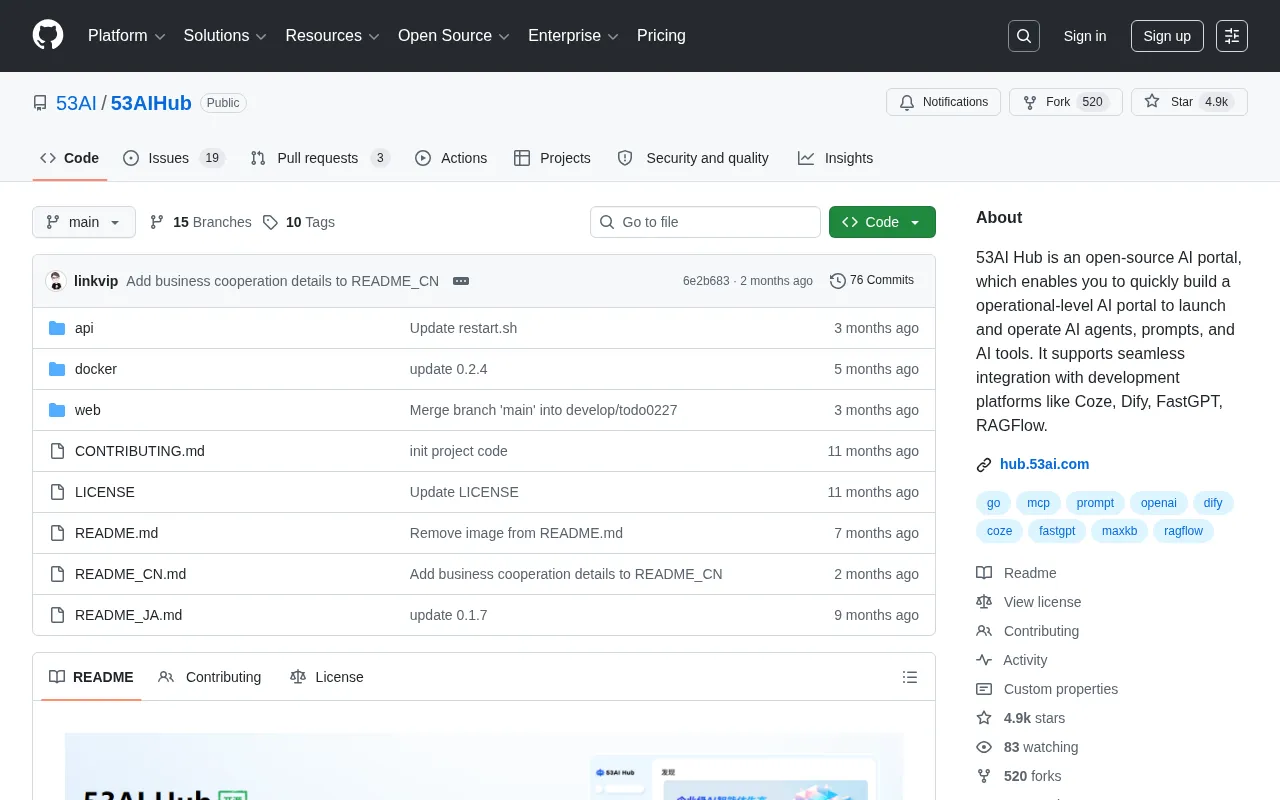
53AI Hub is an open-source portal for unified management of multi-platform AI applications.
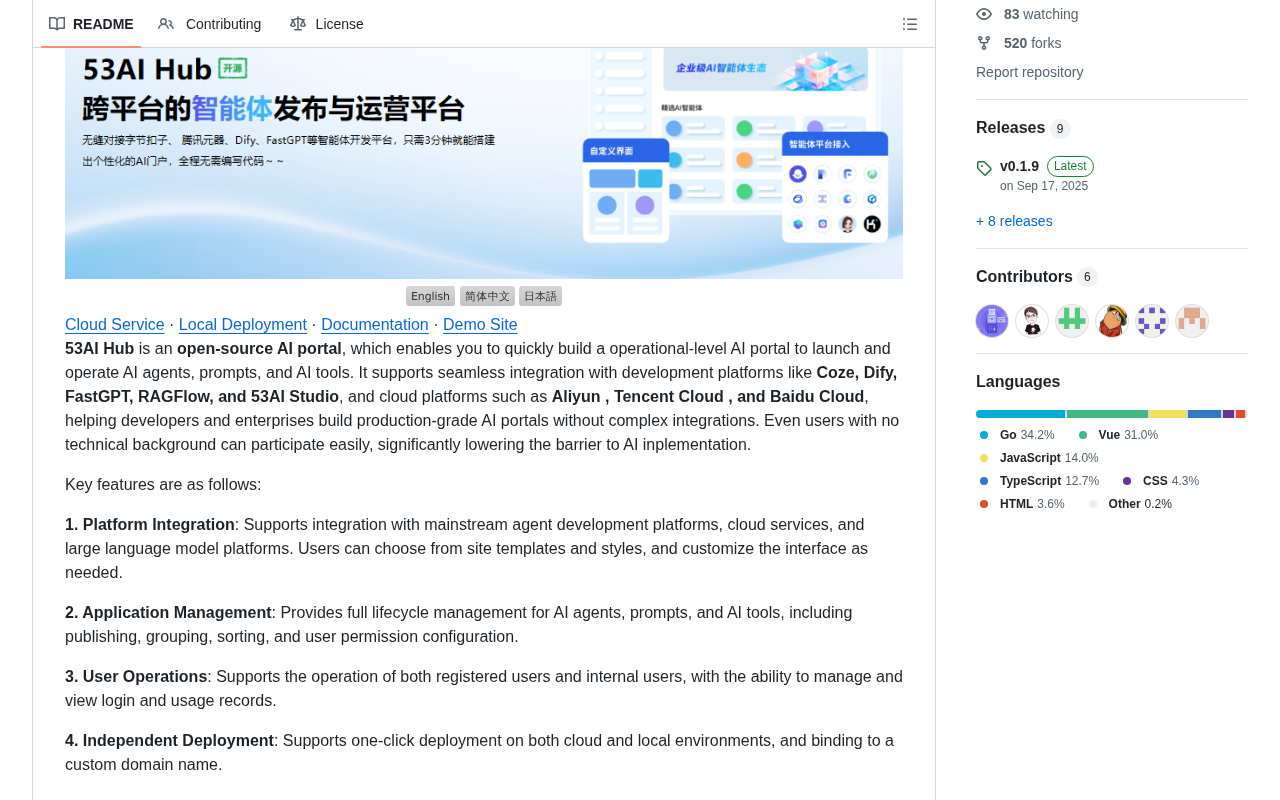
53AI Hub is an open-source AI portal platform built with Go, designed to solve the fragmented management of enterprise AI applications. It seamlessly integrates with mainstream AI development platforms including Dify, Coze, FastGPT, and RAGFlow, unifying the publishing and operations of AI Agents, Prompts, and AI tools scattered across different platforms. With nearly 5,000 GitHub Stars, it positions itself as the "last mile" bridge from AI application development to operations, suitable for enterprise AI middle platform construction, AI service provider operations, and internal team collaboration.
Project Overview: Why You Need an AI Application Portal
In today's flourishing AI application landscape, enterprises and developers face a common challenge: how to unify the management and efficient operation of AI Agents, Prompts, and AI tools scattered across different platforms like Dify, Coze, and FastGPT? 53AI Hub is an open-source project created precisely to solve this pain point.
Since 2023, with the rapid advancement of Large Language Model (LLM) capabilities, the number of AI applications within enterprises has exploded. According to Gartner predictions, by 2026, over 80% of enterprises will use generative AI applications in production environments. However, AI application development platforms are highly fragmented — Dify focuses on LLM application orchestration, Coze excels at Bot building, FastGPT specializes in knowledge base Q&A, and RAGFlow dives deep into Retrieval-Augmented Generation. While this multi-platform coexistence provides developers with rich choices, it also creates severe management fragmentation: applications scattered across different platforms, inconsistent user entry points, and inability to aggregate operational data, forming isolated "AI islands."
53AI Hub is an open-source AI portal platform that helps users quickly build operational-level AI portals for publishing and operating AI Agents, Prompts, and various AI tools. The project has already earned 4,943 Stars and 520 Forks on GitHub, developed in Go, demonstrating strong community demand for this type of AI application management infrastructure.
Core Features: Unified Management and Multi-Platform Integration
Unified AI Application Portal
The core value of 53AI Hub lies in providing a unified entry point that centralizes the display and management of various AI applications built internally by enterprises or teams. Whether it's conversational Agents based on large language models, carefully designed Prompt templates, or various AI-assisted tools, they can all be published, categorized, and operated through this portal.
The AI Agents mentioned here have been one of the hottest directions in the AI field since 2024. Unlike traditional single-turn conversations, AI Agents possess capabilities for autonomous planning, tool invocation, multi-step reasoning, and environment interaction, enabling them to complete complex end-to-end tasks. Leading companies like OpenAI, Anthropic, and Google are all heavily advancing Agent capabilities. However, developing Agents is just the first step — the real challenge lies in operations: How do you help target users discover these Agents? How do you manage Agent version iterations? How do you monitor Agent usage and effectiveness? How do you reasonably distribute traffic among multiple Agents? These operational-level questions are the core pain points that 53AI Hub aims to solve. As the number of internal enterprise Agents grows from single digits to dozens or even hundreds, the lack of a unified operational platform becomes increasingly problematic.
This centralized management approach directly addresses the AI application fragmentation problem. In real enterprise scenarios, different teams may use different AI development platforms to build applications, and end users often need to switch between multiple platforms, resulting in a very fragmented experience. 53AI Hub acts as an "AI app store," allowing end users to discover and use all available AI capabilities within a single unified interface.
Seamless Multi-Platform Integration
Another major highlight of 53AI Hub is its broad platform compatibility. It supports seamless integration with current mainstream AI development platforms, including:
- Coze: An AI Bot development platform launched by ByteDance, supporting plugin extensions, workflow orchestration, and multi-channel publishing. Backed by ByteDance's cloud infrastructure, it has high penetration in the Chinese market. Developers can quickly build AI Bots with complex interaction capabilities through a visual interface.
- Dify: An open-source LLM application development platform that provides a complete toolchain from Prompt orchestration and RAG engines to Agent frameworks. Developers can quickly build AI applications through a visual interface. With over 60k GitHub Stars, it's one of the most active AI application development platforms in the community.
- FastGPT: A knowledge base-powered AI Q&A system whose core advantage lies in its flexible knowledge base management and precise semantic retrieval capabilities. It's suitable for building enterprise-grade FAQ and customer service scenarios, supporting automatic parsing and vector storage of multiple document formats.
- RAGFlow: An open-source engine focused on RAG (Retrieval-Augmented Generation) that effectively addresses LLM hallucination issues and knowledge timeliness problems by combining external knowledge bases with large models. It supports deep parsing of complex documents (such as PDF tables and scanned documents) and has significant advantages in document understanding accuracy.
Regarding RAG technology, it's worth further explanation that RAG (Retrieval-Augmented Generation) is one of the most important technical paradigms in enterprise AI applications today. Its core approach is to retrieve relevant document fragments from external knowledge bases before the large model generates an answer, injecting them into the Prompt as context, so the model generates more accurate responses based on real data. RAG effectively addresses three major pain points of pure large models: knowledge cutoff date limitations (model training data has timeliness), hallucination issues (models may fabricate non-existent information), and insufficient domain knowledge (general models lack enterprise private knowledge). Platforms like RAGFlow and FastGPT are professional tools built around RAG technology, while 53AI Hub, as the portal layer, can uniformly publish knowledge Q&A applications built on these RAG platforms to end users.
This means developers can continue building AI applications on their familiar platforms, then uniformly publish and operate them through 53AI Hub, without redundantly developing frontend interfaces or user management systems. This is especially practical for teams simultaneously using multiple AI development platforms.
Technical Architecture: High-Performance Operations Platform Built with Go
Built with Go for Stable and Reliable Performance
The project chose Go as its primary development language, a technical decision reflecting considerations for high-performance and high-concurrency scenarios. Go (Golang), released by Google in 2009, has a design philosophy emphasizing simplicity, efficiency, and concurrency safety. Go's goroutine mechanism is the core of its concurrency model — each goroutine occupies only about 2KB of initial stack space (compared to 1MB for Java threads), meaning a single server can easily support hundreds of thousands of concurrent connections. Go's GC (garbage collection) latency has been optimized to sub-millisecond levels in recent versions, making it ideal for latency-sensitive API gateway scenarios.
In the cloud-native ecosystem, core infrastructure like Docker, Kubernetes, and Prometheus are all developed in Go, giving Go projects natural cloud-native compatibility. For a portal system like 53AI Hub that needs to simultaneously interface with multiple upstream AI platforms and handle large volumes of concurrent user requests, Go's compiled language characteristics and excellent network I/O performance provide a solid technical foundation, enabling stable operation in production environments while handling massive concurrent access.
Operational-Level Design Philosophy
Notably, 53AI Hub emphasizes being an "operational-level" AI portal. This means it's not just a simple display page but includes comprehensive operational capabilities:
- Application Publishing & Management: Supports listing, delisting, and category management of AI applications
- User Experience Optimization: Provides a unified user interface and interaction experience
- Extensible Architecture: Supports flexible scaling as business grows
Use Cases: From Enterprise AI Middle Platform to Service Provider Operations
Enterprise AI Middle Platform Construction
For enterprises advancing AI transformation, 53AI Hub can serve as the frontend portal for an internal AI middle platform. The AI middle platform is an important concept in enterprise digital architecture, originating from the "big middle platform, small front-end" organizational architecture philosophy. The core goal of an AI middle platform is to unify the consolidation and management of enterprise internal AI capabilities (models, data, tools, applications), avoiding redundant construction across business departments and enabling AI capability reuse and sharing. A complete AI middle platform typically includes three layers: the underlying model service layer (providing unified model invocation interfaces), the middle capability orchestration layer (supporting rapid assembly of AI applications), and the upper application portal layer (the unified entry point facing end users). 53AI Hub primarily solves the application portal layer problem, complementing the underlying model service platforms and middle application development platforms to form the complete technology stack of an enterprise AI middle platform.
AI applications developed by various business departments on platforms like Dify and Coze are uniformly published through this platform, allowing employees to conveniently discover and use AI tools relevant to their work, significantly lowering the barriers to AI application promotion and adoption.
Customer Operations Platform for AI Service Providers
For service providers offering AI solutions, 53AI Hub provides a ready-made customer portal framework. Service providers can deliver customized AI Agents and tools to customers through this platform, achieving standardized service operations and saving the cost of building a portal system from scratch.
Developer Community and Internal Team Collaboration
Within teams, 53AI Hub can also serve as a shared platform for AI capabilities, facilitating AI tool sharing and best practice dissemination among team members, avoiding reinventing the wheel.
Competitive Advantage: Bridging the Last Mile of AI Application Operations
The current AI application development field shows a clear pattern of "easy development, hard operations." Platforms like Dify and Coze have significantly lowered the barrier to AI Agent development, but how to effectively deliver these applications to users and conduct ongoing operations remains a widespread challenge.
53AI Hub precisely targets this "last mile" from development to operations. It doesn't compete with existing AI development platforms but exists as their complementary layer, focusing on solving AI application distribution and operations problems. This differentiated positioning, combined with an open-source and free strategy, has earned it nearly 5,000 Stars in a short time. This positioning strategy is similar to app stores in the mobile internet era — the app store itself doesn't develop apps, but it solves the problem of app distribution and discovery, becoming indispensable infrastructure in the entire ecosystem.
Summary: An Open-Source Solution for AI Application Management
53AI Hub fills an important gap in the AI application ecosystem — the bridge between AI application development and actual operations. As the number of enterprise AI Agents continues to grow, the demand for unified management and operations platforms will only intensify.
As an open-source project, 53AI Hub provides developers and enterprises with a low-cost, highly flexible AI portal solution. If your team is using platforms like Dify or Coze to develop AI applications and struggling without a unified portal to manage and distribute these applications, 53AI Hub is worth exploring in depth.
Consider following the project's GitHub repository to stay updated on the latest feature releases and community developments.
Related articles
 Product Reviews
The Programmer's Desk Setup Guide: Building a Workspace That Feels Like Home
Discover how programmers build productive, comfortable workspaces. From multi-monitor setups to ergonomic design, explore the desk philosophy that drives focus and flow.
 Product Reviews
Qoder vs Cursor Real-World Comparison: Which $20/Month AI IDE Is Better?
Hands-on comparison of Qoder vs Cursor AI IDEs: Agent autonomy, human interaction count, and architecture decisions. Qoder needed only 2 interactions vs Cursor's 8.
 Product Reviews
Cursor Cloud Agent Demo: Eliminating Bottlenecks Across the Entire Software Development Lifecycle
Deep analysis of Cursor's Cloud Agent demo showing how cloud VMs, automated test artifacts, and a full-chain control plane systematically eliminate human bottlenecks across the software development lifecycle.