6.5B-Parameter Coding Model Ripple-65B Goes Open Source, Beating 50B+ Parameter Rivals in Tests
Five-person team trained the 6.5B dense model Ripple-65B for $32M; coding scores shine but need independent checks.
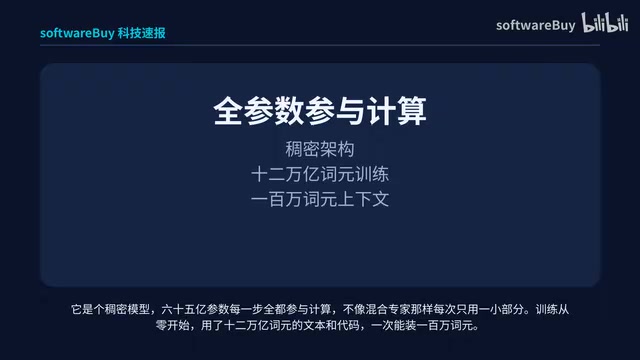
A U.S. chip design company released Ripple-65B, a 6.5B-parameter dense model trained from scratch on 12T tokens with a 1M-token context window, open-sourced under Apache 2.0 for commercial use. It scored 80.52 on a terminal coding test, beating a 50.1B rival, but scores are self-reported and it ranks first in only 3 of 22 comparisons. Training reportedly cost $32M with five people; a 4-bit version runs on NVIDIA DGX Spark.
The Big Ambitions of a Small Model: Ripple-65B Arrives
According to a tech news video on Bilibili, a U.S. chip design company has released its first public large model, Ripple-65B. It is a 6.5-billion-parameter dense model, meaning all parameters participate in computation at every inference step, unlike a mixture-of-experts (MoE) architecture that activates only a small subset each time. The model was trained from scratch on 12 trillion tokens of text and code, has a context window of 1 million tokens, and releases its weights under the Apache 2.0 license, so anyone can download and use it commercially without paying licensing fees.
The release drew attention mainly because it attempts to prove that, on specific tasks, a small-parameter model can—through high-quality data and training strategies—challenge or even surpass much larger rivals.
The difference between dense models and mixture-of-experts (MoE) architectures deserves elaboration. A dense model means every layer's full parameter set participates in the forward pass at inference, so the compute cost of a single inference is roughly proportional to parameter count. An MoE model sets up multiple expert networks per layer and activates only a few of them via a routing mechanism, achieving "large total parameters, smaller activated parameters"—for example, hundreds of billions of total parameters with only tens of billions activated each time. Dense models offer simple structure, deterministic inference behavior, and predictable memory usage, making quantization and local deployment easier; the downside is limited knowledge capacity at equivalent activated compute. Ripple-65B's choice of the dense route is consistent with its positioning as local-deployment-friendly.
Context window refers to the total number of tokens a model can process in a single inference, including input prompts and generated content. One million tokens is roughly equivalent to hundreds of thousands of Chinese characters or thousands of pages of documents, allowing the model to read an entire code repository or a long log in one pass. Note, however, that the effective usable context length (often called "effective context length") is usually shorter than the nominal value, and attention computation grows with length, creating memory and latency pressure; in practice, deployment often requires position encoding extrapolation, sliding windows, or retrieval augmentation.
Strong Coding Test Results, But Keep a Level Head
Ripple-65B's biggest selling point is its coding ability. On a terminal coding test, it scored 80.52, surpassing a rival model with 50.1 billion parameters and leading other open-source models seven to eight times its size.
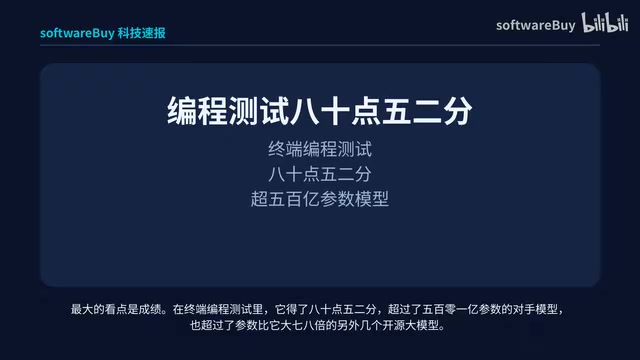
However, the video also clearly notes that these scores are self-reported by the publisher and have not been independently verified. Moreover, of all 22 comparisons, Ripple-65B ranks first in only three; on the standard bug-fixing test, it still trails the 50-billion-parameter rival. This shows its advantage is concentrated in some coding scenarios rather than being a sweeping victory. For developers, selection should still be validated against their own tasks.
Cost and Team: Five People, $32 Million
Cost is another highlight. The publisher claims the entire development cost only $32 million, which they say is less than one-tenth of the previous best result for open-source coding models. The core team consists of just five people.
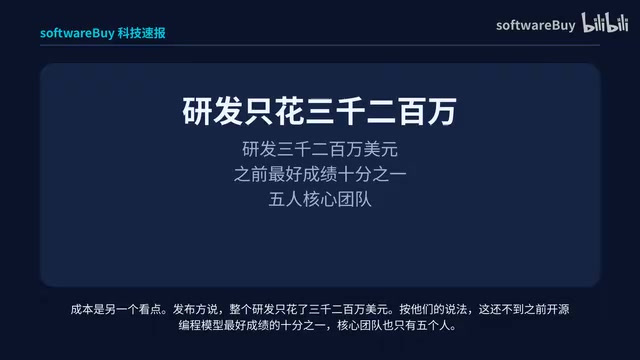
If this figure is accurate, it signals that with the right compute and data strategy, small teams can also build competitive domain-specific models. Of course, the low-cost claim also needs independent verification, but it at least offers the industry a reference path of "small but refined."
Local-Deployment Friendly, Clean Apache 2.0 Licensing
The 4-bit quantized version of Ripple-65B can fit into a single NVIDIA DGX Spark personal device, letting developers run it locally without renting an entire data center's compute.

The Apache 2.0 license means the weights can be freely downloaded, modified, and used commercially, with no licensing fees for product integration. For teams wanting to deploy coding assistants privately, this lowers compliance and cost barriers. The dense architecture is also relatively simple at inference, making optimization and porting easier.
4-bit quantization is a technique that compresses model weights from the common 16-bit floating point to roughly 4-bit integers or low-bit floats per parameter, reducing memory usage to about one-quarter. A 6.5-billion-parameter model after 4-bit quantization has weights of about 3–4 GB, so it can fit on a personal device. Common methods include GPTQ, AWQ, post-training quantization, and quantization-aware training; the cost is usually a small accuracy drop, and on numerically sensitive tasks like code, the degradation must be measured in practice. It's important to distinguish that quantization only compresses weight storage and computation precision—it does not reduce parameter count or change the dense architecture's inference path.
Real Skill or a Victory of Test Methodology?
A 6.5-billion-parameter model surpassing 50 billion parameters sounds counterintuitive. It's important to recognize that model capability depends not only on parameter count but also on training data quality, task alignment, and benchmark match. Ripple-65B's high score on the terminal coding test may partly stem from a high proportion of code in its training data and a task distribution close to the benchmark. But its lag on the bug-fixing test, and the fact that it ranks first in only three categories, shows its capability boundaries are clear.
For developers, the pragmatic approach is to note its open-source weights and local deployment potential, and run small-scale evaluations in real projects. For the industry, Ripple-65B is another reminder that beyond the parameter race, data efficiency and training strategy also determine a model's value. As for whether this is "a victory of test methodology," we await independent reproduction and third-party evaluation for the answer.
One-line Summary
A five-person team trained the 6.5B-parameter dense model Ripple-65B for $32 million; coding test results are impressive but need independent verification.
Paragraph Summary
A U.S. chip design company released its first public large model, Ripple-65B, a 6.5-billion-parameter dense architecture trained from scratch on 12 trillion tokens of text and code, with a 1-million-token context window and open-source weights under Apache 2.0 allowing commercial use. Its biggest selling point is coding ability: it scored 80.52 on a terminal coding test, surpassing a 50.1-billion-parameter rival and open-source models seven to eight times its size. But the article cautions that these scores are self-reported, it ranks first in only three of 22 comparisons, it still trails on bug-fixing tests, and its advantage is concentrated in some scenarios rather than sweeping. On cost, the publisher says development took only $32 million with a five-person core team; the 4-bit quantized version can run locally on an NVIDIA DGX Spark. The article sees this as a reference for a "small but refined" vertical model path, though conclusions still need independent reproduction and verification.
Related articles
 Tech Frontiers
MuJoCo: An Analysis of DeepMind's Open-Source General-Purpose Physics Simulator
An in-depth analysis of Google DeepMind's open-source physics simulator MuJoCo: high-performance C++ kernel, MJCF modeling format, contact solving principles, MJX GPU acceleration, and robot reinforcement learning use cases.
 Tech Frontiers
Claude API Quick Start: The Official Quickstarts Project Collection
Anthropic's official claude-quickstarts project collection helps developers quickly build deployable apps with the Claude API. Nearly 20k stars, Python-based, great for beginners and prototyping.
 Tech Frontiers
AI Agents Connecting Directly to APIs: Which Calls Can Be Safely Allowed?
AI agents can call any API, but the real challenge is deciding which calls can be safely allowed. This article analyzes allowance decisions from three dimensions—intent matching, least privilege, and controllable impact—and argues that the control layer should sit outside the agent, combined with audit traceability to build a trustworthy API call governance mechanism.