Claude API Quick Start: The Official Quickstarts Project Collection
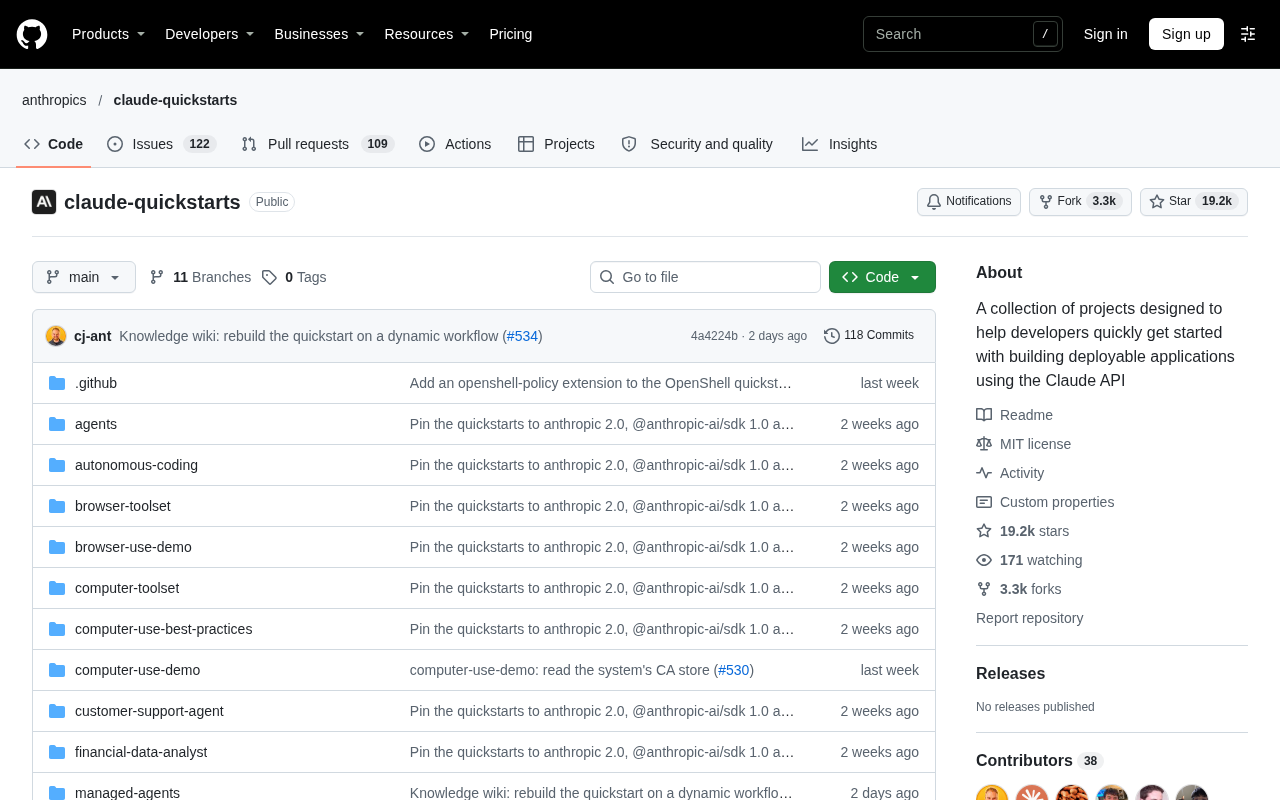
Anthropic's official claude-quickstarts collection helps you skip environment setup and quickly build Claude API apps.
claude-quickstarts is Anthropic's official collection of Python example projects designed to help developers quickly get started building deployable applications with the Claude API. With 19175 stars and 3262 forks on GitHub and ongoing growth, it has strong community interest. Its core value is providing complete deployable projects rather than scattered code snippets, bridging the gap between API documentation and real applications; official maintenance ensures sync with API versions and reduces the risk of outdated examples. It's suitable for developers new to the Claude API, teams needing rapid prototyping, and engineers wanting to learn official best practices. When using it, match your Python environment and SDK version, read the subproject docs, and avoid copying code directly into production.
Claude API Quick Start: The Official Quickstarts Project Collection
Want to build deployable applications with the Claude API but stuck on the first step? Anthropic's officially open-sourced claude-quickstarts project collection might help you skip environment setup and architecture exploration and jump straight into feature development.
The project has already gained 19175 Stars and 3262 Forks on GitHub, and is still growing with 28 stars today, showing it continues to attract developer attention.
Project Positioning and Scale
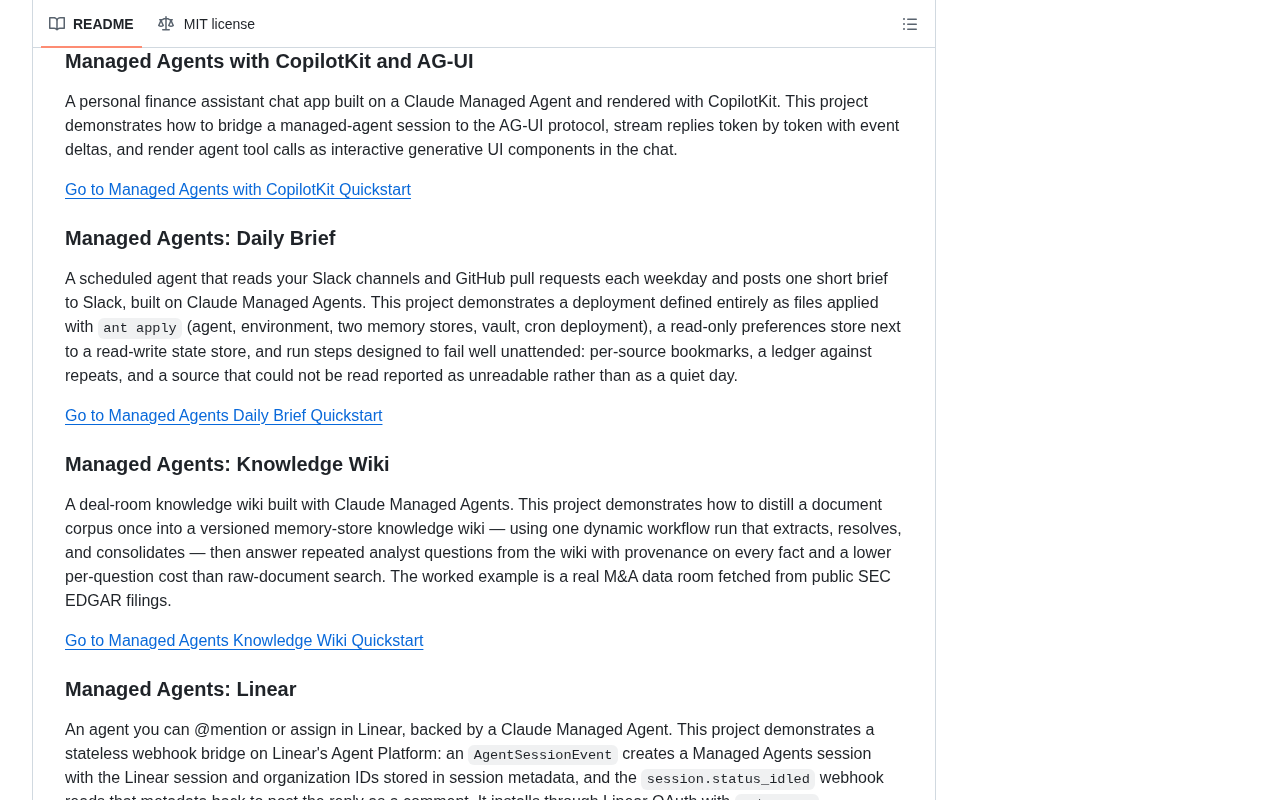
claude-quickstarts is a collection of example projects maintained by Anthropic, with a clear goal: to help developers quickly get started building deployable applications with the Claude API. The primary language is Python, which naturally fits the Anthropic SDK ecosystem.
With nearly 20,000 stars, it ranks high among official example repositories, reflecting the community's strong demand for resources that combine "official backing + runnable code." The 3262 forks mean many developers aren't just browsing—they're actually pulling the code for secondary development.
Anthropic SDK is the official client library provided by Anthropic for calling the Claude API in applications. It encapsulates low-level logic such as HTTP request details, authentication, error handling, and streaming responses, allowing developers to send messages, invoke tools, and conduct multi-turn conversations with concise Python code. SDK version iterations are closely tied to API feature updates, so example projects typically pin compatible SDK version ranges in their dependency files. When using claude-quickstarts, understanding the SDK's basic calling patterns (such as initializing the client, constructing the messages list, and handling returned content) is a prerequisite for reading the example code.
Why It's Worth Your Attention
Bridging the Gap from Documentation to Product
API documentation tells you how to pass each parameter, but it doesn't tell you what a complete application should look like. Quickstarts fills exactly this gap—it provides deployable projects, not just code snippets. For teams that need to quickly validate ideas, this can significantly shorten the path from prototype to a runnable system.
The essential difference between a deployable application and a code snippet is that the former includes a complete project structure, dependency declarations, configuration management, entry points, and runtime environment assumptions. A deployable Claude API example typically needs to handle environment variable injection for API keys, request timeouts and retries, frontend integration for streaming output, and basic service startup scripts. These engineering details are often not covered in API documentation, yet they are exactly where developers get stuck between "getting a single call to work" and "delivering a usable service." Quickstarts organizes these pieces in advance so developers can focus on business logic rather than scaffolding.
Reliability of Official Maintenance
Third-party tutorials tend to become outdated, while official repositories usually stay in sync with API versions. For production dependencies, this consistency is valuable in itself. Developers don't need to worry about example code falling out of step with the latest SDK behavior.
A Signal Validated by the Community
Nearly 20,000 stars and over 3,000 forks constitute a community filtering signal. Although star counts don't fully represent code quality, attention at this scale shows the repository has real reference value among developers—especially in the fast-iterating field of AI application development.
Who It's For
- Developers new to the Claude API: Understanding the API's actual calling patterns through complete projects is more efficient than reading documentation item by item.
- Teams that need rapid prototype validation: Build directly on the example projects and save scaffolding time.
- Engineers who want to learn official best practices: Observe the architecture and code organization recommended by Anthropic.
Usage Tips
Since the repository is primarily Python, make sure your local Python environment matches the Anthropic SDK version first. After pulling the code, read each subproject's documentation first to understand its dependencies and configuration requirements, then tailor it to your own business scenario. Don't copy all the code directly into production—the point of example projects is to demonstrate calling patterns, not to provide production-grade security and operations solutions.
Production-grade security and operations solutions typically include: hosting API keys in a secrets management service rather than plaintext environment variables, request rate limiting and quota control, content filtering and audit logging for inputs and outputs, error monitoring and alerting, and continuous scanning for dependency vulnerabilities. To keep things simple, example projects often omit these layers or handle them only minimally. When migrating example code to production, you need to additionally evaluate dimensions such as authentication, data persistence, concurrency handling, and cost control—don't assume the default configurations in examples are suitable for real traffic scenarios.
Summary
The value of claude-quickstarts isn't in how complex the code is, but in how it turns the abstract question of "how to build an application with the Claude API" into concrete, directly runnable projects. For developers evaluating or already using the Claude API, it's a starting point worth bookmarking.
One-line Summary
Anthropic's official claude-quickstarts project collection helps you skip environment setup and quickly build Claude API applications.
Paragraph Summary
claude-quickstarts is a collection of Python example projects maintained by Anthropic, designed to help developers quickly get started and build deployable applications with the Claude API. The project has 19175 stars and 3262 forks on GitHub and continues to grow recently, indicating high community interest. Its core value lies in providing complete deployable projects rather than scattered code snippets, bridging the gap between API documentation and real applications; official maintenance ensures synchronization with API versions and reduces the risk of outdated examples. The project is suitable for developers new to the Claude API, teams needing rapid prototype validation, and engineers who want to learn official best practices. When using it, first match your Python environment and SDK version, read the subproject documentation, and avoid copying code directly into production.
Related articles
 Tech Frontiers
MuJoCo: An Analysis of DeepMind's Open-Source General-Purpose Physics Simulator
An in-depth analysis of Google DeepMind's open-source physics simulator MuJoCo: high-performance C++ kernel, MJCF modeling format, contact solving principles, MJX GPU acceleration, and robot reinforcement learning use cases.
 Tech Frontiers
AI Agents Connecting Directly to APIs: Which Calls Can Be Safely Allowed?
AI agents can call any API, but the real challenge is deciding which calls can be safely allowed. This article analyzes allowance decisions from three dimensions—intent matching, least privilege, and controllable impact—and argues that the control layer should sit outside the agent, combined with audit traceability to build a trustworthy API call governance mechanism.
 Tech Frontiers
Prank Script 'Ram Altman' Emails Sam Altman Daily to Report Idle RAM
The viral Linux script "Ram Altman" emails OpenAI CEO Sam Altman daily to report idle RAM. We break down its technical implementation, the community prank culture, and the AI compute anxiety behind it.