6 Claude AI Agents Build a Complete Plugin in 5 Minutes: Multi-Agent Collaboration in Practice

6 Claude AI agents collaboratively built a complete plugin in 5 minutes, demonstrating multi-agent orchestration.
An open-source project demonstrates 6 Claude Opus 4.6 AI agents building a complete plugin in 5 minutes, followed by 6 more agents writing 5,298 lines of documentation in 4 minutes. The project showcases agent team orchestration, task dependency management, and parallel AI coordination—pointing toward a future where multi-agent systems redefine software development workflows.
Project Overview
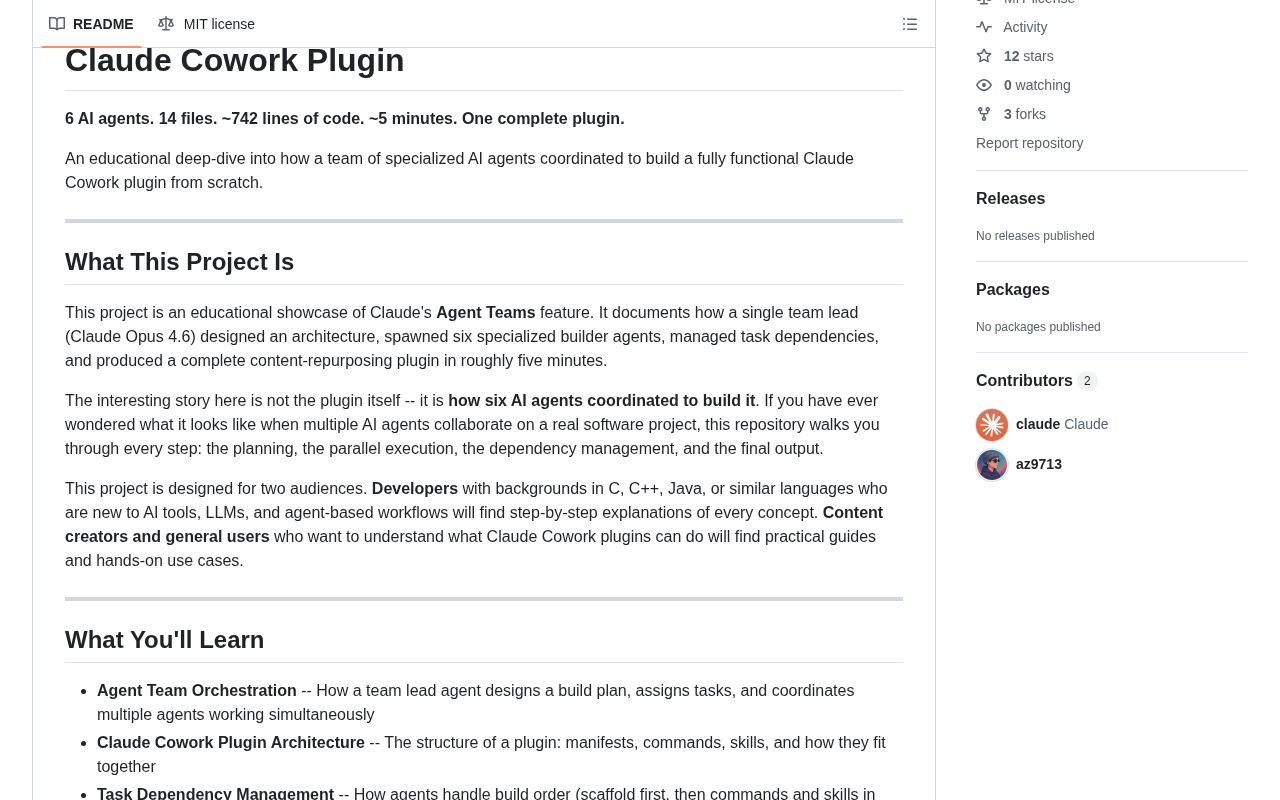
An open-source project called claude-cowork-content-plugin has recently gained attention on GitHub. The project showcases an impressive experiment: 6 Claude Opus 4.6 AI agents collaboratively built a complete Claude Cowork plugin in 5 minutes, followed by another 6 agents writing 5,298 lines of documentation in 4 minutes. This is not just a functional project—it's an educational demonstration of multi-agent collaborative orchestration.
Core Highlight: Multi-Agent Parallel Collaboration
Extreme Development Efficiency
In traditional software development, building a complete plugin from coding to documentation typically takes days or even weeks. In this project, the entire process was compressed to under 10 minutes:
- Phase 1: 6 AI agents working in parallel completed the plugin's core code development in 5 minutes
- Phase 2: 6 AI agents collaboratively wrote 5,298 lines of high-quality documentation in 4 minutes
This efficiency gain isn't simply about "having AI write code"—it's systematic collaboration achieved through carefully designed task orchestration and dependency management.
Three Technical Pillars
The project demonstrates three key technical capabilities of multi-agent systems:
- Agent Team Orchestration: How to decompose a complex task into multiple subtasks and assign them to different AI agents
- Task Dependency Management: Ensuring tasks with sequential dependencies execute in the correct order
- Parallel AI Coordination: Enabling multiple agents to work simultaneously without conflicts
Technical Architecture Analysis
Why 6 Agents?
The choice of 6 agents wasn't arbitrary. In software development, a plugin can typically be decomposed into multiple relatively independent modules—API layer, data processing layer, UI components, configuration management, test cases, integration logic, etc. Each agent is responsible for a relatively independent module, achieving inter-module collaboration through clearly defined interfaces.
Parallelization of Documentation Generation
Completing 5,298 lines of documentation in 4 minutes means each agent produced approximately 220 lines per minute on average. This documentation likely includes different types of content such as API reference docs, user guides, architecture descriptions, configuration docs, contribution guidelines, and changelogs—with each agent handling its own specialty.
Industry Significance and Insights
Maturation of Multi-Agent Systems
This project represents an important trend in AI development tools: the evolution from single AI assistants to multi-agent collaborative systems. Current mainstream AI programming assistants (like GitHub Copilot and Cursor) primarily operate in single-agent mode, while multi-agent collaboration demonstrates higher-level automation possibilities.
Redefining the Development Process
If multi-agent collaboration can reliably complete work in minutes that previously took days, the bottleneck in software development will shift from "coding implementation" to "requirements definition" and "architecture design." The developer's role will increasingly move toward system architect and AI orchestrator.
Limitations and Considerations
Of course, we should view these results rationally:
- The project currently has 12 Stars and 3 Forks, still in its early stages
- Code quality and the plugin's actual usability need further verification
- The complexity of a plugin built in 5 minutes may be limited
- The reliability of multi-agent collaboration in larger-scale projects remains to be proven
Future Outlook
Multi-agent collaborative development is moving from proof of concept to practical application. As the capabilities of large models like Claude and GPT continue to improve, and as agent orchestration frameworks mature, we may soon see more production-grade multi-agent development tools emerge. While this project is modest in scale, it clearly demonstrates the enormous potential of this direction—AI can not only assist with programming but also autonomously complete complex software engineering tasks as a team.
Related articles
 Tech Frontiers
A Rare Quiet Day in AI: Recursive Self-Improvement Stirs Beneath the Surface
A rare quiet day in AI sees multiple sources go silent simultaneously. Behind the calm, Recursive Self-Improvement (RSI) research continues. What this means for the industry.
 Tech Frontiers
Reve 2 vs. Ideogram 4: A Deep Dive into Layout Control in AI Image Generation
A deep comparison of Reve 2 and Ideogram 4's layout control capabilities, covering technical approaches, real-world use cases, and industry trends for designers and creators.
 Tech Frontiers
In the Weights: Check Your Influence Score in the AI World
In the Weights is an AI influence search engine that quantifies your presence in the AI world with a score. Explore how it evaluates practitioners and what it means for digital identity.