7.72TB Fake Anthropic Model Reverse-Engineered and Exposed

A 7.72TB claimed Anthropic leaked model was forensically proven to be pseudorandomly generated, not trained.
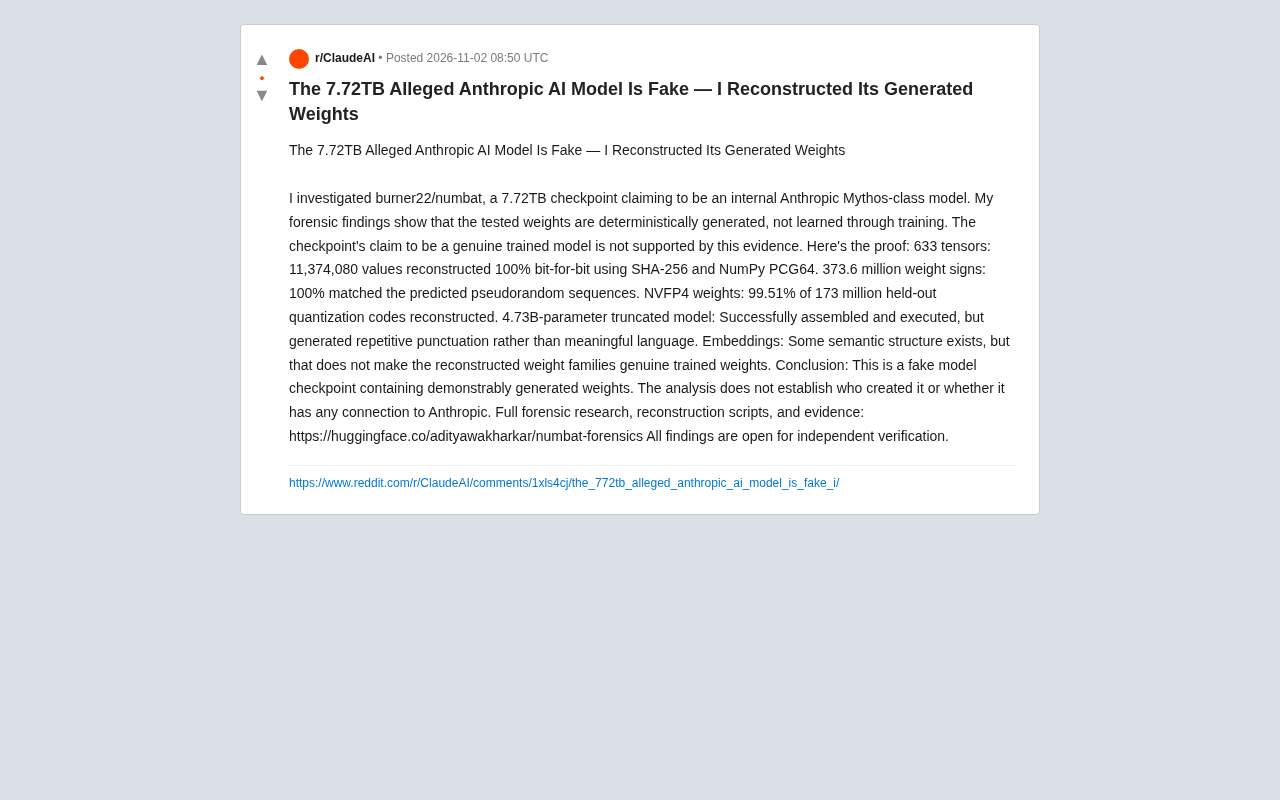
A checkpoint labeled at 7.72TB and claimed to be an Anthropic internal Mythos-class model circulated in the community. Researcher adityawakharkar used SHA-256 and NumPy's PCG64 PRNG to perform reverse forensics on the weights, reconstructing 633 tensors totaling 11,374,080 values with 100% bit-for-bit accuracy, with 373.6 million weight sign bits fully matching the pseudorandom sequence. The model truncated to 4.73B parameters runs but only outputs repeated punctuation. Some embeddings show semantic structure, but that is insufficient to prove real training. The checkpoint is forged, though the forger and any Anthropic link remain unproven; all scripts are public for verification.
A model checkpoint labeled at 7.72TB has been circulating in the community, claimed to be a leak of an Anthropic internal Mythos-class model. A researcher performed forensic analysis on it and concluded: these weights were not trained — they were "manufactured" with a pseudorandom number generator.
Background: A Giant Checkpoint Claimed to Come from Anthropic
The repository in question is burner22/numbat, 7.72TB in size, self-described as an Anthropic internal Mythos-class model. A checkpoint of this scale is extremely rare in the open-source community, and combined with the "internal model leak" narrative, it easily attracts attention and sharing.
Researcher adityawakharkar did not stop at speculation, but instead performed reverse forensics directly on the weights: using deterministic methods to attempt to reconstruct these tensors, to see whether they could be fully reproduced algorithmically. If the weights truly came from training, it would be impossible to restore them bit-for-bit from a pseudorandom sequence.
Forensic Method: "Replicating" Weights with a Generator
The core idea of the analysis is to verify the reproducibility of the weights. The researcher's approach was to use SHA-256 and NumPy's PCG64 pseudorandom number generator to attempt to derive the values in the checkpoint from a seed, then compare them bit-for-bit against the original weights.
According to the published forensic results, the key evidence includes:
- 633 tensors, totaling 11,374,080 values, were reconstructed with 100% bit-for-bit accuracy;
- 373.6 million weight sign bits matched the predicted pseudorandom sequence 100%;
- Among NVFP4 quantized weights, 99.51% of 173 million held-out quantization codes were reconstructed;
- The model truncated to 4.73B parameters could be successfully assembled and run, but its output was repeated punctuation rather than meaningful language.
This set of data points clearly: the weight distribution matches the characteristics of pseudorandom generation, not the statistical structure left by gradient descent during training.
The PCG64 pseudorandom number generator is NumPy's default random number engine, belonging to the PCG (Permuted Congruential Generator) family. It produces a base state from a linear congruential generator, then scrambles the bits through output functions such as permutation and XOR shifts, yielding a random sequence with good statistical quality and an extremely long period (about 2^128). PCG64's determinism means that given the same seed and call order, the output bitstream is fully reproducible. This is precisely the technical premise that enables forensic analysis to reconstruct weights bit-for-bit — if a forger uses PCG64 to generate tensor values, the researcher only needs to guess the seed and generation logic to restore an identical sequence.
NVFP4 is a 4-bit floating-point quantization format proposed by NVIDIA, mainly used for efficient storage and computation of large model weights on Blackwell architecture GPUs. It represents a value with 4 bits, including 1 sign bit, 2 exponent bits, and 1 mantissa bit, combined with block-level scaling factors to extend dynamic range. Compared with FP8 or INT4, NVFP4 strikes a new trade-off between precision and memory footprint. In a forgery scenario, quantization codes can likewise be generated pseudorandomly, so the high reconstruction rate of held-out quantization codes further corroborates that the weights did not come from a real post-training quantization process.
The Only "Real"-Looking Part: Semantic Structure in Embeddings
There is one easily misinterpreted detail in the analysis: some embeddings do exhibit a certain semantic structure. This looks like evidence that "the model was trained," but the researcher explicitly points out that the existence of semantic structure is not sufficient to prove that these reconstructed weight families came from real training.
One reasonable explanation is that the generator adopted some structured initialization or mapping when constructing embeddings, causing observable clustering phenomena to appear in vector space. But the overall reproducibility of the weights is the decisive indicator for determining authenticity — truly trained weights cannot be restored bit-for-bit from a pseudorandom sequence.
Semantic structure in embeddings typically refers to the fact that semantically similar tokens are close to each other in word vector space — for example, the vectors for "cat" and "dog" have a small angle between them and can support analogical operations. In a genuinely trained model, this structure is a byproduct of gradient descent optimization over large corpora. But semantic structure is not an exclusive marker of training: if the generator used structured initialization when constructing embeddings (such as mapping by token frequency or hash buckets), or applied some linear transformation to random vectors, clustering could also appear in dimensionality-reduction visualizations. Therefore, the semantic appearance of embeddings alone cannot distinguish "obtained through training" from "structured generation"; judgment must be combined with the overall reproducibility of the weights.
Conclusion and Boundaries: A Fake Checkpoint, but the Source Remains Undetermined
The researcher's conclusion is: this is a forged model checkpoint, whose weights can be proven to have been generated rather than trained.
At the same time, the boundaries of the evidence are clearly drawn: the existing analysis does not establish the identity of the forger, nor does it prove any connection between the checkpoint and Anthropic. This point is important — proving "the model is fake" and proving "who made the fake" are two different things; the former already has sufficient evidence, while the latter remains an open question.
All forensic research, reconstruction scripts, and evidence have been published in the Hugging Face repository adityawakharkar/numbat-forensics for independent verification. This open-forensics approach itself deserves recognition: the conclusion can be tested by anyone re-running the scripts, rather than remaining a one-sided assertion.
A Reminder for the Model Community
This incident exposes an underestimated risk in the large-model ecosystem: the size and naming of a checkpoint can easily manufacture credibility. A terabyte-scale file size, the name of an internal project, plus a plausible-looking model architecture, are enough to make some people believe in its authenticity.
For developers who download and use weights of unknown origin, the lesson from this case is direct: size does not equal authenticity, and weight files require a verifiable chain of provenance. For "leaked models" claimed to come from closed-source labs, the default stance should be skepticism in the absence of independent forensics.
The maturation of forensic toolchains also makes this kind of forgery harder to hide — as long as the weights are algorithmically generated, there is a possibility of reverse reproduction. This is a deterrent to forgers and a protection for the community.
One-line Summary
A 7.72TB Anthropic leaked model was forensically proven to be pseudorandomly generated, not trained.
Paragraph Summary
A checkpoint labeled at 7.72TB and claimed to be an Anthropic internal Mythos-class model circulated in the community. Researcher adityawakharkar used SHA-256 and NumPy's PCG64 pseudorandom number generator to perform reverse forensics on the weights, successfully reconstructing 633 tensors totaling 11,374,080 values with 100% bit-for-bit accuracy, with 373.6 million weight sign bits fully matching the pseudorandom sequence. Although the model truncated to 4.73B parameters could run, it only output repeated punctuation. Some embeddings exhibited semantic structure, but this was insufficient to prove the weights came from real training. The conclusion is that the checkpoint was forged/generated, but the forger's identity was not determined, nor was any connection to Anthropic proven; all scripts have been made public for independent verification.
Related articles

Glasshand: Giving AI Agents a Real iPhone and Mac
Glasshand lets AI agents rent real iPhones and Macs, supporting Claude Code, Codex, and more to post, book services, and test iOS apps on real devices. This article explains how it works, its use cases, and potential boundaries.

ChatGPT Images 2.6 Released: GIF Generation, Reference Image Reuse, and 50% Speed Boost
ChatGPT Images 2.6 released: prompt-to-GIF animation with frame-by-frame editing, reusable reference images for yourself, pets, or characters, 50% faster generation, plus Flare and Sunburst API model variants and SVG export for developers.

Rerun: Turn Your AI Subscription into an AI Coworker Team
Rerun, #3 on Product Hunt, turns your ChatGPT or Claude subscription into a team of AI coworkers that run on schedules or triggers, each with tools, a computer, and a shared workspace. It asks before risky actions, is open source (AGPL v3), and supports self-hosting.