Glasshand: Giving AI Agents a Real iPhone and Mac

Glasshand lets AI agents rent real iPhones and Macs in data centers to execute operations via a prompt.
Glasshand is the top-ranked new product on Product Hunt. It lets AI agents such as Claude Code and Codex rent real iPhones or Macs in a data center — not emulators or VMs — via a single prompt. Each device is exclusively used by one user during the rental period and wiped afterward. It targets hardware behaviors emulators struggle to reproduce, covering social posting, travel booking, and real-device iOS testing, though compliance and reliability still need validation.
AI Agent capabilities are extending beyond pure software environments into physical devices. Glasshand, the top-ranked new product on Product Hunt, proposes a bold solution: let agents rent a real iPhone or Mac and operate the device just like a human would.
What Is Glasshand
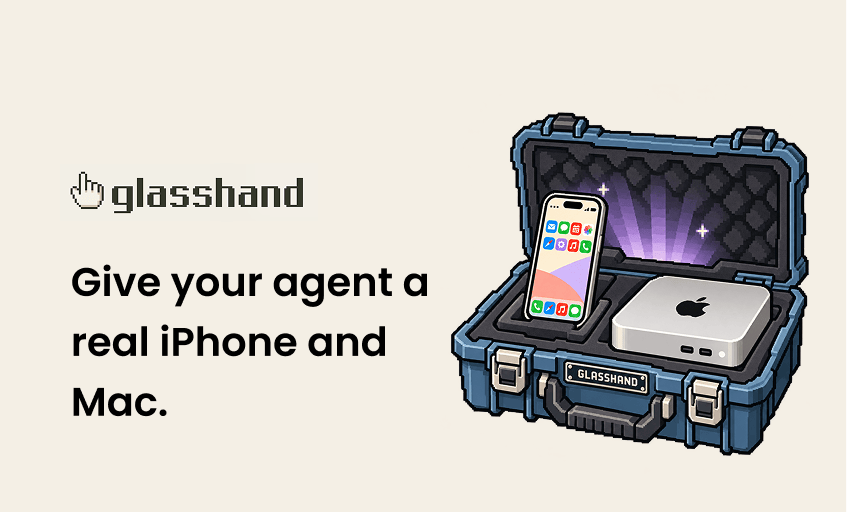
The core positioning of Glasshand can be summed up in one sentence: equip your AI Agent with a real iPhone and Mac. According to the Product Hunt description, users can connect Claude Code, Codex, or any other agent to Glasshand and then rent a device with a single prompt.
These are not emulators or virtual machines — they are physical devices actually hosted in Glasshand's data centers. Agents use them exactly as human users would — posting on TikTok, booking an Uber, or building and testing iOS apps. Each device is exclusively used by a single user during the rental period; after the rental ends, data is wiped and the device is restored to factory settings.
The product received 154 votes and 38 comments on Product Hunt, ranking first for the day, with category tags Productivity, Artificial Intelligence, and Apple.
Why Agents Need Real Devices
The Limits of Emulators
Most agent toolchains currently run in controlled software environments. For web applications, browser automation is relatively mature; but once native mobile or desktop apps are involved, emulators often cannot fully replicate real device behavior. Factors such as push notifications, biometrics, specific hardware sensors, and carrier network status are difficult to trigger reliably in emulated environments.
Glasshand's approach is to bypass these uncertainties: since the agent ultimately needs to operate real apps on real devices, just give it a real device.
Differences between emulators and real devices: The iOS Simulator (such as Xcode Simulator) runs on macOS and is essentially process-level virtualization sharing the host kernel. It does not emulate the ARM instruction set, nor does it include hardware components such as the baseband, cellular network, GPS, or gyroscope. Therefore, capabilities that depend on real hardware and the Secure Enclave — push notifications (APNs), Face ID/Touch ID, camera, Bluetooth, NFC, and more — cannot be fully reproduced in the simulator. Although Android emulators perform full-system virtualization based on QEMU, they likewise struggle to reproduce carrier network switching, sensor noise, and behavioral differences in vendor-customized ROMs. This is precisely why real-device cloud testing services (such as BrowserStack and Firebase Test Lab) have long existed; Glasshand can be seen as extending this idea from "testing" to "autonomous agent operation."
From "Generating Content" to "Executing Actions"
The value of agents is shifting from content-generation tasks like assisted writing and code completion to completing concrete operations on behalf of users. Posting a social media update, hailing a ride, or running a round of real-device tests — these actions all require the agent to interact within real app interfaces. Glasshand packages this capability into rentable infrastructure, lowering the barrier for individual developers or teams to set up real-device environments.
How agents operate: There are currently two main technical approaches for having agents operate graphical interfaces. The first is structured interfaces based on the accessibility tree or DOM, reading control semantics and then directly triggering actions — stable, but powerless against apps that do not expose semantics. The second is a pure vision approach: take a screenshot, have a multimodal model locate coordinates, and simulate clicks, swipes, and input — highly general but affected by resolution, latency, and misclick rates. On a real iPhone, the latter usually also requires a remote control channel via WebDriverAgent or similar tools. Glasshand has not disclosed its specific implementation, but the phrase "operate like a human" suggests it is closer to the vision-plus-input-simulation approach, which also means its success rate and latency will become key metrics.
How It Works and Key Design Choices
According to the official description, Glasshand's workflow can be broken down into several steps:
- Connect an agent: Supports Claude Code, Codex, and other compatible agent frameworks, with device rental triggered via a prompt.
- Exclusive use: Each device belongs to only one user during the rental period, avoiding state interference between tenants.
- Data isolation: After the rental ends, data is wiped and factory settings restored, providing a clean environment for the next rental.
This design makes a clear trade-off between convenience and security: convenience in that the agent does not need to care where the device comes from or how it is maintained; security relying on the reset process after the rental ends. For scenarios involving account logins, users need to assess for themselves the risk of handing credentials to an agent to operate.
Use Cases and Potential Boundaries
Based on the examples listed officially, Glasshand's target scenarios fall into three categories:
- Social media operations: Let agents publish content in real apps, avoiding missing functionality or risk-control restrictions on the web.
- Life service operations: Tasks such as booking travel and placing orders that require a real app environment.
- iOS development and testing: Build and validate apps on real devices, covering hardware-related behaviors that emulators struggle to reproduce.
It is worth noting that having agents operate third-party apps on real devices may run afoul of platform terms of service. Whether automated operation of social media or travel apps is permitted depends on each platform's specific rules, and this point is not elaborated in the product description.
Platform terms and automation risks: Major platforms generally restrict unauthorized automated access in their user agreements. For example, Meta's and TikTok's developer terms require content to be published through official APIs, and scripted operations that bypass the API may trigger risk controls or even account bans; service terms for Uber and similar platforms likewise prohibit placing orders using bots or scripts. Because an agent operating on a real device looks nearly indistinguishable from a real person's device to the platform, this both lowers the probability of detection and means that, if rules are violated, the risk falls on the user who lent the account. Before adopting such solutions, enterprises typically need to assess exposure in three areas: loss of account assets, compliance audits, and data protection (such as credential custody).
Judgment from Multiple Perspectives
Currently, public information about Glasshand comes mainly from the Product Hunt product page and official descriptions, and independent third-party hands-on reports are still limited. Looking at the quantitative community feedback, 154 votes and 38 comments indicate it gained attention in its early launch period, but the specific content of the comments is not presented in the available material, so evaluations of the actual experience should still be made cautiously.
What can be confirmed: the product positioning is clear, the hardware genuinely exists and is hosted in data centers, and the rental and reset processes are clearly described. As for the agent's success rate operating on real devices, latency performance, and the long-term cost structure, more first-hand testing is needed to verify.
Conclusion
Glasshand addresses a real pain point in agent deployment — acquiring and maintaining real device environments. It turns real devices into an on-demand rentable resource, enabling agents to move from "being able to talk" to "being able to do." This direction is worth watching, but its performance on platform compliance and practical reliability still awaits more public validation.
One-line Summary
Glasshand lets AI agents rent real iPhones and Macs in data centers to execute operations via a prompt.
Paragraph Summary
Glasshand is the top-ranked new product on Product Hunt. Its core idea is to let AI agents such as Claude Code and Codex rent real iPhones or Macs in a data center — not emulators or virtual machines — via a single prompt. Each device is exclusively used by one user during the rental period and is wiped and restored to factory settings afterward. The product targets the pain point that emulators struggle to reproduce hardware behaviors such as push notifications, biometrics, and sensors, covering three scenarios: social media posting, booking travel, and real-device iOS build testing. The article argues that its positioning is clear and addresses the need for real device environments in agent deployment, but platform terms-of-service compliance, operation success rates, and cost structure still lack third-party hands-on validation.
Related articles
 Tech Frontiers
Sherlock: An Open-Source Tool for Tracking Usernames Across Social Networks
Sherlock is an open-source Python tool that tracks social accounts across networks by username. This article covers its core features, why developers love it, typical use cases, and privacy compliance considerations.
 Tech Frontiers
GitHub Daily·Nov 07: Agent-Ready and Context Compression
GitHub Trending Nov 07: meta's agent-ready design system astryx, billion-context's 5x context compression, sherlock nearing 100k stars, plus local-first localthings and bare-metal GPU orchestration nvke.
 Tech Frontiers
Buoyant Open-Sources Kinference: An Inference Control Plane for vLLM on K8s
Buoyant open-sources Kinference, an inference control plane for vLLM on Kubernetes, with declarative routing, KV-cache-aware load balancing, and per-tenant metrics—claiming 95% lower median TTFT in official benchmarks.