7 AI Projects in One Year, All Failed: Lessons Learned from Real Mistakes

A programmer built 7 AI-assisted projects in one year—all failed, revealing AI's real limits.
An ordinary programmer used AI tools to complete 7 projects in one year, spanning mini-games, a sci-fi novel, a hardware product, and a HarmonyOS app—none went viral. The article distills lessons from each failure: AI dramatically boosts development speed but cannot compensate for missing demand validation, lack of product focus, context forgetting in long-form creation, or physical constraints in hardware. The only technically successful project—a HarmonyOS app—proved AI's exceptional value for learning new platforms with good documentation.
An ordinary programmer used AI tools to complete 7 projects in one year—from mini-games to a sci-fi novel, from a hardware product to a HarmonyOS app. None went viral, but each failure crystallized real insights about the boundaries of AI capabilities. This isn't a success story—it's a frontline "AI pitfall journal."
Seven Projects, Seven Ways to Fail
Project 1: Virtual Sheep Counting — AI Writes Code Fast, But Can't Save a Bad Idea
Inspired by "cyber-absurdist" culture, the author wanted to build a simple app to help insomniacs count sheep. Using Cursor plus Claude 3.5, the entire logic was up and running in three days: tap the screen, get another sheep.
Technical Background: The Cursor + Claude 3.5 Combination
Cursor is an AI-native code editor deeply rebuilt on top of VS Code. Its core strength lies in embedding large language models directly into the coding workflow. Unlike plugin-based solutions like GitHub Copilot, Cursor supports "multi-file context awareness"—it can understand the structure of an entire codebase simultaneously, not just the current file. Claude 3.5 Sonnet, released by Anthropic in 2024, outperformed GPT-4o on code generation benchmarks (such as HumanEval), excelling particularly at understanding complex instructions and fixing bugs. Together, they represent one of the most efficient AI programming combinations accessible to individual developers in 2024—which is why the author could get the full logic running in three days, a task that would traditionally take at least two to three weeks.
But user feedback was blunt: "Why would I count your sheep?" The premise itself didn't hold up. No amount of development speed can fix that.

Lesson: AI boosts development efficiency 10x, but your product manager can't be "your drunk self." Demand validation should always come before writing the first line of code.
Project 2: Retro Game Bundle — Trying to Do Everything, Achieving Nothing
The second project was a retro game collection. Using AI, the author cranked out Tetris, a shoot-'em-up, an infinite dungeon crawler, and more in one go. The momentum was intoxicating—everything seemed worth adding.
The result was "broad but shallow." Every game had ideas but none were polished. Players came in, tapped around for a minute, and left with two words: not fun.
Lesson: AI lets you move fast, but if you're heading in the wrong direction, speed is useless. Products need focus. One core mechanic polished to perfection beats ten half-baked ones.
Project 3: A 17-Chapter Sci-Fi Novel — AI Writing Long-Form Is Like a Drunk Screenwriter
This time, instead of building a product, the author pivoted to content creation. He outlined a grand sci-fi novel spanning galactic empires, quantum consciousness, and AI rebellion—17 chapters, each around 2,000–3,000 words.
By chapter eight, the AI started forgetting earlier plot points. By chapter twelve, it had changed the protagonist's name. The project was eventually abandoned.
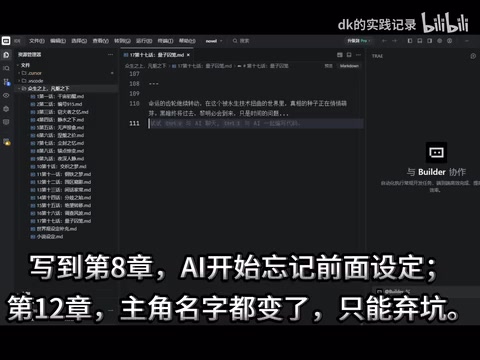
Lesson: AI is impressive for short-form writing, but long-form creation is like working with a drunk screenwriter—he doesn't know where he is. Current large models' context management capabilities are far from sufficient for complex, long-arc narratives. This is why AI-assisted writing currently works better for short pieces, outlines, and brainstorming rather than complete novels.
The Deeper Reason: Context Windows and Attention Decay in Large Models
A large language model's "Context Window" refers to the maximum number of tokens it can process in a single inference pass. GPT-4 Turbo supports 128K tokens, and the Claude 3 series supports up to 200K tokens. This sounds enormous, but a 17-chapter novel with 2,000 words per chapter totals roughly 34,000 Chinese characters—about 50,000 tokens—which should theoretically fit within the window. The real problem is "attention decay"—the Transformer architecture's attention mechanism significantly reduces focus on earlier content when processing very long sequences, causing the model to "forget" prior settings. Additionally, when continuing a conversation without re-injecting the full preceding text, the model's effective usable context shrinks dramatically. This is a shared limitation across all mainstream large models today, and the fundamental technical reason why "AI writing novels" remains an unsolved problem.
Project 4: Car-Mounted Blue Light — AI Can Write Firmware, But Can't Override Physics
After getting a new car that lacked a voice-prompted blue light indicator, the author decided to build one. Using an ESP32 plus a voice module, the prototype worked on the first try. Visions of mass production and profits danced briefly.
Technical Background: ESP32 and AI-Assisted Firmware Development
The ESP32 is a low-cost Wi-Fi/Bluetooth dual-mode SoC chip from Espressif Systems. Thanks to its rich peripheral interfaces, active open-source community, and extremely low unit cost (roughly $1.50–$4 USD), it has become the go-to platform for makers and independent hardware developers worldwide. With AI entering firmware development, developers can describe functional requirements in natural language and have AI generate C/C++ code under the Arduino or ESP-IDF framework, dramatically lowering the barrier to embedded development. However, what AI solves is at the "software logic" level. The real challenges in hardware development come from the physical world: electromagnetic interference in PCB routing, acoustic propagation through enclosure structures, supply chain stability during mass production, and BOM cost control. These constraints cannot be abstracted away by code—they represent boundaries that AI tools currently cannot cross.
But road testing revealed a fatal flaw: with the blue light mounted at the rear of the car, voice commands were inaudible from the driver's seat. Fixing it would require a split-unit design, and the market already had mature OBD-based products. The project was abandoned.
Lesson: Hardware "pitfalls" run deeper than code. AI can help you write firmware and tune parameters, but physical-world constraints—sound propagation, structural design, supply chain costs—can't be solved with a few lines of code.
Project 5: HarmonyOS App — The Only Project That Fully Worked Technically
Turning to the HarmonyOS ecosystem incentive program, the author—a complete HarmonyOS novice—successfully published an app using AI plus official documentation. While it wasn't a commercial success, it was the only project among the seven that fully worked at the technical level.
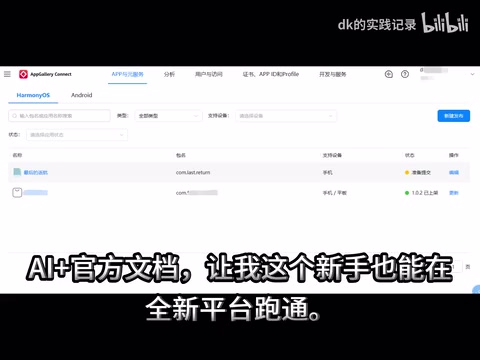
Background: HarmonyOS Ecosystem and AI-Assisted Cross-Platform Development
HarmonyOS is Huawei's self-developed distributed operating system. Its app development primarily uses the ArkTS language (an extension of TypeScript) and the ArkUI framework. For programmers accustomed to Android/iOS or web development, HarmonyOS represents an entirely new programming paradigm and API system. AI's value in this scenario is extremely pronounced: as long as official documentation is sufficiently complete (HarmonyOS developer docs are already quite systematic), AI can serve as a "real-time translator," mapping a developer's existing experience onto the new platform's syntax and APIs. This confirms the core mechanism of AI-assisted learning—it's essentially efficient retrieval and recombination of existing structured knowledge, not creation from nothing. The HarmonyOS incentive program (a traffic and revenue support policy for developers) was also an important factor attracting large numbers of independent developers during 2023–2024.
Takeaway: As long as documentation is comprehensive, AI can turn a complete newcomer into someone capable of shipping on a brand-new platform.
Related articles
 Product Reviews
The Programmer's Desk Setup Guide: Building a Workspace That Feels Like Home
Discover how programmers build productive, comfortable workspaces. From multi-monitor setups to ergonomic design, explore the desk philosophy that drives focus and flow.
 Product Reviews
Qoder vs Cursor Real-World Comparison: Which $20/Month AI IDE Is Better?
Hands-on comparison of Qoder vs Cursor AI IDEs: Agent autonomy, human interaction count, and architecture decisions. Qoder needed only 2 interactions vs Cursor's 8.
 Product Reviews
Cursor Cloud Agent Demo: Eliminating Bottlenecks Across the Entire Software Development Lifecycle
Deep analysis of Cursor's Cloud Agent demo showing how cloud VMs, automated test artifacts, and a full-chain control plane systematically eliminate human bottlenecks across the software development lifecycle.