7-Cent Video AI Takes the Top Spot! Google Gemini Omni Crushes Runway and OpenAI

Google Gemini Omni 1.2 Flash tops the AI video leaderboard with 1,541 ELO at one-fifth the cost of competitors.
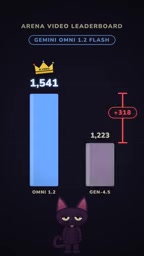
Google's new Gemini Omni 1.2 Flash debuted at the top of the Arena Video leaderboard with 1,541 ELO, leading Runway Gen 4.5 by 318 points and establishing a decisive lead in human blind-test preferences. More importantly, its cost structure: it generates 15-second videos with synchronized speech at one-fifth the price of C-Dance 2.5, an ~80% cost reduction. Meanwhile, Runway itself uses Gemini Omni on Google Cloud, creating a nested coopetition relationship; OpenAI reportedly shut down Sora 2 in September and has no available video API, sitting out this round. The article argues that video AI competition is shifting from pure image quality to a combined efficiency race of "quality + audio + cost," with cloud providers' dual identity reshaping application-layer companies' competitive positions.
Google Storms the AI Video Throne: A Coronation Without OpenAI
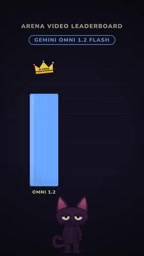
Google has dropped a bombshell in the AI video race. Its new model, Gemini Omni 1.2 Flash, debuted directly at the top of the Arena Video leaderboard, scoring 1,541 ELO and leading Runway Gen 4.5 by a full 318 points. That means in human blind-test preferences, Google's video generation model has established a clear, decisive advantage.
Even more striking to the industry is the cost structure. According to a YouTube analysis channel, the model can generate 15-second video clips with synchronized speech at just one-fifth the cost of C-Dance 2.5. This price comparison reveals a key trend: video generation is shifting from a laboratory race to a contest of cost efficiency.
What ELO 1,541 Means: The Technical Gap Behind the Leaderboard Data
The Arena Video leaderboard uses a blind-test mechanism in which users vote on pairwise comparisons of anonymously generated videos, ultimately producing ELO scores. The number 1,541 needs to be understood within the leaderboard's distribution, but a 318-point lead is enough to make the point—in the ELO system, this typically represents a significant preference gap rather than random fluctuation.
Runway Gen 4.5 is no weakling; it is Runway's latest flagship in video generation. Being pulled this far behind suggests Google may have found a new scaling path in multimodal spatiotemporal modeling. Combined with the "Omni" naming logic consistent across the Gemini series, the addition of synchronized speech capability upgrades video generation from a contest over image quality to a contest over complete content units.
The ELO rating system originates from the rating algorithm used in international chess and has since been widely adopted for model arenas (such as Chatbot Arena and Arena Video). Its core assumption is that when two players face off, the probability of the higher-rated player winning is determined by the rating difference—the larger the gap, the higher the expected win rate. In the standard ELO formula, a 400-point gap corresponds to an expected win rate of about 91%, while 318 points means the higher-rated side has an expected win rate of roughly 88% against the lower-rated side. However, AI leaderboards typically use Bradley-Terry models or online ELO variants for fitting, and confidence intervals exist, so comparing scores alone requires considering the voting sample size. The absolute value of 1,541 is limited in meaning on its own; what is truly informative is its relative distance from other models and whether the score remains stable as new votes come in.
15-Second Synchronized Speech at One-Fifth the Cost: The Lethality of the Pricing Strategy
The cost of video generation has always been the biggest obstacle to moving from demo to commercial use. Gemini Omni 1.2 Flash brings a 15-second clip with synchronized speech to one-fifth the price of C-Dance 2.5—a ratio far more commercially meaningful than benchmark scores alone. For marketing, e-commerce, and social media teams that need to produce short-form video content at scale, an 80% cost reduction means a fundamental change in workflow feasibility.
The integration of synchronized speech also deserves attention. Previously, most video generation models handled audio as a separate step, requiring post-production dubbing or lip-syncing. End-to-end generation of video with speech shortens the chain from prompt to publishable content—precisely the lightweight, high-speed positioning suggested by the "Flash" suffix.
Synchronized speech generation refers to a model producing, end-to-end, an audio track that matches the lip movements, actions, and scene of the video while generating the visuals—rather than first generating a silent video and then dubbing it separately. The traditional pipeline requires multiple independent steps such as text-to-speech (TTS), audio alignment, and lip-sync, each introducing errors and additional costs. End-to-end multimodal generation treats audio as a generation target equal to video frames, jointly modeling them within the same diffusion or autoregressive process, thereby reducing post-production stitching. This capability is particularly critical for scenarios such as marketing short videos, virtual anchors, and educational content, because it directly determines whether content can be "generated once and published immediately."
Runway Runs Gemini Omni on Google Cloud: A Subtle Reversal of the Competitive Landscape
The most intriguing detail comes from the channel level: Runway itself now uses Gemini Omni on Google Cloud. This means competition in video models is no longer a simple head-to-head product battle but a nested relationship at the infrastructure layer. Runway is both Google's competitor and a customer of Google Cloud services—a coopetition dynamic that is becoming increasingly common in the AI industry.

From a business logic perspective, Google is penetrating its competitor's workflow with model capabilities through its cloud platform, gaining both compute revenue and ecosystem leverage. For application-layer companies like Runway, the trade-off between building in-house models and calling external models is becoming a core issue of survival strategy.
Coopetition refers to a state in which companies are simultaneously competitors and collaborators. This relationship is especially common at the AI infrastructure layer: cloud providers both supply compute and model APIs and directly enter the application market through their own models, competing with their application-layer customers. For Runway, training and inference of in-house models require massive GPU resources, while Google Cloud can provide stable compute and ready-made models as a fallback; for Google, selling cloud services to a competitor both spreads infrastructure costs and provides API usage data to understand downstream demand. The risk of this nested relationship is that the differentiation space for application-layer companies will be continuously squeezed by the rapid iteration of upstream model capabilities.
OpenAI's Absence: The Sora 2 Shutdown and the Video API Void
In contrast to Google's high-profile ascent is OpenAI's silence. According to the YouTube channel, OpenAI shut down Sora 2 in September, currently has no available video API, and retains only animated image generation capability. If this claim holds, the top-tier competition in the video generation race has effectively become a game among Google, Runway, C-Dance, and other players.
A note: the channel's description of Google as "killing Sora with a 7-cent model" carries an obvious editorial stance, and OpenAI's strategic adjustment may have undisclosed reasons such as product focus or resource reallocation. But regardless of motive, on public leaderboards like Arena Video, OpenAI's absence is an objective fact, and this has provided a window for Google's ascent.
Video generation APIs are an important channel for commercializing model capabilities. Unlike consumer products, APIs target developers and enterprises, charge by call volume or generation duration, and allow video generation capabilities to be embedded in third-party workflows—such as batch ad production, e-commerce asset generation, and game cutscenes. A usable video API typically needs to meet engineering requirements including stability, latency, concurrency quotas, and content moderation—a far cry from a lab demo. If a vendor shuts down or does not open a video API, it means its capabilities have temporarily exited the B2B integration market, and competitors can seize position in the developer ecosystem. Therefore, "whether an API exists" often reflects a company's true commercial positioning better than "leaderboard ranking."
The Next Battleground in the Video AI War
Three clues can be drawn from this leaderboard shift. First, the competitive dimension of video generation is shifting from pure image quality to a comprehensive efficiency of "image quality + audio + cost." Second, cloud providers, through their dual identity as model and infrastructure providers, are reshaping the competitive position of application-layer companies. Third, although the authority of public leaderboards is limited, they have become an important arena for model releasers to compete for mindshare.
Google took the top spot with a model positioned as Flash, showing that lightweight and low-cost no longer mean compromised performance. For developers and content teams, what deserves attention now is not who won this round, but which content production workflows will be completely rewritten when high-quality video generation drops to a few cents per generation.
Related articles

Codex and AI Coding Agents in Practice: A Complete Guide from Prompts to MCP
A Codex-centered guide to agentic coding: Task-Context-Output prompts, AGENTS.md project memory, plan mode, skills, characterization vs. spec tests, permissions and config.toml, MCP tool calls, plus secrets safety and context management.

GPT-6 Security Model and the AI Attack-Defense Escalation: This Week in AI
This week in AI: OpenAI's GPT-6 Saber found 948 Linux kernel root-escalation paths; Cursor deploys full apps from one sentence; Binance details a social engineering attack; C++26 fails ISO vote.
KIKUmap: Manage Your Claude and ChatGPT Conversations with Mind Maps
KIKUmap is a macOS menu bar app that visualizes Claude and ChatGPT conversations as mind maps with real-time status. Free and open source.