7 Core Components for Designing Long-Running AI Agents

Seven architectural components — not just the Agent itself — that make long-running AI Agents reliable and autonomous.
Building a long-running AI Agent requires more than a powerful model — it demands a seven-layer system: a well-defined Goal (as a contract), an independent Evaluator, a binary Verifier, an outer correction Loop, multi-role Orchestration, real-time Observability, and a Memory system that mines past runs for reusable rules. Together, these components keep the Agent on track over hours or days of autonomous operation.
More and more companies are claiming their AI Agents can run continuously for hours or even days without any human supervision. That sounds exciting — but as developers, what we really care about is: how do you design such a system? What components does it need? And most critically — how do you keep it on track instead of going off the rails?
This article breaks down the seven core components required to build a Long-Running Agent. The central thesis is clear: the Agent itself is just the engine. What actually enables it to run autonomously and reliably is the system you build around it.
Technical Background on Long-Running Agents
Long-Running Agents represent the evolved form of multi-step AI autonomous execution systems. Early AI assistants (like Q&A bots) handled only single-turn interactions, while modern Agent systems need to span hours or even days, continuously executing complex workflows with dozens or even hundreds of subtasks. This paradigm shift stems from the improved capabilities of large language models (LLMs) and the maturation of function calling / tool use mechanisms. Typical long-running scenarios include: automated software development (e.g., GitHub Copilot Workspace, Devin), data pipeline processing in scientific research, and enterprise-level automation (AI-powered upgrades to RPA). However, the inherent characteristics of LLMs — context window limitations, hallucination tendencies, and the inability to self-correct without feedback — make simply extending an Agent's runtime infeasible. External architecture for constraint and fallback is essential.
Why a Single Agent Can't Handle Long-Running Tasks
If you only have an isolated Agent as an executor, it will inevitably fail. It's a core component, no doubt, but on its own, an Agent will gradually drift from its goal, take shortcuts, and even stall midway.
To keep an Agent running stably over longer time horizons, you need to wrap it in seven layers of mechanisms: Goal, Evaluator, Verifier, Loop, Orchestration, Observability, and Memory.
This shift in thinking is crucial: what we want isn't an Agent that thinks for us, but a system that runs short-cycle attempts, monitored by a loop, and self-optimizes when needed.
Component 1: Goal Is a Contract, Not a Prompt
When designing a long-running AI Agent, the first thing to get right is the definition of the "goal." The core principle: a goal is far more than a prompt — it's a contract between you and the Agent.
Instead of telling the Agent step by step what to do, clearly define the end state — what "done" actually looks like. You need to specify three things: clear success criteria, non-negotiable constraints, and a budget cap.
Vague goals are dangerous. If you say "add a settings page," the Agent will slap something together, declare it done, and move on — even if half the features are broken. But if you say "match this design, save every setting, and pass this test," it now has a measurable target.
If success criteria aren't measurable, these systems will make a ton of assumptions, implement things you never wanted, and trap you in an endless rework loop.
Component 2: Evaluator — The Independent Judge
Once you've set the goal, you need an Evaluator to validate the work. On one side, the Agent is doing the work (say, writing code); on the other, an independent Evaluator is keeping watch.
The most critical point: the Agent doing the work must never be the one grading itself. The Evaluator should look only at the initial spec and the final output, then render a verdict. It should not share the same context as the executing Agent — otherwise, you'll get a biased evaluation.
It's worth understanding the underlying logic of the LLM-as-Judge paradigm: using another language model as a judge to score outputs has been shown in multiple studies to correlate well with human evaluations, but it also suffers from issues like Position Bias (tending to rate options listed first higher) and Sycophancy Bias (tending to favor outputs from authoritative sources). This is why context isolation between the judge model and the execution model isn't optional — it's a prerequisite for trustworthy evaluation.
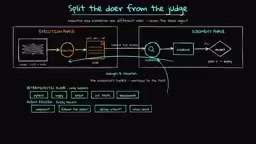
How you check depends on the nature of the task. If success criteria are clear and concrete, use deterministic checks — unit tests, type checking, linting, etc. If the result is more subjective — "is this code well-written?" "does the UI look right?" — you'll need another Agent to act as judge. Good Evaluator setups often combine both: deterministic checks as a baseline, with an Agent review layer on top.
Component 3: Verifier — The Agent's Safety Anchor
The Verifier is the component that truly keeps an AI Agent in line. An Agent can confidently tell you the task is complete, but its self-description is not evidence.
The essential difference between the Verifier and the Evaluator lies in their level of judgment: the Evaluator focuses on "does the output quality meet the intended goal" — a semantic, subjective judgment; the Verifier focuses on "does the result satisfy mechanically verifiable constraints" — a binary, objective judgment: pass or fail, with no middle ground. This distinction is highly analogous to the division of labor between "code review" and "automated testing" in software engineering.
Verification design is best approached in two steps:
- Step 1 (low-cost deterministic checks): Does it compile? Does it pass tests? Are linting and types aligned?
- Step 2 (high-cost deep verification): Run benchmarks, compare screenshots, held-out evaluation.
Only outputs that pass all checks can truly be accepted as "done." Think of this like anchor points in rock climbing: the Agent can feel as confident as it wants, but the anchor either holds or it doesn't — there's no middle ground.
Component 4: Outer Loop — The Wake-Up and Correction Mechanism
Agents stop when they hit obstacles, can lose track of the task, or decide a half-finished result is "good enough." That's why you need to put the Agent inside an outer loop that periodically wakes it up and corrects its course.
It's worth clarifying the relationship between the outer loop and mainstream Agent reasoning frameworks (such as ReAct, Chain-of-Thought, Tree of Thoughts): these frameworks primarily address "how to make decisions within a single task," while the outer loop adds a layer of macro-level control on top, performing periodic checks across task completion, resource consumption, and error accumulation. This is highly analogous to a "closed-loop control system" in control theory — sensors collect state (observability), the controller compares the target against the current state (evaluator), and the actuator outputs a corrective action (replanning or escalating to a human).
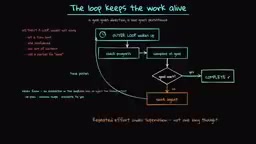
The loop checks progress, compares it against the goal defined at the start, and asks: has the goal truly been achieved? If complete, mark it complete; if not, feed the failure reason back to the Agent and re-run. The simplest version is a rough retry loop; more advanced versions embed the Evaluator inside the loop, enabling replanning and escalating to a human when necessary. Features like SlashGoal in Codex and Claude Code are essentially implementing this loop pattern.
Component 5: Orchestration — From Choosing Models to Defining Roles
Once goals are defined, the core idea for the orchestration layer is: stop thinking about "which model to use" and start thinking about "what roles are needed."
Multi-Agent orchestration typically takes two topological forms: Centralized Orchestration and Decentralized Orchestration. In centralized orchestration, a dedicated Orchestrator Agent is responsible for task decomposition, subtask assignment, and result aggregation — similar to an API gateway in microservices architecture. Decentralized orchestration allows Agents to communicate and collaborate directly with each other, which is more flexible but also harder to debug.
The ideal division of roles is: use a powerful model for planning, a fast and lightweight model for execution, and a capable model for evaluation — then repeat this pattern in the loop. This turns model selection into an architectural decision — using model routing to dynamically select models of different scales based on task complexity, keeping the process controllable while effectively managing cost. OpenAI's GPT-4o and GPT-4o-mini combination, and Anthropic's Claude Opus and Haiku combination, are both classic examples of this mixed deployment strategy.
The most important point here: the planning step is where your expertise is most valuable. As a "human in the loop," you should review and refine the plan before handing it off to the loop for execution. Don't outsource your thinking to the model — a good plan paired with a capable execution model is what delivers results efficiently.
Component 6: Observability — Your Real-Time Control Surface
After multiple Agents have been running for hours simultaneously, you can't possibly debug by scrolling through raw logs line by line. You need to separate storage from presentation: raw logs and data stored where Agents can retrieve them, while a clear dashboard is rendered for you.
Agent observability evolved from the traditional software engineering "three pillars of observability" (Logs, Metrics, Traces), but adds several dimensions unique to AI Agents. Traditional software observability focuses on latency, error rates, and throughput; LLM applications (LLMOps) additionally need to track token consumption, prompt versions, and hallucination rates; for multi-step Agent systems, you also need to record tool call chains, reasoning path branches, context window utilization, and state transitions across run cycles.
Think of it as a Kanban-style interface showing task status, running costs, error messages, screenshots, and key decision points. This is what lets you judge when to intervene — rather than discovering problems only after everything is over.
More importantly, observability should provide a feedback mechanism — it's your control surface, not a report you review after the fact. When an Agent gets stuck in a loop, costs spike abnormally, or errors trigger repeatedly, developers can intervene before the damage grows. For long-running AI Agents that require a human in the loop, this capability is often severely underestimated.
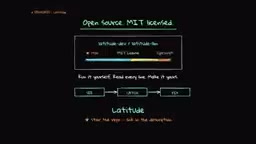
The open-source tool Latitude (MIT licensed) is built around exactly this philosophy: tracking cost, latency, and the full call tree for every run; supporting natural language search across traces; clustering large volumes of conversations into a panoramic view; converging repeated failures of the same type into a single signal; and providing an MCP server that can connect directly to coding Agents like Codex and Claude Code.
Component 7: Memory — The Free Training Data You're Wasting
Memory isn't just about helping an Agent remember your preferences. In fact, your past Agent run records are free training data — but most people throw them away.
Agent memory systems are typically divided into four types: Semantic Memory (storing general knowledge and preferences), Episodic Memory (storing specific interaction history), Procedural Memory (storing operational rules and skills), and Working Memory (the current context window). This four-type classification framework is borrowed from cognitive psychology and corresponds to different engineering implementation paths: vector databases (Vector DB) are suited for semantic retrieval, structured logs for episodic lookback, and rule files for persisting procedural memory.
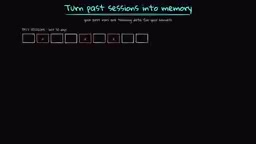
Here's a practical idea called Session Mining: go back and review recent run records, looking for patterns. You'll find the same errors recurring — similar check failures, wrong paths taken. These are the signals you want to mine.
The approach is to turn these patterns into rules, written into project documentation, Agent configuration, or directly placed as rules in AGENTS.md or CLAUDE.md. That way, the Agent won't repeat the same mistakes on the next run. This is essentially a mechanism for converting episodic memory into procedural memory — achieving "behavioral-level continuous learning" without retraining model weights — and is conceptually similar to meta-learning in machine learning, but with extremely low implementation cost that any team can adopt. This is a form of naive recursive self-improvement specific to the Agent, and many teams have yet to take full advantage of it.
Systems Thinking: Design, Not Trust
These seven components don't make the hard problems disappear. Agents will still take shortcuts, stop early, and produce weak plans — especially in areas with insufficient training data coverage.
But the key is that each type of failure has a corresponding component to catch it:
- Taking shortcuts and stopping early → Verifier + Outer Loop
- Weak plan quality → Human review
- Overfitting → Held-out evaluation
- Stale context → Memory mechanism
The real shift in thinking is this: don't try to "trust" a large number of Agents — instead, design systems around them that constrain their behavior. The system must be observable and correctable.
The seven components — Goal, Evaluator, Verifier, Outer Loop, Orchestration, Observability, Memory — together with the Agent engine itself, form a complete AI Agent architecture capable of running autonomously and reliably. When you start doing session mining for your Agents, summarizing lessons, and codifying them into rules, you've truly graduated from "using an Agent" to "engineering an Agent system."
Key Takeaways
Related articles

Alguard: Building a Dual-Layer Trust Defense for AI Agent Shopping
Alguard, an Amazon Developer Hackathon project, designs a dual-layer trust architecture for Alexa+ agent shopping. Through physical isolation between an MCP server and a human approval channel, it replaces prompt defenses with structural constraints to block unauthorized purchases caused by prompt injection.

Food Poisoning: Causes, Symptoms, Treatment, and Prevention Explained
Food poisoning is caused by bacteria, viruses, parasites, or toxins contaminating food, with common symptoms including vomiting, diarrhea, and dehydration. This article explains the causes, symptoms, treatment, and prevention of food poisoning to help you safeguard food safety.

Meta Uses LLMs to Make Facebook Feed Customizable
Meta launches LLM-powered algorithm personalization for Facebook and Reels, letting users manage interests via menu and customize feed with a text box.