Meta Uses LLMs to Make Facebook Feed Customizable

Meta launches LLM-driven algorithm personalization for Facebook and Reels, letting users manage feeds in natural language.
Meta is rolling out LLM-driven algorithm personalization on Facebook and Reels, allowing users to manage interest lists via a menu and describe content preferences in natural language. The Facebook version is more complete than Instagram's, adding the ability to reduce ads and mark followed-account posts as interested. This positions algorithm transparency as a cross-platform product direction, giving users more control while hedging regulatory risk.
Meta Uses LLMs to Make Facebook Feed Customizable
Meta is handing part of the control over content recommendations back to users. According to RSS sources, Facebook and Reels are about to launch a set of algorithm personalization features powered by large language models, allowing users to actively manage their interest lists and even describe in natural language what they want to see and what they don't.
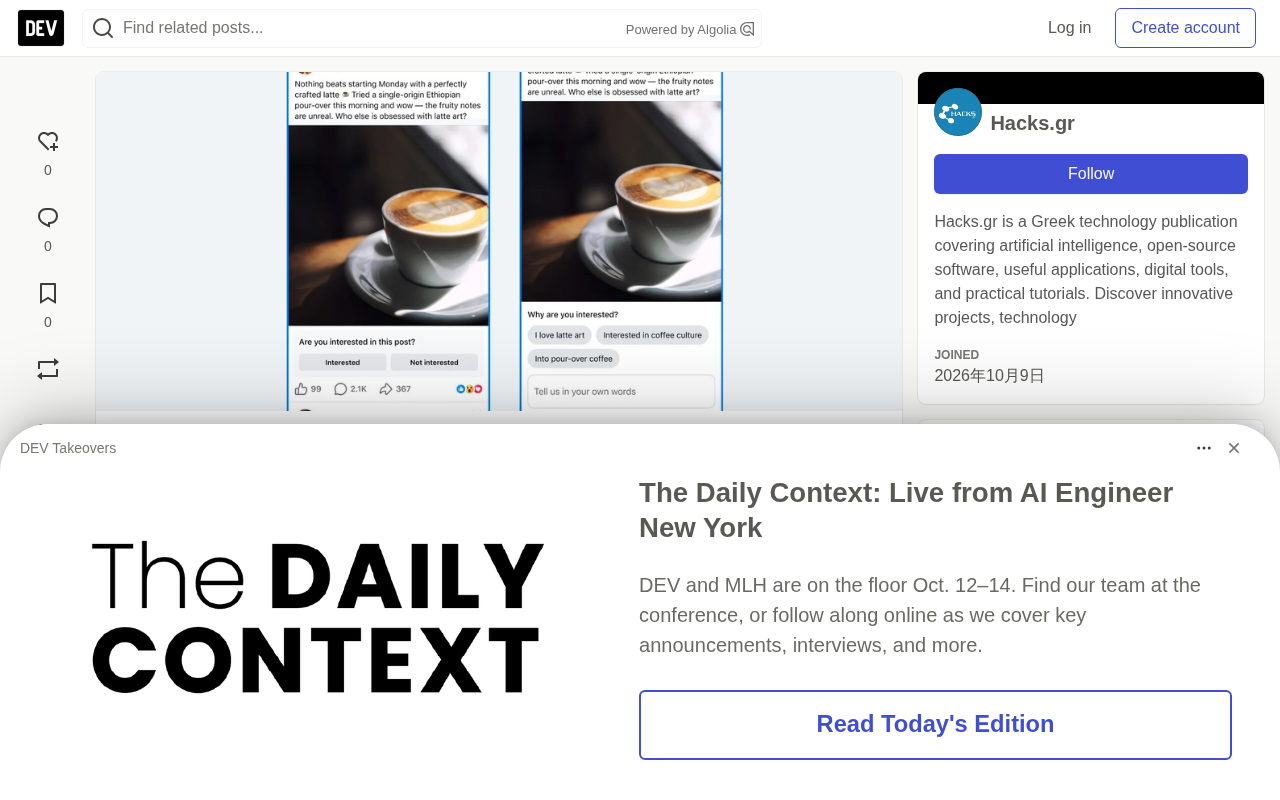
How It Works: Pick Interests from a Menu, Write Requests in a Text Box
The interaction design for this update isn't complicated. While browsing Facebook, users can select a post or video, which triggers a new menu. In this menu, users can add a specific topic to their interest list or mark it as "don't want to see." There's also a text box where users can describe in their own words what they'd like to appear in their feed.
Behind this mechanism is the AI technology Meta uses for content ranking. In other words, large language models aren't just involved in recommendations — they're now taking on the role of understanding users' explicit intent.
LLM-driven algorithm personalization refers to using LLMs (such as Meta's own Llama series) to parse users' natural language input, converting vague statements like "I don't want to see too much sports news, but I'd like more independent films and photography tips" into signals the recommendation system can execute, such as topic weight adjustments, category filtering, or ranking features. Traditional recommendation systems mainly rely on behavioral data (clicks, dwell time, likes), and users' explicit feedback is often just a single "not interested" button. With LLMs, the system can understand more complex intents — for example, distinguishing between "temporarily tired of this" and "permanently block," or identifying multiple parallel preferences in a user's description. This is also a recent trend in recommendation systems: inserting generative models' semantic understanding capabilities before the ranking and retrieval stages, serving as an intent parsing layer.
How It Differs from the Instagram Version
Instagram launched a similar feature earlier this year. But that version had clear limitations: users couldn't ask to see fewer ads, nor could they mark posts from accounts they already follow as "interested." Facebook's version expands on these capabilities, filling in those gaps.
The convergence of features across the two platforms suggests Meta is pushing algorithm transparency and control as a cross-platform product direction rather than a one-off experiment.
The "reduce ads" capability mentioned here involves the coupling between recommendation systems and advertising systems. Content in the feed typically falls into two categories: organic content (friends' posts, followed accounts, recommended content) and paid ads. A user's interest settings for organic content theoretically wouldn't automatically carry over to ad delivery logic, since ad ranking has its own objective function (conversion rate, bids, etc.). Facebook's version allowing users to express "show fewer ads" means the platform needs to make concessions on ad load frequency or the ratio of ads to organic content — which comes at a commercial cost. And "marking posts from followed accounts as interested" relates to the weight allocation between social graph signals and interest signals. The absence of these two features in the Instagram version suggests its recommendation architecture is less open to explicit user intervention.
Why This Matters
Recommendation algorithms have long been viewed as a black box, with users only able to passively accept their feed. By letting users directly intervene in recommendation results through text, Meta is essentially opening a natural language interface to the algorithm. For ordinary users, this is an increase in sense of control; for Meta, it's also a form of risk hedging — when regulatory pressure mounts, "users can manage it themselves" is a useful card to play.
Of course, the actual effect depends on how accurately the model understands user descriptions and whether interest settings can truly significantly change the feed. These remain to be verified once the feature is officially rolled out.
The core of the recommendation algorithm "black box" problem is that users can't know why they're seeing a certain piece of content, nor can they effectively change the outcome. At the regulatory level, the EU's Digital Services Act (DSA) requires very large platforms to offer at least one recommendation option "not based on user profiling" and to explain their recommendation logic. By allowing users to describe preferences in natural language, Meta can argue in its compliance narrative that "users have control." But it's worth noting that the natural language interface itself could become a new layer of opacity: users don't know how their descriptions are interpreted by the model, nor how much weight the interest list carries in ranking. Therefore, the substantive degree of transparency improvement depends on whether the platform is willing to disclose how these signals actually work.
One-line Summary
Meta launches LLM-driven algorithm personalization for Facebook and Reels, letting users manage their feed in natural language.
Paragraph Summary
Meta is rolling out LLM-driven algorithm personalization on Facebook and Reels, allowing users to add topics to an interest list or mark them as unwanted via a menu, and to describe content preferences in natural language through a text box. The feature previously launched on Instagram, but the Facebook version is more complete, adding the ability to reduce ads and mark posts from followed accounts as interested. This marks Meta pushing algorithm transparency and control as a cross-platform product direction, opening a natural language interface to the recommendation algorithm. For users, it's an increase in sense of control; for Meta, it's risk hedging under regulatory pressure. Actual effectiveness still depends on how accurately the model understands user descriptions and whether interest settings can genuinely change the feed.
Related articles

Automate Job Search with AI Agents and Residential Proxies for Precise Matching
Build an AI Agent with MCP and residential proxies to bypass recruitment site anti-scraping and geo-restrictions, scrape thousands of DevOps jobs, then have Claude score and rank each against your resume. Includes proxy comparison experiments, project structure, and cost analysis—filtering only, no auto-submission.

The AI Task Assistant That Knows When to Back Off: A Cure for Activation Struggles
One Small Step is an AI assistant for task initiation struggles, using agentic decisions for guilt-free reminders, timely retreat, and cross-platform task management. The developer shares real test results on 13 tasks and architectural trade-offs.

FastAPI: A High-Performance Python Framework and a Production-Ready API Development Powerhouse
FastAPI is a high-performance web framework based on Python type hints, supporting async and automatic OpenAPI docs. With over 100k GitHub stars, this article analyzes its core strengths, production readiness, and selection advice.