7 Free AI Agents Reviewed: Automating Sales, Research, and Workflows

A review of 7 free-to-start AI agent tools covering sales, customer service, research, and automation scenarios.
The article introduces 7 AI agent tools that can be started for free, categorized by scenario into sales and customer service, research and reports, open-source self-hosting, cross-app automation, conversation and voice, visual workflows, and data training. Relevance AI and Gumloop focus on no-code or drag-and-drop operation with low barriers to entry; n8n is the only solution emphasizing open-source self-hosting, suitable for data-sensitive teams; Zapier Agents leverages an ecosystem of thousands of apps with low migration cost; Botpress, Make, and Dust cover conversation and voice, visual processes, and training on your own data, respectively. The article concludes with a selection approach: weigh whether coding is required, whether data is controllable, and ecosystem compatibility, and reminds readers that free quotas are limited.
Handling repetitive work manually is both time-consuming and exhausting. If you had a set of free AI agents to handle sales follow-ups, research, and process automation for you, things would be much simpler. The following 7 tools come from a share by the YouTube channel AIML Core, covering everything from no-code team collaboration to open-source self-hosted solutions, all with free starting points.
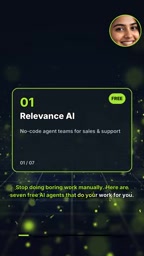
Sales & Customer Service: No-Code Agent Teams
Relevance AI positions itself as a "no-code agent team," aimed at sales and customer service scenarios. Users can build multiple agents that work together to complete tasks like lead qualification and customer replies without writing any code. For small and medium teams, it lowers the barrier to building AI workflows.
Research & Reports: Drag-and-Drop Agents
Gumloop focuses on drag-and-drop operation, breaking down research and report generation into visual steps. Users simply combine modules, and the agent automatically collects information and organizes conclusions. It's suitable for roles that need to regularly produce industry briefings or competitive analysis.

Drag-and-drop (no-code/low-code) agents refer to defining AI behavior by piecing together modules on a visual canvas. Users don't write code, but rather use connections to express data flow and trigger conditions. These tools typically break "input—processing—output" into reusable nodes, such as scraping web pages, calling large models, and formatting results. The advantage is intuitive debugging and a fast learning curve, so non-technical staff can also maintain them; the limitation is that when handling highly customized logic, they're less flexible than code, and complex processes may be constrained by the capability boundaries of the nodes.
Open-Source Self-Hosted: n8n
n8n is a free, open-source automation tool whose biggest feature is support for self-hosting. For teams with data sensitivity or compliance requirements, it can be deployed on their own servers and connected to various services as needed to complete automation. The open-source nature also means greater extensibility.
Self-hosting refers to deploying software on servers controlled by the team itself, rather than using a vendor's cloud services. For AI agents, this means data, conversation records, and connection credentials never leave the organization's own environment, better meeting the requirements of GDPR, industry compliance, or internal security audits. The cost of self-hosting is that you're responsible for server operations, version upgrades, and backups yourself. n8n uses a fair-code license, with core functionality open-source and free to self-host, while the enterprise edition offers additional support services. This model maintains transparency while balancing commercial sustainability.
Cross-App Automation: Zapier Agents
Zapier Agents leverages Zapier's massive app ecosystem to execute AI tasks across thousands of applications, and it's available on the free plan. If your workflows already run on Zapier, layering on agent capabilities has virtually no migration cost.
Conversation & Voice: Botpress
Botpress is aimed at website scenarios, offering chat and voice agents that can be started for free. It's suitable for teams that need to quickly deploy customer service or guided conversations on the web.
The technical paths for chat agents and voice agents differ. Chat agents mainly handle text, relying on intent recognition and dialogue state management; voice agents additionally need to integrate speech recognition (ASR) to convert user speech into text, then use speech synthesis (TTS) to read out replies, and handle real-time interaction issues like interruptions and noise. Botpress provides a unified dialogue orchestration layer that can connect to both web chat windows and phone/voice channels simultaneously, suitable for teams needing omnichannel customer service to scale as needed.
Visual Workflows: Make
Make builds AI workflows visually and also offers a free plan. The node-based editor makes process logic clear at a glance, and debugging and modifications are fairly straightforward.
Data Training Assistant: Dust
Dust's intelligent assistant can be trained on your own data and offers a free quota. For teams that want AI to understand internal documents and knowledge bases, this is an entry point worth trying.
Selection Approach
The differences among these 7 tools mainly come down to three points: whether coding is required, whether data is controllable, and ecosystem compatibility. For quick onboarding, choose Relevance AI or Gumloop; for data sovereignty, choose n8n; if you're already deeply invested in a particular platform, prioritize the corresponding native agent. Free quotas usually have limits, so before putting them into production, it's advisable to confirm the usage caps first.
One-line Summary
A review of 7 free-to-start AI agent tools covering sales, customer service, research, and automation scenarios.
Paragraph Summary
The article introduces 7 AI agent tools that can be started for free, categorized by scenario into sales and customer service, research and reports, open-source self-hosting, cross-app automation, conversation and voice, visual workflows, and data training. Relevance AI and Gumloop focus on no-code or drag-and-drop operation with low barriers to entry; n8n is the only solution emphasizing open-source self-hosting, suitable for data-sensitive teams; Zapier Agents leverages an ecosystem of thousands of apps with low migration cost; Botpress, Make, and Dust cover conversation and voice, visual processes, and training on your own data, respectively. The article concludes with a selection approach: weigh three points—whether coding is required, whether data is controllable, and ecosystem compatibility—and reminds readers that free quotas are limited, so usage caps should be confirmed before production use.
Related articles

How Big Can Stars Really Get? The Physical Limits of the Largest Stars
Red supergiants are the largest stars by volume, with radii up to 2,000 times the Sun, engulfing the inner solar system. But there is no precise upper limit on stellar size—models predict up to 15,000 solar radii. The most massive blue stars are far smaller than red supergiants—biggest and heaviest are two different things.

Apple HomeView Smart Display Full Feature Breakdown: Wall-Mount or Desktop, $299
Apple launches HomeView, a $299 smart display with wall-mount and desktop options, 12MP camera for facial recognition, smart home control, music playback, and recipe step-by-step cooking. Full breakdown of watch faces, apps, privacy, and cooking integration.

Where Did the Promised New Studio Go? Craft Computing Answers After Five Years
Craft Computing's host responds to viewer questions: the new studio promised five years ago was shelved as construction costs soared from $30,000 to $75,000, and was replaced by a 168-square-foot garage conversion.