7 Hidden-Gem AI Dev Tools: From 3D Geospatial Visualization to Agent Security Auditing

Seven emerging GitHub open-source tools covering 3D visualization, agent security, rapid prototyping, copy refinement, and architecture diagrams.
This article covers seven noteworthy AI tools and techniques from GitHub: a 3D interactive global data visualizer; NVIDIA's Skill Spectre for pre-install agent skill security auditing; Float for one-click backend deployment of ChatGPT/Claude prototypes; Mediocrity Monster for stripping AI-ness from generated text; the Cloud Loop technique for dual-model cross-validation; the Deep-seek customizable agent framework with file/terminal/browser access; and Archify for instant text-to-architecture diagram generation. The author argues that while the tools evolve rapidly, the underlying methodologies — security-first, cross-validation, and process visualization — are the durable skills that matter most.
GitHub has become an important window into where AI technology is heading. Over the past month, a number of noteworthy open-source projects have emerged — spanning 3D geospatial visualization, agent security auditing, AI text refinement, automated architecture diagram generation, and more. This article walks through seven tools shared by a Bilibili creator, with in-depth commentary on real-world use cases to help you decide which ones are genuinely worth adding to your workflow.
1. God's Eye View: 3D Visualization Aggregating Global Public Data
The first project, dubbed the "God's Eye View," is essentially an interactive global situational awareness system. It aggregates a large number of independent public data sources into a single world view — real-time flights (including military aircraft), satellite trajectories, vessel positions, earthquake data, license plate recognition cameras, and more. Almost any open-source intelligence you can think of can be rendered on the map.
What's particularly interesting is its natural language interaction support. You can simply say "take me to the Pentagon" and the view shifts accordingly. You can also "teleport" onto the nearest overhead flight and enter a cockpit-like perspective, even tuning into local radio broadcasts for audio. This approach of integrating massive datasets into an immersive experience is highly valuable for visual storytelling and intelligence visualization.
The project is also quite extensible — you can connect different API keys for additional perspectives and it supports 3D map rendering. It gained a large number of stars in a short period, with popularity climbing rapidly. The installation barrier is low, with a one-click deployment method provided. That said, be aware that projects aggregating public data may carry compliance implications depending on your jurisdiction.
2. Skill Spectre: NVIDIA's Agent Security Auditing Tool
As the agent (Agent) ecosystem expands, security concerns are becoming increasingly prominent. The second tool, Skill Spectre, comes from NVIDIA and is specifically designed to scan an agent's "skills" for hidden instructions, unsafe access permissions, and potential data leakage risks.

It works like a security health checker: it detects suspicious instructions and abnormal data flows, verifies whether the access permissions a skill actually requests match its stated functionality, and produces a risk assessment score. The usage logic is straightforward — whenever you're about to install a new skill, run it through Skill Spectre first, confirm there are no malicious instructions embedded, and then enable it.
This approach is worth taking seriously for any developer building Agent systems. Once an agent has tool-calling and file-access capabilities, a single compromised skill can have severe consequences. Moving security auditing to the installation stage is one of the more mature practices in current Agent security.
The concept of "skills" in the agent ecosystem stems from the modular design philosophy of the Agent ecosystem. An agent is often not a monolithic program but is composed of multiple composable skills/plugins — each responsible for a specific capability, such as searching the web, reading/writing files, or calling external APIs. This architecture makes agents highly flexible, but also introduces supply chain security risks: anyone can publish a skill, and one that appears harmless may request permissions beyond its stated function during installation, or exfiltrate sensitive data to external services at runtime. This mirrors the malicious app problem in mobile ecosystems, with the key difference that agent skills typically have direct access to code execution environments and file systems — making the potential blast radius far larger. "Prompt Injection" is the most common attack vector: attackers embed hidden instructions in skill descriptions or returned content, tricking the agent into performing unintended actions. The value of Skill Spectre lies precisely in moving the discovery of such risks from "after the fact" to "before installation."
3. Float: One-Click Publishing for Things Built with ChatGPT/Claude
The third entry isn't strictly a code repository but a service called Float — though it solves a very real pain point. When you build a product prototype in Cursor, ChatGPT, or Claude, Float can publish your design as a fully functional application with a single click.
Its biggest value is taking over the backend parts developers hate dealing with most — user authentication, forms, databases, email and notifications are all handled automatically. It's also natively search-engine friendly and can integrate with your existing toolchain. In the demo, the creator built a homepage and research form in ChatGPT, then said "connect to Float and publish as an app" — the system completed the authentication flow and wired up the entire design, form, and database to go live.
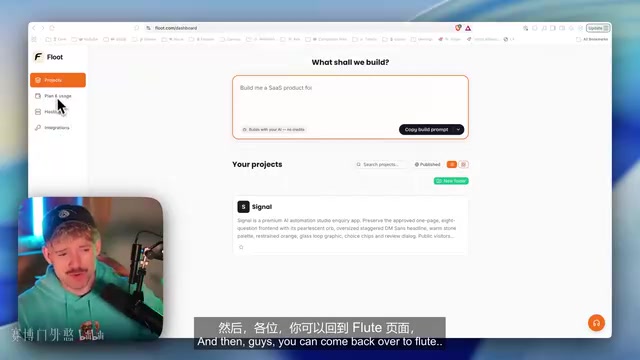
Float offers a free tier to get started, and you can clearly see plans and resource usage on the project page. For anyone who wants to quickly validate an idea into a usable product without getting bogged down in backend configuration, this kind of "idea-to-app" accelerator can genuinely save a significant amount of time.
4. Mediocrity Monster: Stripping the "AI Smell" from AI-Generated Text
The fourth is a project the creator built himself — Mediocrity Monster. Its core goal is to take any piece of text and rewrite it so it no longer reads like AI-generated content. The creator notes that there are quite a few libraries out there fighting AI-slop copy, and he consolidated the best of them while patching gaps that most commonly overlook.
The tool scores text across multiple dimensions: AI-favored vocabulary, sentence structure, punctuation habits, tonal rhythm, and the classic AI "three-part parallel structure" — and it adds a sales and marketing perspective that most similar tools ignore, focusing on what the industry is actually doing, what customers fear, and what competitors won't say.

It draws on Steve Krug's Don't Make Me Think philosophy — the idea that reading shouldn't require mental effort — while incorporating marketing insights from Daniel Priestley, Alex Hormozi, and others. The rewriting results are convincing: vague platitudes like "trustworthy, reliable, and long-lasting" get replaced with specific, verifiable statements like "six nails per tile"; "industry-leading materials" becomes "materials sourced from suppliers we've tested for wind, hail, and UV resistance." The difference is immediately apparent. The tool is completely free and works for both web copy and email.
5. The Cloud Loop: Having Two Top Models Cross-Validate Each Other
The fifth isn't a tool but a usage technique — which the creator calls the "Cloud Loop." The core idea: when building complex systems with Claude and ChatGPT, engage both of the currently strongest models simultaneously for cross-validation, letting them poke holes in each other's reasoning.
The specific approach is to have one model draft a plan and the other specifically look for weaknesses in that plan. Because each model has its own blind spots, no matter how strong any single model is, the two working together will often catch errors that either would miss alone. The creator estimates he uses this loop for about 10% of his AI usage time — specifically for complex builds where the stakes are high and diverse perspectives matter.
The underlying principle here is a simple but important engineering concept: introduce independent review for critical decisions. In AI-assisted development, formalizing this "dual-model review" process can significantly reduce hidden risks at the planning level.
The concept of "cross-validation" has a long history in engineering, corresponding to the "Four-Eyes Principle" — any important decision should be reviewed by at least two independent parties to eliminate single-point judgment bias. When applying this principle to AI usage, two limitations are worth noting. First, while Claude and ChatGPT differ in architecture and training data, both learn from internet text, meaning certain systemic biases may exist in both simultaneously. Second, if two models are given identical context, their understanding of the problem frame may converge significantly — leading to a situation that "looks like mutual verification but actually shares the same blind spots." To make the loop genuinely effective, it's advisable to deliberately switch the role framing when prompting the second model (e.g., "you are a critic of this plan") or explicitly ask it to start from the opposing assumption, rather than simply reviewing the first model's conclusions.
6. Deep-seek Framework: A Customizable Agent Framework
The sixth is the Deep-seek framework. The creator uses a vivid analogy: a model is like an F1 driver, and the framework is the race car — all the supporting infrastructure around the model. ChatGPT and Claude each have their own applications and environments, and Deep-seek now has its own framework version too.
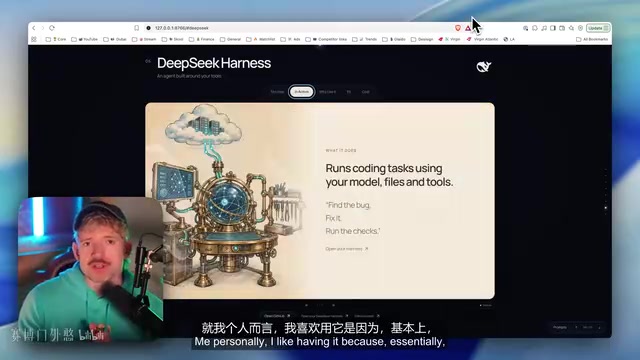
What makes this framework truly distinctive is that it can access files, terminals, tools, and browsers — and is fully customizable. Rather than being constrained by ChatGPT's or Claude's default behaviors, you can run coding tasks using your own models, files, and tools to shape a workflow that's entirely your own.
The creator favors it because Deep-seek models are low-cost and can be spun up with a single command. He pairs it with Glido (a voice-to-text launch tool) to quickly invoke various commands. For developers who frequently hit token limits or want greater control over agent behavior, this kind of customizable framework is a great direction to explore.
7. Archify: Turn Any Description into an Architecture Diagram in Seconds
The final tool is Archify, which converts any text description into a clearly structured architecture diagram in seconds. The creator demoed it by having it map out Alex Hormozi's sales system, automatically generating a visual flowchart from abstract concepts like "create demand, earn interest."
It supports dark mode and multiple themes, and can trace process nodes upstream and downstream to show the complete flow of a request through a system. While the creator admits it's not the most visually cutting-edge tool in terms of design aesthetics, it wins on practicality — far outperforming most enterprise-grade internal tools in terms of efficiency.
Typical use cases include drawing business process diagrams, mapping out components and connections in complex systems, and onboarding/handoff documentation and code reviews. When a process has hundreds of steps, generating a readable flow map with Archify beats any verbal explanation. Diagrams can be exported and shared, and the tool is also free.
Final Thoughts
These seven projects cover the full spectrum from data visualization, agent security, rapid publishing, and copy refinement to architecture diagramming. Knowing what's trending on GitHub is just the first step — what really sets developers apart is understanding how to integrate these tools into their own intelligent agent workflows. The tools themselves are iterating rapidly, but the underlying methodologies — security-first, cross-validation, process visualization — are the capabilities that remain effective long-term.
Background Context
Steve Krug's Don't Make Me Think is a classic in web usability, with its central argument being that good design should let users complete tasks without having to think — the lower the cognitive friction, the better the experience. Applying this principle to copywriting means readers shouldn't have to expend extra mental energy to understand the text: no vague abstractions, no jargon that needs decoding, information mapped directly to concrete images. The "AI smell" in AI-generated text largely stems from its tendency to choose "statistically safe" phrasing — high-frequency, neutral, inoffensive expressions that end up stripping content of distinctiveness and persuasive power. Alex Hormozi's and Daniel Priestley's marketing theories emphasize that truly effective copy must address readers' specific fears and specific desires, rather than vaguely claiming "we're great." Mediocrity Monster combines readability theory with sales psychology, attempting to correct the structural flaws of AI text from both dimensions simultaneously.
Related articles

How Big Can Stars Really Get? The Physical Limits of the Largest Stars
Red supergiants are the largest stars by volume, with radii up to 2,000 times the Sun, engulfing the inner solar system. But there is no precise upper limit on stellar size—models predict up to 15,000 solar radii. The most massive blue stars are far smaller than red supergiants—biggest and heaviest are two different things.

Apple HomeView Smart Display Full Feature Breakdown: Wall-Mount or Desktop, $299
Apple launches HomeView, a $299 smart display with wall-mount and desktop options, 12MP camera for facial recognition, smart home control, music playback, and recipe step-by-step cooking. Full breakdown of watch faces, apps, privacy, and cooking integration.

Where Did the Promised New Studio Go? Craft Computing Answers After Five Years
Craft Computing's host responds to viewer questions: the new studio promised five years ago was shelved as construction costs soared from $30,000 to $75,000, and was replaced by a 168-square-foot garage conversion.