7 Shifts in How We Interact with AI: From Prompt Engineering to Shared Agents

Seven paradigm shifts — from prompt engineering to shared agents — are reshaping how we work with AI.
This article maps seven deep shifts in how AI products are built and used: interfaces are being radically simplified; mono thread replaces fragmented context-switching; chatbots quietly evolve into orchestrators of agent fleets; voice plus real execution becomes a standard agent capability; users shift from writing prompts to setting goals and success criteria; multi-model usage becomes a cost imperative rather than a power-user trick; and team-level shared agents are emerging, though questions of accountability and organizational design remain unresolved. These trends are interconnected and collectively signal a fundamental paradigm migration in how we harness AI.
The way we use AI is undergoing a quiet but profound transformation. From prompt engineers to context engineers, then to harness engineers and loop engineers — each evolution in role isn't just a game of swapping new jargon for old. It's a genuine trail of collective discovery in how we learn to wield this new technology. In its latest episode, The AI Daily Brief mapped out seven shifts in interaction patterns reflected across a wave of recent product launches — many of which may leave lasting marks, and are worth understanding.
1. Interfaces Are Getting Radically Simpler
The first shift isn't users changing how they behave — it's product design decisions reshaping the options available. The direction is unmistakable: simplify, consolidate, and minimize the cognitive load and decision fatigue placed on end users.
Interestingly, early AI in some ways defied conventional Silicon Valley logic — the assumption that users won't pay for complex experiences. The opposite happened: a large wave of early adopters, not just engineers but a much broader group of knowledge workers, actively waded into complexity. The show's host mentioned that a free Claude bootcamp he launched this year drew 9,000 sign-ups, most of whom weren't engineers at all, yet were willing to "walk through glass" to learn how to build their own agents.
But the demand for simplicity is just as real. Meta's MUSE product has become the poster child for this trend, earning praise for its design restraint even from power users who are fully capable of handling complexity. Tech commentator Tom Goodwin wrote: "The beauty of MUSE is that it's presented in an incredibly accessible way — don't tell me how it works, just tell me how to use it." David Herman shared the experience of watching his nearly 70-year-old father use SMS to have AI draft a contract, revise it, and send it to a client — marveling that "less than 1% of people currently understand what these models really are, and Meta made all of this simple."
This simplification is surfacing everywhere. Anthropic this week announced that Claude's co-work and chat would no longer be separate features, merging into a single unified experience. Mike Krieger, head of Anthropic Labs and co-founder of Instagram, noted that the most common user confusion was simply "not knowing which product to start with" — and that friction was exactly what prevented them from getting the most out of the model.

2. Mono Thread: One Persistent Thread to Rule Them All
The second shift is also a form of simplification, but it's about how we control AI — specifically, the move toward mono thread.
The core idea: instead of constantly switching context windows, re-explaining your needs, and writing fresh prompts, you use a single long-running thread that inherits the context of past conversations to manage an entire workflow. Previously, this was constrained by context window limits — once full, the AI would "fatigue," start making errors, and lose track of instructions. A lot of earlier course content was actually dedicated to teaching people how to write proper "handoff documents" for transferring context between threads.
The turning point came from the Codex team's sustained investment in compaction (context compression). Codex's Nick Bauman wrote that many coding agents were designed around the assumption that long threads would inevitably degrade — and once you let go of that assumption, the product direction becomes obvious. In his post My Codex Threads Are Alive, he described how his most useful Codex thread had been running continuously for three weeks — checking Slack, Gmail, and PRs every hour, converting noise into clear, actionable signals. "I've become mono-threaded," he wrote.
This is now an official capability. The Claude account announced this week that projects now launch from "a single conversation" — you describe what needs to get done, and Claude orchestrates parallel threads to keep working. Cursor built the same logic into its projects launch: "Collaborate with an orchestrator agent in a single persistent thread, rather than creating new conversations for each task." Claude Code creator Boris Cherny said projects changed not just how he interacts with Claude, but how he writes code: "I no longer manage sessions — I just send thoughts as they come, and Claude breaks them into threads."
A note on the underlying technology: The context window refers to the maximum amount of text a model can "see" in a single inference pass, measured in tokens. Early mainstream models had context windows of only 4K to 32K tokens, meaning a moderately long conversation or task would hit the ceiling and the model would start forgetting earlier instructions. Between 2024 and 2025, major models rapidly expanded their context windows to 100K and even million-token scale — the material foundation that makes mono thread viable. Compaction adds another layer of protection: when a thread accumulates to a certain length, the system automatically distills past conversations into a compact summary rather than simply truncating them, preserving the most critical working memory within a finite window. Together, these two technologies turned "running a single thread for three weeks" from a theoretical possibility into an actual product capability.
3. Chatbots Become Fleet Commanders for Agent Swarms
Connecting mono thread with the examples above reveals a deeper shift: chatbots are increasingly becoming orchestrators for entire fleets of agents.
You interact with one coordinator AI, but that coordinator spawns a large number of sub-agents to handle different parts of the work. What's interesting is that many people once believed the chat interface was just a transitional form — destined to be replaced. What actually happened is that model and framework companies quietly changed the engine inside the chatbot without pulling the familiar interface out from under us. We still enjoy the comfortable chat experience — even simplified further by mono thread — but what it's doing under the hood looks nothing like it did a year ago.
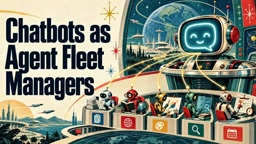
Ethan Mollick observed that one of the most interesting things about Claude projects is how well it handles agent teams — you talk to a primary orchestrator that spins up specialized experts, essentially creating an organization to solve your problem, and it can mix expensive and cheaper agents based on your preferences. This also means that other software services may increasingly function as "context databases" for the main orchestrator agent. Some users have noted that Gmail has essentially become a database for them — "agents will become the default interface for my personal and professional life."
4. Voice Becomes the Default Interaction Mode
Closely related is a simple but far-reaching change: more and more interactions will happen through voice.
The show noted that every free learning program launched this year opens by urging people to use native voice controls or set up tools like Whisperflow — because the efficiency gains and expanded context that voice enables are enormous. This is rapidly becoming a baseline capability for agent products. Grokbot added native voice integration this week, and SpaceX team member Danny Graziosi described it as feeling "like magic" — "quickly briefing your chief of staff by voice while it orchestrates the entire robot team."
Gaurav Bison put his finger on the key point: voice alone always felt like a gimmick, until agents could actually go execute real tasks. "Voice + real work" is the lethal combination. OpenAI released a new Codex ad showing a developer coding with GPT live voice while working out. Google also launched Gemini 3 Live with its extended thinking variant, emphasizing that enhanced intelligence and parallel reasoning make voice collaboration more intuitive.
5. From Prompting to Setting Goals and Loop Engineering
With stronger agent orchestration capabilities, the nature of how we give AI instructions has changed. The core shift: stop prompting AI and start setting goals for them. This naturally grants AI greater autonomy, letting it work iteratively through a loop until the goal is achieved.
This started with primitives like /goal in Claude Code and Codex, and expanded into the broader concept of "loop engineering." Peter Steinberger, creator of OpenClaude, gave it a memorable framing: "You shouldn't be prompting coding agents directly anymore. You should be designing loops that prompt agents." The essence of a loop is that beyond defining a goal, you also define quantifiable success criteria that the agent can measure itself against — enabling it to run continuously until the goal is met. While such terminology tends to earn eye-rolls outside early adopter circles, it represents a genuinely critical shift in mindset for getting maximum value from AI.
A note on the underlying mechanism: Loop engineering is technically often referred to as an "eval-feedback loop" or "agentic loop": the model executes a step, the system feeds the result back as new context, the model evaluates whether the goal has been achieved and decides the next action, and the cycle repeats until a termination condition is triggered. Quantifiable success criteria are the key to making this mechanism run autonomously — without clear acceptance criteria, the model can't determine what "done" means, and the loop either exits too early or gets stuck in meaningless repetition. This closely parallels unit testing logic in traditional software engineering: test cases are success criteria, and agents self-validate by "running the tests." For non-engineer users, the practical implication of goal-setting is a shift from "telling AI what to do" to "defining when AI has done it well enough" — a thought habit that needs to be deliberately cultivated.
6. Multi-Model Usage Becomes a Cost Imperative
The sixth shift is "multi-model" usage at the personal stack level — not just at the organizational level, but within the work of a single user mixing multiple models.
Power users have long treated model selection as a way to get an edge — not being locked into the single model included in a subscription, but finding the right model for each specific task. What's different now is that the complexity, difficulty, depth, and duration of work — combined with the cost of frontier models and the shrinking subsidies in standard plans — has turned this from an "early adopter trick" into a hard requirement for cost and efficiency.

This overlaps heavily with the "chatbot as fleet commander" trend. Many people have noticed that some frontier models' default behavior not only uses the most advanced model as orchestrator, but also routes all sub-agents through it as well — meaning what looks like a standard task can instantly consume massive token quotas when five to ten sub-agents are all running the most powerful model. Understanding what level of model capability each task actually requires, and building that discipline into your AI workflow, is becoming increasingly important. Worth noting: this trend can cut against the "simplification" trend — to make the average experience simpler, labs often hide or remove fine-grained model controls, and automated systems don't always make the right call.
7. Shared Agents: The Rise of Multi-Person AI Collaboration
The final shift is "shared agents." 2026 will likely be looked back on as "the year agents truly landed" — but for the first two-thirds of this year, nearly all agent behavior remained at the individual level. Everyone built their own team, transformed their personal workflows, but hadn't changed how entire teams work together.
That's starting to change. Claude's Claude Tag, launched this summer, replaced the old individual-instance system with a team-based mechanism — every channel gets its own Claude that can work across contexts without being tied to any single person. MioXYZ launched this week as "the first AI employee shared by your entire team," claiming to have saved teams thousands of hours during its beta period.
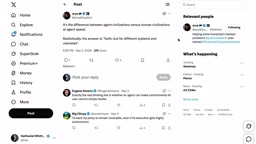
But what "multi-person AI collaboration" actually means is still being vigorously explored. Ethan Mollick noted this remains one of the biggest non-technical challenges in AI use today, with current solutions still quite rudimentary — mostly stopping at "AI as one member in a group chat." Aria Bhutani raised a more fundamental question: in multi-user agent systems, who is the "principal"? Is it the user, or the agent itself? That's the difference between "agent civilization" and "human civilization running at agent speed." Atlan's Rishigar Bhatnagar argued that multi-person AI collaboration will be one of the greatest design challenges of 2027 — meaning something different to everyone: shared memory, shared context, organizational design, or something else entirely. He further suggested that the hardest part may not be technical at all, but rather "getting an entire team to adopt a shared way of working — which is more like organizational design than engineering."
A note on the "principal" problem: The principal question is a core governance issue in multi-agent systems, rooted in the "principal-agent" framework from economics and law. In traditional software, the chain of command is clear: a user issues an instruction, the software executes. But when agents can autonomously spawn sub-agents and act on behalf of multiple users, accountability becomes blurry — whose intent is the agent actually executing? When different users' goals conflict, whose interests take priority? This question is barely noticeable in individual use cases, but surfaces immediately in team collaboration. Shared context also introduces privacy and information-isolation challenges: should a team-shared agent let all members see each other's conversation history? Where do you draw the line between "collaborative transparency" and "personal privacy"? These questions currently have neither industry consensus nor mature product practices — which is precisely why Atlan's Rishigar Bhatnagar calls it "more like organizational design than engineering."
Closing Thoughts
These seven shifts — interface simplification, mono thread, chatbots as fleet commanders, voice interaction, goal-setting and loop engineering, multi-model usage, and shared agents — together sketch out a new form of relationship between humans and AI. They aren't isolated product gimmicks, but deeply interwoven, mutually reinforcing paradigm migrations. For anyone who wants to use their time effectively, understanding which of these changes will stick is itself a valuable capability.
Related articles

Felix Rieseberg Personal Homepage
Felix Rieseberg's personal homepage sparks attention on Hacker News. This article covers the Slack engineer's technical background, the rise and fall of nativefier, and the value of a developer homepage as a tech calling card.

@ai-sdk/vue 3.0.306 Patch Release Syncs with [email protected] Update
@ai-sdk/vue 3.0.306 released, synced with [email protected]. A routine patch release for the Vercel AI SDK ecosystem with no public API changes; the Vue adapter layer stays version-aligned with the core package.

Gemini 4 Argon API Launches: The Era of Million-Token Output Begins
Google launches Gemini 4 Argon with sparse MoE architecture, up to 1M output tokens, and a 68.90% Vals Index score, available across API, AI Studio, and the Gemini app.