74% of Independent Stores Ignored by AI Shopping? Open-Source Tool CatalogPulse Tested

AI shopping agents rely on structured data; independent e-commerce faces a new visibility gap, and open-source CatalogPulse offers a low-cost audit and fix solution.
The article reveals that over 74% of independent e-commerce stores have structured data defects, making them hard for AI shopping agents to discover. Open-source tool CatalogPulse uses deterministic parsing, SerpApi market signals, and Gemma 2 to audit product pages in 10 seconds and generate ready-to-use Schema.org JSON-LD fix code at near-zero cost. A real test showed a D2C store's product page going from 65 points to fixed in two minutes.
When AI Shopping Agents Become the New Gateway, Independent Stores Are "Disappearing"
Consumers are changing their shopping habits: instead of browsing search results one by one, they directly ask ChatGPT Search, Perplexity, or Gemini—"Find me a pair of breathable eucalyptus fiber running shoes in US 10.5, under $120, in stock." This approach improves efficiency for users, but for merchants it's a silent screening process.
Product pages from large brands like Nike and Amazon include complete Schema.org JSON-LD structured data, which AI agents can read smoothly. But independent Shopify stores and small D2C merchants often encounter three types of problems: client-side JavaScript variant selectors hide secondary SKUs, so AI crawlers only see the default size; missing GTIN/UPC barcodes prevent products from being cross-validated; and secondhand resale platforms outrank official stores in search results with outdated or lower prices.
According to data shared by developer Meghana Shyam on the DEV community, over 74% of independent e-commerce stores suffer from this kind of "silent catalog lag." Enterprise-grade catalog observability platforms cost over $2,000 per month, which individual sellers and small agency teams simply cannot afford.
Schema.org JSON-LD is a standardized format for embedding structured data in web pages, describing entities such as products, prices, and inventory through <script type="application/ld+json"> tags. Search engines and AI agents can directly read these machine-readable fields without understanding the page's visual layout, allowing them to accurately determine product attributes. For e-commerce, complete Product and Offer nodes should include name, brand, SKU, GTIN, price, availability status, and variant lists. Missing these fields, AI agents may fail to include the product in candidate sets, or judge the information untrustworthy during cross-validation.
GTIN/UPC is the Global Trade Item Number, used to uniquely identify products. In e-commerce catalogs, it serves as a product identity anchor, enabling AI agents to match and deduplicate the same product across different platforms. Without GTIN, agents struggle to confirm whether an official store and a reseller listing refer to the same physical item, easily leading to distorted price comparisons or incorrect recommendations.
CatalogPulse: Filling the AI Visibility Gap with an Open-Source Solution
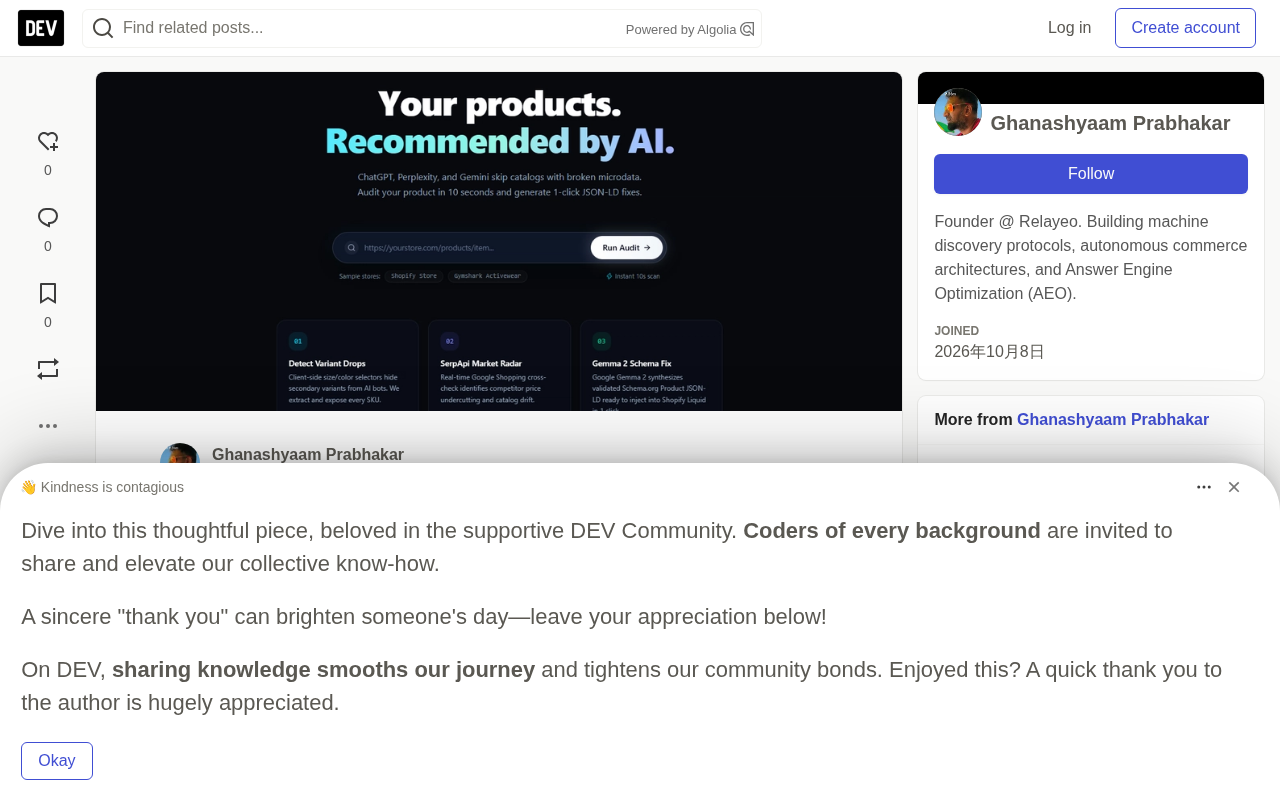
To address these pain points, the developer built CatalogPulse—a zero-install, open-source AI e-commerce linter. Merchants input a product URL and within 10 seconds receive a discoverability score, a specific defect list, and ready-to-paste Schema.org Product JSON-LD fix code.
The tool's technical approach is noteworthy: rather than letting a large model "freestyle," it combines deterministic parsing with open-weight models to ensure outputs don't fabricate facts.
Three-Layer Processing Pipeline
Layer 1: Deterministic DOM parsing (parser.ts). Using Cheerio to fetch raw HTML server-side, simulating how non-browser AI crawlers read pages, it parses existing JSON-LD Product/Offer nodes and OpenGraph tags, flagging missing GTIN, SKU, and variant omission issues.
Layer 2: Real-time market signals (serpapi.ts). Calling SerpApi's Google Shopping engine, building queries with "brand + product title," it retrieves the top 5 market listings and price distribution to detect reseller price drift and variant naming inconsistencies.
Layer 3: Open-weight AI audit (gemma.ts). Based on Google Gemma 2 (gemma-2-9b-it), running inference through Groq or HuggingFace, it takes the structured telemetry extracted by the first two layers as input and outputs strictly JSON-formatted scores, grades, key defects, improvement suggestions, and generated JSON-LD code.

Open-weight models refer to large language models whose parameters are publicly downloadable and allow local deployment and modification, as opposed to closed-source models that only offer API access. Gemma 2 is a series of open-weight models released by Google; the 9B parameter version can run on consumer-grade GPUs or through inference frameworks like Ollama and vLLM. Its advantages include extremely low marginal invocation cost, data never leaving local premises, and controllable behavior versions; the disadvantage is that reasoning capability is typically weaker than frontier closed-source models, making it better suited for structured output tasks rather than open-ended reasoning.
Why Choose Open-Weight Models
The author gives three business-reality reasons for the technical choice. On cost: an independent merchant might have 200 to 2,000 SKUs; if every page were structurally audited daily using frontier closed-source APIs, the profit margin of a $9/month micro-SaaS would be completely devoured. Open-weight models can push marginal costs close to zero, or even run entirely free on local hardware.
On data sovereignty: agencies frequently audit staging stores containing unreleased products, wholesale profit structures, and internal SKU mappings. Open Gemma weights mean it can run on local Ollama or vLLM endpoints, so client catalog data doesn't have to pass through third-party cloud services.
On controllability: closed-source models' behavior can change silently or endpoints can be deprecated, whereas the combination of deterministic parser + real-time market grounding + open-weight JSON synthesis gives small merchants a truly controllable toolchain.
SerpApi is a real-time search engine results scraping service that returns structured results from Google Shopping, Google Search, and other pages via API. In CatalogPulse, it's used to obtain actual listings and price distribution of products in the public market, providing external calibration signals for the audit. This "market grounding" enables the tool not only to check whether the page's own declarations are complete, but also to detect cross-platform issues like reseller price drift and variant naming inconsistencies.
Real Test: From 65 Points to Fixed in Two Minutes
The author ran the first round of testing with a friend who runs an independent D2C shoe and apparel store. The store's flagship product page scored 65 points (Grade C) in CatalogPulse. The store actually has 6 sizes on sale, but the Shopify theme only output the default variant in the root Offer node and didn't declare the gtin13 property. Meanwhile, the SerpApi panel showed a secondhand reseller on Poshmark listing the same product at half price.
The fix wasn't complicated: paste the JSON-LD code block generated by CatalogPulse into the theme header, and within two minutes the page passed validation, including complete Brand, SKU, and Offer properties. The whole process didn't require hiring a $500/month SEO consultant.
The user then asked: "Can it crawl my entire sitemap.xml every Sunday night and email me if a theme update breaks the structured data?" The author said this is already on the roadmap.
Independent E-Commerce Needs a New Toolkit for AI Visibility
The significance of CatalogPulse isn't another SEO checker. It reveals a structural gap taking shape: AI shopping agents crawl differently from traditional search engines, demanding higher completeness and machine-readability of structured data. Large brands have budgets for enterprise-grade observability services, while independent merchants lack equivalent tools—yet AI shopping recommendations translate directly into sales.
The combination of open source, low marginal cost, and local deployability offers this group a viable middle path. The project's architecture also provides a reusable paradigm—deterministic extraction ensures factual grounding, real-time market data provides external calibration, and open-weight models only handle structured output, each playing its part.
For developers running Shopify stores, building e-commerce sites for clients, or operating product side businesses, this tool is worth running a score with actual product URLs. After all, as more consumers delegate "buy this for me" to AI agents, whether a product can be seen first depends on whether machines can read it.
One-line Summary
AI shopping agents rely on structured data, and independent e-commerce faces a new visibility gap due to catalog defects; open-source tool CatalogPulse offers a low-cost audit and fix solution.
Paragraph Summary
The article notes that consumers increasingly ask AI agents like ChatGPT Search and Perplexity directly for shopping, and AI agents rely on structured data such as Schema.org JSON-LD to read product information. Over 74% of independent e-commerce stores have issues like client-side rendering hiding variants, missing GTIN barcodes, and incomplete Schema markup, making products hard for AI to discover. Enterprise catalog audit tools cost over $2,000 per month, unaffordable for small merchants. The developer built open-source tool CatalogPulse, using a three-layer architecture of deterministic DOM parsing, SerpApi real-time market signals, and Gemma 2 open-weight model, providing a discoverability score and fix code within 10 seconds. In a real test, a D2C store's flagship product page went from 65 points Grade C to fixed in two minutes by pasting the generated JSON-LD. The article argues this reveals a new AI visibility gap forming between large brands and independent merchants.
Related articles

Workbuddy for Absolute Beginners: How a Desktop AI Agent Fits Into Real Workflows
A beginner's guide to the Workbuddy desktop AI agent: installation, claiming credits, file management, and building automated workflows—compared with CodeX for fit and cost, helping professionals shift from AI question-askers to AI managers.

OpenAI's New Agent Stack: Computer Use, Decisions API, and Ultra-Fast Workflows
OpenAI Dev Day unveiled a new agent stack: Computer Use outperforms humans, Decisions API delivers ultra-low-latency classification via Luna, Agents API opens the same Computer Use capabilities, and GPT-6.1 Sol costs only one-seventh of Astra. Core updates, benchmark data, and developer insights.

Liang Wenfeng Open-Sources DeepInfo Inference Framework, Takes On U.S. Ban
DeepSeek open-sources its DeepInfo inference framework after its models, featuring GPU/CPU cross-pipelining, small-model prediction with large-model verification, and full Huawei Ascend and NVIDIA chip support—facing the U.S. federal ban head-on. This article analyzes its significance for AI deployment and open-source strategy.