748-Episode AI Agent Development Course: A Complete Guide to Enterprise-Level Intelligent Agent Practice

Breakdown of Bilibili's 748-episode AI Agent course: four-stage closed loop and practical value assessment.
Based on publicly available information about a 748-episode AI Agent development course on Bilibili, this article breaks down its content architecture and practical value. The course reconstructs the knowledge system from a zero-foundation perspective, divided into four stages: basic, advanced, practical, and employment. The Basic section hand-holds through environment setup and running the first Agent; the Advanced section covers prompt engineering, tool calling, RAG knowledge bases, workflow orchestration, and multi-agent collaboration; the Practical section focuses on high-frequency scenarios such as enterprise knowledge base Q&A, intelligent customer service, data analysis, and office automation; the Employment section guides project resume conversion and interview breakdown. The article affirms its advantages of clear path and supporting materials, while noting that under the 748-episode volume, the learning curve and project engineering depth require learners to verify through sampling, and suggests experienced learners selectively read as needed.
In an era of rapid AI iteration, AI Agents are moving from concept to enterprise-level deployment. A 748-episode AI Agent development course on Bilibili attempts to bridge the gap between zero-foundation learners and engineering practice with a complete "from beginner to employment" path. Based on publicly available information about the course, this article breaks down its content architecture and practical value, providing a reference map for learners who want to systematically master Agent development.
Course Positioning: Reconstructing the Knowledge System from a "Beginner's Perspective"
According to the creator, the course deliberately "emptied" their perspective during preparation, reorganizing Agent knowledge along the cognitive path of zero-foundation learners. The author spent a month researching Agent tutorials across platforms and found uneven quality—some had few views, while others had high view counts but were "a mixed bag."
The course goal is clear: make it understandable for zero-foundation users while providing actionable practice resources after class. The entire course took three months to complete, emphasizing a density where "every second is frantically outputting knowledge points" rather than fragmented popular science.

This positioning addresses a pain point in current AI education: Agent development involves LLM invocation, toolchains, orchestration frameworks, and more, making it easy for beginners to get lost in scattered tutorials. A structured long course at least has an advantage in path clarity.
Four-Stage Structure: From Environment Setup to Job Interviews
The course divides content into Basic, Advanced, Practical, and Employment sections, forming a complete chain from skill acquisition to career output.
Basic and Advanced Sections: Building the Foundation and Framework
The core task of the Basic section is to "hand-hold you through setting up the development environment and running your first Agent," building intuitive understanding in the simplest way. The Advanced section enters truly deep territory, covering prompt engineering, tool calling and plugin extension, RAG knowledge bases, workflow orchestration, and multi-agent collaboration.
These contents correspond exactly to several key capability layers in enterprise-level Agent development: prompts determine the controllability of model output, tool calling gives Agents action capability, RAG solves knowledge timeliness and private data issues, and workflow and multi-agent collaboration target the decomposition and scheduling of complex business scenarios.

It's worth noting that the course mentions providing accompanying "green book" and note resources, which to some extent reduces the risk of forgetting and disconnection during long-course learning.
RAG (Retrieval-Augmented Generation) is a core technology in current Agent development for solving the "stale knowledge" and "hallucination" problems of large models. Its basic process is: convert user questions into vectors through embedding models, retrieve the most relevant document fragments in a vector database, then splice these fragments as context into prompts for the LLM to generate answers. Compared to fine-tuning, RAG allows Agents to access private knowledge bases or real-time data without retraining models, and supports citation traceability. Engineering concerns include document chunking strategies, embedding model selection, recall efficiency of vector databases (such as Milvus, Chroma), and multi-way recall and reranking optimization. RAG is often combined with tool calling, forming the typical architecture of enterprise knowledge Q&A Agents.
Multi-Agent Collaboration refers to multiple Agents with independent roles, tool sets, and memories collaborating through message passing or shared blackboards to complete complex tasks. Common patterns include: Manager-Worker division of labor, Debate-style for improving reasoning reliability, and Pipeline-style serial processing. Orchestration frameworks such as LangGraph, AutoGen, and CrewAI provide abstractions for inter-Agent communication, state management, and task routing. Its value lies in decomposing complex business into independently verifiable subtasks, reducing the prompt burden on single Agents, but it also introduces coordination overhead, infinite loop risks, and debugging complexity. Enterprise deployment requires weighing task coupling and operational costs—not all scenarios are suitable for multi-agent systems.
Practical Section: Turning Knowledge into Deliverables
The practical projects listed cover enterprise knowledge base Q&A, intelligent customer service, data analysis Agents, as well as office automation scenarios such as automatically writing weekly reports, batch processing spreadsheets, generating images, and organizing documents.
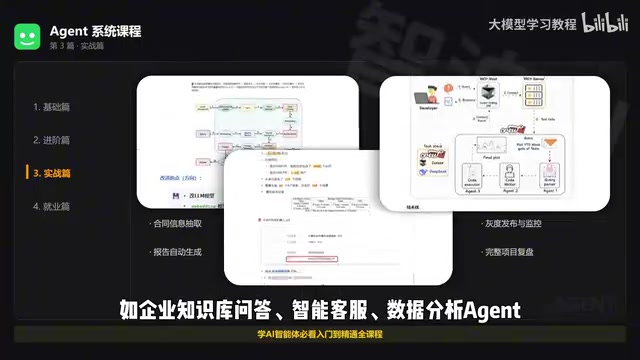
The commonality of these cases is "high-frequency, essential, reusable." Enterprise knowledge base Q&A and intelligent customer service are the most mature commercialization directions for Agents; data analysis and document processing directly correspond to daily office efficiency. The course emphasizes "transforming theoretical knowledge into practical applications" and explicitly states the goal of knowledge monetization, indicating its design logic is not purely technical demonstration but output-oriented.
Enterprise knowledge base Q&A and intelligent customer service are the two most mature directions for Agent commercialization, but their engineering requirements differ significantly. The core challenges of knowledge base Q&A lie in document parsing (PDF/tables/scanned documents), permission isolation, and recall accuracy, typically using a "RAG + citation traceability" architecture with fallback responses to prevent irrelevant answers. Intelligent customer service emphasizes multi-turn dialogue state management, intent recognition, and human handoff mechanisms, often requiring integration with CRM and ticketing systems. Both face the "cold start" problem: when the initial knowledge base is incomplete, feedback loops must be designed for operations staff to continuously annotate and supplement. If the course covers these non-functional details, its practical value would significantly increase.
Employment Section: Project Experience and Interview Breakdown
The employment section is relatively rare in technical courses: organizing completed projects into resume-worthy experience, breaking down high-frequency questions in Agent job interviews, and guiding application directions and expression methods.
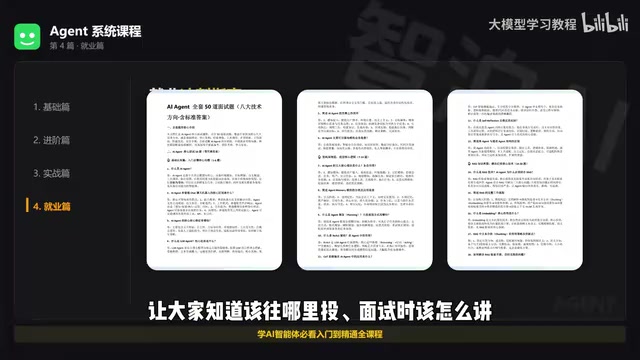
The value of this module depends on the substance of the course projects themselves. If the practical projects have sufficient complexity and completeness, converting them into resume material is feasible; but if projects remain at demonstration level, learners still need to strengthen their job competitiveness independently.
Agent job interviews typically examine three levels: first, basic concepts such as LLM invocation parameters (temperature, top_p), Function Calling principles, and the trade-offs between RAG and fine-tuning; second, engineering capabilities such as how to evaluate Agent performance (recall rate, task completion rate, human ratings), how to do prompt version management and regression testing, and how to handle tool call failures and retries; third, project depth, where interviewers probe architecture selection rationale, pitfalls encountered, and quantified benefits. When converting course projects into resume material, it's recommended to highlight a "problem-solution-metric" structure, for example "improved knowledge base Q&A accuracy from X% to Y% by introducing reranking," rather than merely listing the tech stack. Without real business data, offline evaluation sets can be designed to substantiate results.
Objective Review: Advantages of Long Courses and Points to Verify
The 748-episode volume means extremely high content coverage, but also brings two practical issues. First, whether the learning curve is truly gentle depends on the information density and pacing of each episode, which is difficult to judge from the course introduction alone. Second, course quality must ultimately be tested by the engineering standards of project code and the timeliness of framework selection—the Agent tech stack updates quickly, and if course content cannot be continuously maintained, some chapters may quickly become outdated.
On the positive side, the course connects "basic—advanced—practical—employment" into a closed loop and provides resource packages and notes, making it friendlier for beginners lacking learning path planning ability. For engineers with some development experience who only want to fill in specific Agent-related gaps, it's more suitable to selectively read the advanced and practical sections as needed.
There are no shortcuts in learning AI Agents, but a clearly structured course can help avoid detours. To judge whether it's worth investing time, it's recommended to first sample the environment setup in the Basic section and the RAG chapter in the Advanced section, then decide whether to follow the entire course.
One-line Summary
Breakdown of Bilibili's 748-episode AI Agent course: four-stage closed loop and practical value assessment.
Paragraph Summary
Based on publicly available information about a 748-episode AI Agent development course on Bilibili, this article breaks down its content architecture and practical value. The course reconstructs the knowledge system from a zero-foundation perspective, divided into four stages: basic, advanced, practical, and employment. The Basic section hand-holds through environment setup and running the first Agent; the Advanced section covers prompt engineering, tool calling, RAG knowledge bases, workflow orchestration, and multi-agent collaboration; the Practical section focuses on high-frequency scenarios such as enterprise knowledge base Q&A, intelligent customer service, data analysis, and office automation; the Employment section guides project resume conversion and interview breakdown. The article affirms its advantages of clear path and supporting materials, while noting that under the 748-episode volume, the learning curve and project engineering depth require learners to verify through sampling, and suggests experienced learners selectively read as needed.
Related articles

JobRunner MCP Server: AI Agents Can Now Fix Failed Java Jobs
JobRunner launches an open-source MCP server enabling AI agents to view cluster status, diagnose failures, and recover Java jobs—incident response from any cloud coding environment or existing agent.

MLAI Digital Launches 9 Security Agents: MCP Server Safeguards the Full Lifecycle of Agentic AI
MLAI Digital launches Security MCP Server with nine built-in specialized security agents covering vulnerability discovery, attack simulation, prompt injection detection, API and infrastructure assessment, and accelerated remediation—embedding security validation across the full Agentic AI lifecycle from development to production.

Running Isaac Lab on H100 GPUs: Exploring Better Approaches
Exploring optimization methods for running Isaac Lab on NVIDIA H100 GPUs, including MIG configuration, mixed precision, TensorRT acceleration, and community experience to improve robotics simulation and reinforcement learning efficiency.