MLAI Digital Launches 9 Security Agents: MCP Server Safeguards the Full Lifecycle of Agentic AI

MLAI Digital's Security MCP Server embeds nine security agents into AI workflows for full-lifecycle Agentic AI security automation.
MLAI Digital's Security MCP Server targets Agentic AI security pain points by embedding nine specialized security agents (vulnerability discovery, attack simulation, prompt injection detection, API and infrastructure assessment, accelerated remediation) into AI workflows via MCP. It advocates shifting security validation left—automatically scanning and simulating during development rather than remediating after launch—with the core philosophy of "find gaps before attackers do." The article analyzes Agentic AI's unique attack surface (prompt injection, tool abuse, data poisoning), notes traditional tools struggle to cover it, and highlights the engineering value of multi-agent division of labor and standardized MCP integration. It also reminds production teams to watch undisclosed metrics like detection logic, false positive rates, and framework compatibility.
Building Agentic AI is no longer difficult—the real challenge is making it secure, resilient, and production-ready. MLAI Digital's Security MCP Server is aimed squarely at this pain point: embedding nine specialized security agents into AI workflows so that security is no longer an after-the-fact check, but runs through the entire lifecycle from agent development to production deployment.
Why Agentic AI Needs a Dedicated Security Layer
Traditional applications have relatively clear security boundaries: code, dependencies, network, APIs—harden each layer and you're done. But Agentic AI introduces an entirely new attack surface—agents plan autonomously, invoke tools, read external data, and generate natural language responses, which means attackers can indirectly manipulate system behavior through prompt injection, tool abuse, data poisoning, and other means.
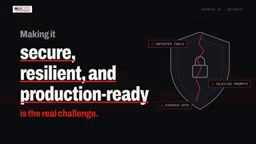
In its official video, MLAI Digital puts it bluntly: "Building Agentic AI is easy, but making it secure, resilient, and production-ready is the real challenge." This statement captures the core contradiction in today's AI engineering: capabilities iterate far faster than security validation. The positioning of Security MCP Server is to fill the missing layer of security automation in agent workflows.
Prompt injection is the most typical attack method against Agentic AI, referring to attackers disguising malicious instructions as normal input (such as user messages, web content, or tool return results) to induce the agent to perform unintended actions—for example, leaking system prompts, invoking tools without authorization, or executing dangerous operations. Unlike traditional SQL injection, prompt injection has no strict syntactic boundaries and is harder to defend against, often requiring a combination of input filtering, instruction isolation, output validation, and other layered measures.
Data poisoning involves contaminating data sources during model training or retrieval, causing the agent to produce biased outputs or perform malicious actions during inference. For Agentic AI that relies on external knowledge bases or real-time retrieval, the harm of data poisoning is especially insidious—it can lie dormant for a long time without being noticed.
Nine Security Agents Covering the Full Attack Surface Chain
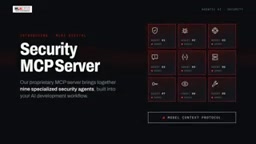
The core design of Security MCP Server is to break security capabilities down into nine specialized agents, each responsible for one category of security task and running directly embedded in AI workflows. According to the official description, these agents cover the following areas:
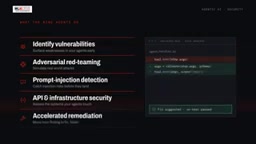
- Vulnerability discovery: Automatically identify security flaws at the code and configuration level during agent construction
- Real attack simulation: Simulate attack paths from an attacker's perspective to verify whether defenses actually work
- Prompt injection detection: Identify and block malicious instruction injection—the most typical attack method against Agentic AI
- API and infrastructure security assessment: Check the exposure surface of external interfaces and underlying infrastructure invoked by agents
- Accelerated remediation: Not only find problems but also drive rapid closure of vulnerabilities
This "multi-agent division of labor" architecture is worth noting. A single security scanning tool often covers only one category of issues, whereas splitting detection, attack simulation, assessment, and remediation across different agents—orchestrated uniformly by MCP (Model Context Protocol)—better matches the need for multi-dimensional cross-validation in real-world attack and defense scenarios.
The MCP Protocol: The Adhesive Between Security Capabilities and AI Workflows
The MCP in the product name is not a marketing gimmick. Model Context Protocol is a protocol layer that standardizes how AI models connect to external tools and data sources. By choosing to切入 at this layer (enter at this layer), Security MCP Server means security agents can integrate directly with developers' existing AI workflows without building a separate testing pipeline.
From an engineering perspective, the value of this integration lies in two points. First, security validation is "shifted left"—vulnerability scanning and attack simulation can be performed continuously during agent development, rather than waiting until after launch to do penetration testing. Second, validation is built into the AI lifecycle, so every iteration automatically runs through a security baseline, reducing the manual effort of testing. The company summarizes this as "find gaps before attackers do"—precisely the extension of DevSecOps principles into the Agentic AI context.
Model Context Protocol (MCP) is a standardized protocol proposed and open-sourced by Anthropic, designed to unify how AI models interact with external tools and data sources. It abstracts tool invocation into a "server-client" architecture: MCP Servers expose tool capabilities, and AI clients discover and invoke these tools through standard interfaces. This design allows security agents to plug into any MCP-compatible AI workflow in a "plug-and-play" manner, eliminating the need for separate adaptation for each agent framework, thereby reducing integration costs and improving portability.
Practical Implications for Development Teams
For teams building Agentic AI products, the emergence of tools like this highlights a real problem: security testing for agents cannot rely solely on general-purpose vulnerability scanners. Issues such as prompt injection, tool invocation chain contamination, and contextual privilege escalation require detection methods designed specifically for LLM interaction patterns. Security MCP Server encapsulates such detection into agents that can be embedded in workflows, lowering the barrier for teams to build their own security capabilities.
However, the official video is currently more of a capability overview and has not yet disclosed the specific detection logic of each agent, false positive rate data, or compatibility details with mainstream agent frameworks. For production teams evaluating whether to adopt it, these will be key metrics to verify. Ultimately, the value of a security tool depends on its detection rate and operability in real-world attack and defense—not on the number of agents stacked together.
Looking at industry trends, as Agentic AI moves from demos to production, security toolchains围绕 its lifecycle (around its lifecycle) are rapidly taking shape. MLAI Digital's Security MCP Server is a clear signal in this direction: security is no longer the last checkpoint before an agent goes live, but is decomposed, embedded, and automated into every link of the development process.
One-line Summary
MLAI Digital launches Security MCP Server, embedding nine security agents into AI workflows to achieve full lifecycle security automation for Agentic AI.
Paragraph Summary
MLAI Digital's Security MCP Server targets the security pain points of Agentic AI by embedding nine specialized security agents (covering vulnerability discovery, attack simulation, prompt injection detection, API and infrastructure assessment, and accelerated remediation) into AI workflows via the MCP protocol. The product advocates shifting security validation left—automatically performing scans and simulations during agent development rather than remediating after launch—with the core philosophy of "find gaps before attackers do." The article analyzes the attack surface unique to Agentic AI (such as prompt injection, tool abuse, and data poisoning), notes that traditional security tools struggle to cover it, and emphasizes the engineering value of multi-agent division of labor and standardized MCP integration. It also reminds production teams to pay attention to key metrics not yet disclosed by the company, such as detection logic, false positive rates, and framework compatibility.
Related articles

Meta vs. Publishers: The AI Data Battle Over Terms of Service Changes and the Future of the Internet
Meta changed its business account terms to allow AI training on linked website data, sparking backlash from publishers and creators. Industry groups demanded negotiations, forcing Meta to remove 'training' wording and delay the effective date. The dispute reveals the deeper battle over data authorization and the future of the internet in the AI era.

When Outside Xbox Meets Blood on the Clocktower: A Legion Match in Minecraft
Outside Xbox guests Ellen and Mike play Minecraft Blood on the Clocktower in a Legion game. How can three good players fight an evil majority amid information noise? This article breaks down Legion mechanics, information-role mind games, and the endgame reversal.

Kimi K3.1 Hands-On Test: Open-Source Model Nears Opus, Video Generation Steals the Show
Kimi K3.1 completed motion graphics, 3D rendering, mini-games, and video generation in a live test. Analysis of its 2.8T MoE architecture, gap vs Opus/GPT, and hidden video generation.