748-Episode Python Course Breakdown: The Real Learning Path from Zero to Freelancing

748-episode beginner Python course on Bilibili: solid framework, but treat the "ready to freelance" promises skeptically.
A Bilibili creator released a 748-episode Python course spanning fundamentals, intermediate, and applied skills — covering syntax through web scraping, data analysis, and machine learning, with mind maps and study plans included. The course structure is sound and works well as a systematic beginner reference. However, claims like "748 episodes," "finish and freelance," and "cut 99% of the learning curve" are mostly marketing — episode count doesn't guarantee quality, and real freelancing requires project experience and engineering skills beyond any single course.
A Systematic Python Course for Absolute Beginners
A Bilibili content creator has launched a brand-new Python course series, claiming it took three months to produce and spans 748 episodes — covering everything from basic syntax to web scraping, data analysis, and machine learning. Before filming, the author spent roughly a month restructuring the curriculum from the perspective of a complete beginner, referencing a wide range of similar courses on Bilibili — from videos with millions of views to those with just dozens. The conclusion: the existing landscape is a mixed bag, and courses that are both beginner-friendly and paired with sufficient practice materials are few and far between.
This pain point deserves serious attention from anyone learning to code on their own. For self-learners, the biggest risk isn't that a course is too shallow — it's that concepts jump around without a continuous feedback loop of practice, leaving learners in the frustrating position of "understanding it but not being able to write it." Positioning the course explicitly for beginners and combining conceptual explanations with hands-on examples is the right approach.
Three Modules: A Progressive Design from Fundamentals to Real-World Skills
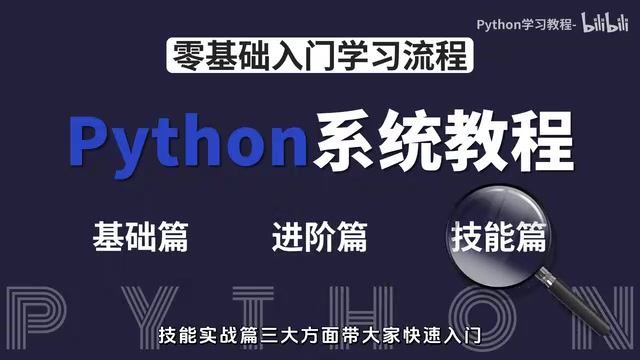
The course is divided into three stages — Fundamentals, Intermediate, and Applied Skills — a fairly standard and sensible structure for learning programming.
Fundamentals: Building the Foundation
The fundamentals section starts with software installation and works through core concepts like variables, operators, loops, strings, and tuples. For complete beginners, setting up a development environment and grasping basic syntax are often the first major hurdles. Taking the time to explain this section clearly and at a measured pace genuinely lowers the barrier to entry.
Intermediate: Leveling Up Your Development Skills
The intermediate section moves into object-oriented programming (OOP), exception handling, regular expressions, and more. These topics are the bridge between "writing scripts" and "writing production-quality code." OOP shapes how code is organized; exception handling determines a program's robustness; and regular expressions are an essential tool for text processing and web scraping. The author also mentions providing a complete set of mind maps for the entire course — a valuable resource for reducing the note-taking burden, especially for learners studying in fragmented time slots.
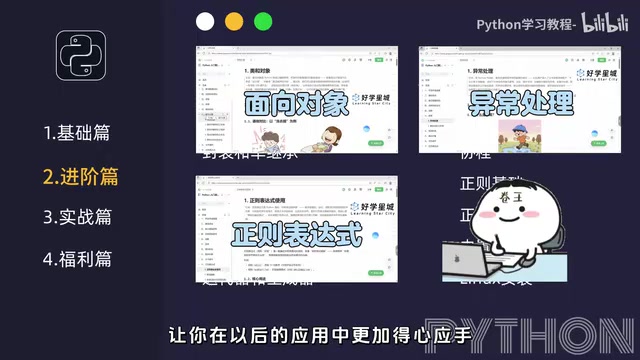
OOP is one of the most significant conceptual leaps in intermediate Python learning. It encapsulates data and the functions that operate on it within "classes," and uses inheritance, encapsulation, and polymorphism to make code more reusable and maintainable. For beginners, transitioning from writing linear scripts to thinking in OOP terms takes time to adjust to — which is precisely why so many self-learners get stuck at the intermediate stage. Regular expressions (Regex) represent another steep learning curve, with dense syntax symbols like \d+, [a-z]*, and (?:...) that can feel intimidating at first. But once mastered, they dramatically boost efficiency in web scraping, text cleaning, and similar tasks. Learners are advised to invest extra time in both of these topics and practice repeatedly with real-world examples — not just watch the videos through.
Applied Skills: From Learning to Doing
The applied skills section is arguably the most compelling part of the course, covering topics like scraping images and videos, office automation, data analysis, and machine learning. These directions map almost perfectly onto Python's most mainstream use cases: web scraping and office automation have a low barrier to entry with quick, visible results — great for building momentum; data analysis and machine learning are higher-level skills suited for the big data era. The author frames this stage's goal explicitly as "putting knowledge to use and monetizing skills," which echoes the headline claim of "finish and start freelancing or get a job."
Data analysis and machine learning in the Python ecosystem rely on a fairly established set of tools: data analysis typically involves NumPy (numerical computation), Pandas (tabular data manipulation), and Matplotlib/Seaborn (data visualization); machine learning centers on Scikit-learn as the primary entry-level framework, with TensorFlow or PyTorch for deep learning. For beginners, each of these libraries carries its own learning curve. Whether the course systematically covers the core usage of these tools — or merely offers surface-level demonstrations — will directly determine the real value of the applied section. Common libraries for web scraping include Requests (making HTTP requests) and BeautifulSoup/Scrapy (parsing pages), while office automation typically relies on libraries like openpyxl and python-docx. Understanding this tech stack helps learners assess whether a course's coverage goes deep enough.
Supplementary Resources: Study Plans and Materials
Beyond the video content, the author promises a bundle of supplementary resources: a development environment setup guide, a "Python 0 to 1" study schedule, course slides, recommended books, and various practice materials.
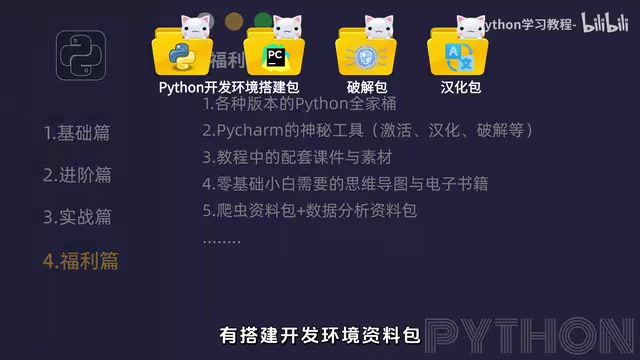
For self-learners, a structured study schedule can be just as valuable as the videos themselves. Programming learning most often derails from a lack of rhythm — two hours of studying today, then nothing for a week makes long-term retention nearly impossible. A clear roadmap from zero to one helps learners break down those 748 episodes into manageable daily tasks.
A Realistic Take: 748 Episodes and "Ready to Freelance"
It's worth noting that some of the marketing language in the promotional copy deserves a healthy dose of skepticism.
"748 episodes" sounds impressive, but episode count doesn't equal quality. When individual episodes are short and topics are finely segmented, the total number naturally inflates. What actually determines learning outcomes is content density and the quality of the practice feedback loop — not the episode count. Similarly, "finish the course and start freelancing or land a job" is a significant promise. Python freelancing and employment require far more than syntax knowledge — project experience, engineering standards, communication skills, and collaboration ability all play essential roles. Watching through a single course series rarely gets you all the way there. Phrases like "cut 99% of the learning curve" are also classic clickbait.
Objectively speaking, the course's structural design — Fundamentals → Intermediate → Applied Skills — along with its supplementary materials (mind maps, study plans, practice packs) is well-thought-out and comprehensive, making it a reasonable systematic reference for beginners. Whether it can live up to its self-proclaimed title of "the most complete and beginner-friendly course on the entire internet" still depends on the actual quality of the instruction — something learners will need to judge by watching a few episodes themselves.
Python "freelancing" typically refers to taking on small development projects through platforms like Zhubajie or Chengxuyuan Kezhan, with common requests including data scraping scripts, automation tools, and basic data analysis reports. The real barrier to freelancing isn't "finishing the course" — it's the ability to independently analyze requirements, handle unexpected issues in real-world data, and communicate effectively with clients. The bar for employment is even higher, typically requiring version control (Git), basic software engineering practices, and a portfolio of demonstrable projects. Understanding the gap between "watching the videos" and "being ready to freelance or work" helps learners set realistic milestones and avoid giving up when expectations don't match reality.
Advice for Self-Learners
If you're planning to use a large-scale free course like this to get started, a few principles are worth keeping in mind: prioritize writing code alongside the practical examples rather than passively watching; use the provided study schedule to maintain a consistent daily learning rhythm; don't linger too long in the fundamentals — push into project work that produces real results as soon as possible; and keep realistic expectations about freelancing and employment, treating them as long-term goals rather than quick outcomes. A structured course solves the problem of "what to learn" and "in what order" — the rest comes down to consistent, hands-on practice.
Related articles

Felix Rieseberg Personal Homepage
Felix Rieseberg's personal homepage sparks attention on Hacker News. This article covers the Slack engineer's technical background, the rise and fall of nativefier, and the value of a developer homepage as a tech calling card.

@ai-sdk/vue 3.0.306 Patch Release Syncs with [email protected] Update
@ai-sdk/vue 3.0.306 released, synced with [email protected]. A routine patch release for the Vercel AI SDK ecosystem with no public API changes; the Vue adapter layer stays version-aligned with the core package.

Gemini 4 Argon API Launches: The Era of Million-Token Output Begins
Google launches Gemini 4 Argon with sparse MoE architecture, up to 1M output tokens, and a 68.90% Vals Index score, available across API, AI Studio, and the Gemini app.