7900XTX Local Deployment of Qwen3 in Practice: 53 TPS Inference Speed Optimization Guide
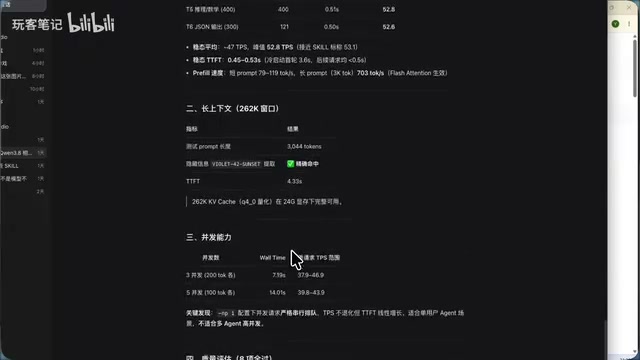
Deploy Qwen3 27B on AMD 7900XTX achieving 53 TPS through Q4 quantization and optimization techniques
A practical guide demonstrating how to deploy Qwen3 27B model on AMD RX 7900XTX 24GB graphics card, achieving 47~53 TPS inference speed through three key optimizations: 262K ultra-long context, KV Cache Q4 quantization, and MTP speculative sampling. Includes detailed comparison of quantization precision loss across levels and step-by-step installation tutorial.
Consumer-Grade GPUs Can Also Handle Local Large Model Deployment
As open-source large models continue to grow in capability, more developers and enthusiasts are attempting local deployment to gain advantages like data privacy, offline availability, and low-cost inference. Based on a hands-on tutorial from a Bilibili content creator, this article walks through how to achieve impressive performance running the Qwen3 27B-level model on a single AMD RX 7900XTX 24GB graphics card.
With this setup, the author achieved a combination of 262K ultra-long context, KV Cache Q4 quantization, and MTP speculative sampling, ultimately pushing the 24GB VRAM to 99% utilization with output speeds reaching 5253 TPS (Tokens Per Second) at peak and averaging around 47 TPS. TPS is the core metric for measuring large language model inference speed, specifically referring to the number of tokens the model generates per second during the generation phase. Humans read English at approximately 45 tokens per second, so when generation speed exceeds 1520 TPS, users perceive virtually no waiting during interaction. An output speed of 4753 TPS means the model generates far faster than humans can read, essentially equivalent to instant response in practical use. For reference, running a similarly scaled Q4 quantized model on an NVIDIA RTX 4090 (24GB) typically achieves generation speeds in the 40~60 TPS range, indicating that the 7900XTX, after optimization, can approach or even match the inference performance of equivalent NVIDIA flagship consumer cards.
Hardware Configuration and Key Parameter Analysis
Core Hardware: GPU Is the Star
The author admits the system's CPU is just an entry-level Ryzen 3700, and while it has 94GB of RAM, nowhere near that much is actually needed. What truly determines success is the 7900XTX 24GB graphics card. This confirms a core principle: for running large models locally, VRAM capacity and bandwidth are the bottlenecks—CPU is not the critical factor.
For AMD graphics card users, this is a signal worth noting—in the past, local large model deployment was almost monopolized by NVIDIA's CUDA ecosystem, but now through llama.cpp's AMD support path, AMD cards can also deliver solid inference performance. llama.cpp is an open-source C/C++ large language model inference framework developed by Georgi Gerganov, designed to efficiently run quantized large models on consumer-grade hardware. Initially supporting only pure CPU inference, it gradually expanded to heterogeneous computing backends including NVIDIA CUDA, Apple Metal, and AMD ROCm/HIP. AMD graphics cards gained GPU acceleration capability through the ROCm (Radeon Open Compute) platform, which provides a CUDA-like programming interface called HIP, allowing many core operators originally written for CUDA to be ported to AMD GPUs at relatively low cost. The 7900XTX uses the RDNA 3 architecture and received official support in ROCm 6.x, marking AMD consumer graphics cards entering a practical stage in the large model inference field.
Three Key Optimization Parameters
The author attributes maximum performance to the combination of three key settings:
- 262K ultra-long context: Far exceeding the typical 8K~32K common in local deployment, capable of handling ultra-long documents and complex conversations.
- KV Cache Q4 quantization: Applies Q4 quantization to key-value cache, dramatically reducing VRAM usage and thus freeing up space to support longer context windows.
- MTP speculative sampling (Multi-Token Prediction): Through speculative decoding, predicts multiple tokens at once, significantly boosting generation throughput.
Technical Principles of KV Cache and Q4 Quantization
KV Cache (Key-Value Cache) is the core acceleration mechanism in Transformer architecture during autoregressive generation. When generating each new token, the model needs the attention Key and Value vectors from all previous tokens. Without caching, each token generation would require recalculating KV for the entire sequence, with computational complexity growing quadratically with sequence length. KV Cache saves already-computed KV vectors in VRAM for reuse, reducing complexity to linear, but at the cost of VRAM usage growing linearly with context length. For a 27B parameter model at 262K context length, FP16 precision KV Cache could require tens of GB of VRAM. Q4 quantization compresses each cached value from 16-bit floating point to approximately 4-bit integer representation, directly reducing VRAM usage to about one-quarter. Q4_K_M is a mixed quantization scheme in llama.cpp that applies different quantization strategies to different model layers—key layers maintain higher precision while redundant layers use more aggressive compression, achieving significant VRAM savings with only 2%~5% overall precision loss.
How MTP Speculative Sampling Works
MTP (Multi-Token Prediction) speculative sampling is a decoding strategy that accelerates generation speed in autoregressive language models. Traditional autoregressive generation produces only one token per forward pass, limited by model inference latency, creating a natural throughput bottleneck. The core idea of Speculative Decoding is: use a lightweight "draft model" to quickly predict multiple candidate tokens at once, then use the full large model to verify these candidate tokens in parallel. Since Transformers can process multiple tokens simultaneously in verification mode (similar to the prefill stage), the cost of verifying multiple tokens differs little from verifying a single token. The Qwen3 model has MTP modules built-in natively, requiring no separate draft model—the model's own auxiliary prediction heads can generate candidate sequences, further simplifying deployment. When candidate token acceptance rate is high, each forward pass can output 24 effective tokens, thereby boosting overall generation speed by 1.5x3x, which is the key technical support for the 47~53 TPS high throughput in this article.
With all three combined, GPU VRAM usage reaches 23.9GB / 24GB, running almost completely full while maintaining high hit rate and concurrency. This "maximum squeeze" tuning approach is typical of cost-effective local deployment.
Can Q4 Quantization Really Be Used? Precision Loss Comparison Across Quantization Levels
Many users have doubts about quantization precision, worrying that quantization will severely harm model quality. Here's a comparison of precision loss across quantization levels:
| Quantization Version | Precision Loss | Use Case |
|---|---|---|
| Q5 | Nearly lossless, indistinguishable to humans | High-quality choice when VRAM is sufficient |
| Q4 | ~2%~5% loss | Golden balance point, default first choice for most scenarios |
| Q3 | ~8%~15% loss | Compromise when VRAM is insufficient |
| Q2 | ~30%~50% loss | Not recommended |
The conclusion is crystal clear: Q4 is the optimal solution for most users. It strikes an excellent balance between quality and VRAM usage. 24GB VRAM paired with Q4_K_M version is the sweet spot combination. Only on low-end devices with truly insufficient VRAM should you consider falling back to Q3; Q2's loss is too severe and has limited practical value.
VRAM Capacity and Model Scale Selection Guide
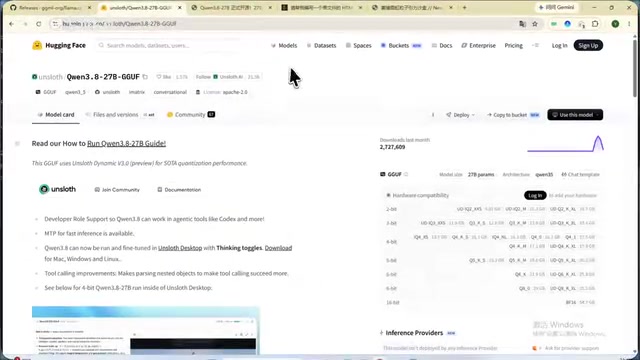
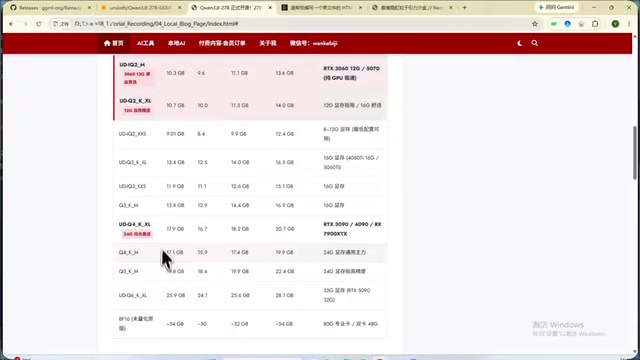
When choosing model scale for local deployment, VRAM capacity is the most critical constraint. Under Q4 quantization, model weight VRAM usage is roughly: parameters (billions) × 0.5GB. For example, a 27B model occupies about 13.5GB, with remaining VRAM used for KV Cache, computational intermediate states, and system overhead. This explains why 24GB VRAM can support a 27B Q4 model with 262K context—through Q4 quantization of KV Cache, the tens of GB of cache originally needed is compressed to an acceptable range. For graphics cards with 16GB VRAM (such as RTX 4060 Ti 16GB or RX 7800XT 16GB), it's recommended to choose 14B-level Q4 models or 27B Q2/Q3 models, but context length must be shortened accordingly. 8GB VRAM typically can only run 7B8B level Q4 models, with context length limited to the 8K16K range.
Step-by-Step Deployment Tutorial: Running Qwen3 Locally from Scratch
Three Things You Need Before Deployment
The entire deployment process is actually not complicated. You need three core components:
- Model file: Choose the corresponding quantization version based on VRAM capacity. 24GB VRAM recommended Q4_K_M.
- Inference engine (llama.cpp): Windows users recommended llama.cpp; Mac users can use LM Studio or similar tools.
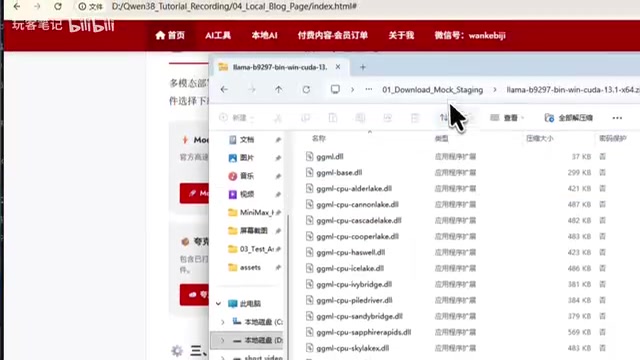
- Corresponding runtime: NVIDIA users download CUDA version (30 series and later use CUDA 13), AMD users download AMD card-specific version.
The author specifically reminds that CUDA-related files need to be downloaded together, and models should strictly match VRAM capacity.
Detailed Installation Steps
The deployment process can be summarized in these steps:
- Extract the llama.cpp folder and copy-paste the CUDA (or AMD runtime) files into that folder.
- Create a
modelsfolder in the root directory and place the downloaded model file inside. - Place the one-click startup script in the root directory. The author provides both a 24GB-specific version and a multi-model free-switching version.
- Double-click to run the one-click startup script.
After successful startup, the program will display a local access address. Paste 127.0.0.1:8080 into your browser and press Enter to access the web interface.
Model Loading and Actual Use
After entering the interface, select the corresponding quantization version from the model list (Q4 users select Q4, low-end devices select Q2), wait for loading to complete, and you can start conversing. The author also demonstrated a flashy webpage generated with this model, proving its code generation capability is quite reliable.
Summary: Key Takeaways from AMD Graphics Card Local Large Model Deployment
This tutorial brings several important insights for local large model deployment:
First, AMD graphics card local inference ecosystem is maturing. The 7900XTX, with its 24GB large VRAM, has become a cost-effective choice for consumer-level local deployment, no longer exclusive to NVIDIA. As the ROCm platform's support for RDNA 3 architecture continues to improve and open-source frameworks like llama.cpp keep optimizing AMD backends, AMD card users' experience in local large model inference is rapidly catching up to the NVIDIA ecosystem.
Second, parameter tuning is more critical than piling on hardware. Through techniques like KV Cache quantization and MTP speculative sampling, ultra-long context and high throughput can be achieved with limited VRAM, demonstrating the value of engineering optimization. These techniques aren't simple "switch-style" configurations but require understanding the memory characteristics of attention mechanisms in Transformer architecture, computational bottlenecks in autoregressive generation, and the differentiated impact of quantization on different model layers to find the optimal parameter combination.
Finally, Q4 quantization is the practical consensus for local deployment. Between quality and resource usage, Q4 provides the best balance and deserves to be the default choice.
For users hoping to have a controllable, private, and free powerful AI assistant locally, this solution provides a highly practical reference path.
Key Points
Related articles

DeepCell: One-Click AI Generation of Documents, Spreadsheets, and Slides
DeepCell tops Product Hunt with one-click generation of documents, spreadsheets, and slides, using the .deepcell format for linked updates, designed for System 2 tasks like modeling and sales reviews.

Doneas: 15-Minute Daily Accountability Calls That Keep Indie Developers From Procrastinating
Doneas is a daily accountability tool for indie developers: plan tasks on Monday, join a 15-minute call with five builders each day, and log deliveries on a public progress page. This article analyzes its core mechanics, effectiveness, and potential issues around retention and matching.

Fastlane 2.0: Fully Automated AI Ad Campaigns, From Creative to Optimization
Fastlane 2.0 is an AI ad automation tool: enter your website and it learns your brand, generates video and image ads, and runs and optimizes them on Meta, TikTok, Instagram, and YouTube.