8 AI Video Models Tested on the Same Prompt: Kling 4.0 Edges Out Seedance 2.5

8 AI video models blind-tested on the same prompt and platform; Kling 4.0 wins with 35 points, compound instructions emerge as a shared weakness.
A YouTube creator ran an unedited, no-retry blind comparison of 8 of the latest AI video models on the Higgs Field platform using the same complex continuous-shot prompt, scoring prompt accuracy, motion and physics, consistency, and realism at 10 points each. Kling 4.0 led alone with 35, while Gemini Omni Flash 1.1, Minimax H3, and Seedance 2.5 tied for second at 33, with WAN 3.0 Prime, Seedance 2.0, Flux 3 Video, and Grok Imagine 1.5 spread between 29 and 32. The test reveals three signals: compound prompts are a shared weakness, resolution and image quality are not determining factors, and version upgrades don't guarantee all-around progress — Seedance 2.5 improved in texture but missed instructions.
A Blind AI Video Test With No Editing Tricks
With AI video models proliferating, it's hard for ordinary users to tell which one truly delivers. A YouTube creator ran a fairly rigorous head-to-head comparison: feeding the same prompt to 8 of the latest AI video models, generating on the exact same platform, with the same 10-second duration and the same 16:9 aspect ratio, with no cherry-picking or retry-based polishing. The prompt described a complex continuous shot — an astronaut in a weathered white spacesuit walking slowly through a neon-lit city on a rainy night, the camera smoothly pulling back to keep the subject centered, passersby naturally walking by under transparent umbrellas, vehicles splashing water, and the astronaut briefly turning his head to look at a glowing skyscraper.
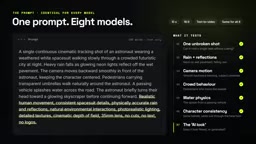
All models ran on the Higgs Field platform; the creator only had to paste the prompt once and then switch through models via the model selector. The models tested included Kling 4.0, Seedance 2.5, Seedance 2.0, Minimax H3, WAN 3.0 Prime, Grok Imagine 1.5, Lux 3 Video, and Gemini Omni Flash 1.1. Scoring covered four dimensions: prompt accuracy, motion and physics, consistency (whether the astronaut remains the same astronaut throughout), and realism (whether it's obvious at a glance that it's AI), each out of 10 points.
Higgs Field is an aggregator AI video generation platform where users can switch between base models from different vendors within the same interface, without registering and subscribing separately. The value of such platforms lies in simplifying the variable control of "model comparison": prompt, duration, aspect ratio, resolution and other parameters stay consistent within a single session, avoiding bias introduced by differing default settings across platforms. For evaluation purposes, running on the same platform means differences in generated results are more likely to come from the models themselves rather than platform pre-processing or post-processing pipelines. Note, however, that aggregator platforms sometimes apply uniform rewriting or safety filtering to input prompts, and may impose resolution caps on some models, so "same platform" is not entirely equivalent to "same underlying parameters." Readers looking at such comparisons should pay attention to whether the platform discloses details like default sampling steps and guidance coefficients.
The Mid-Tier Contenders: Each Has Highlights and Each Has Flaws
Models scoring in the 28–33 range show clear specialization. WAN 3.0 Prime scored 32, with an overall texture close to real street photography, but the astronaut's helmet visor had obvious flaws. Gemini Omni Flash 1.1 and Minimax H3 tied at 33; the former hit almost all elements — splashes, head turn, transparent umbrellas — while the latter, despite only offering a 2K resolution option, had a darker, more cinematic atmosphere.
Flux 3 Video scored 29; the creator considered its crowd faces the most natural, at the cost of the astronaut nearly drowning in the crowd — the subject was lost. Grok Imagine 1.5 supports a maximum of only 720p, and its splash effect was the largest of the bunch, but it splashed so exaggeratedly it looked like a geyser, and the camera also drifted. The baseline Seedance 2.0 scored 30, with umbrellas and vehicles in place, but the crowd looked copy-pasted.
Prompt accuracy and realism are often conflated in AI video evaluations, but they measure different capabilities. Prompt accuracy examines how well a model parses and executes compound instructions — whether the subject's action (head turn), environmental events (splashes, transparent umbrellas, passing vehicles), and camera movement (smooth pullback, subject centered) occur as described. Realism examines whether the image is easily identified at a glance as AI-generated, involving perceptual aspects like materials, lighting, faces, and motion blur. A model can very well have high realism yet miss key actions, or have all the events present while the image looks obviously plastic. Precisely because these two can diverge, scoring the four dimensions separately in this test is meaningful; with only a single total score, a model like Seedance 2.5 ("strong texture, weak execution") would be lumped together with a model like Grok Imagine 1.5 ("execution highlights, limited image quality").
Seedance 2.0 vs. 2.5: Version Differences Under the Same Prompt
The comparison between the two Seedance generations is telling. 2.0 generates up to 15 seconds per generation, while 2.5 raises this to 30 seconds. In the same shot, 2.5's frame is closer to the subject, with noticeably richer spacesuit detail and lighting layers; 2.0 instead delivered more transparent umbrellas and a passing car. Ultimately 2.5 scored 3 points higher than 2.0 — it won on detail texture, but missed specific events from the prompt, with neither the splashes nor the head turn appearing.
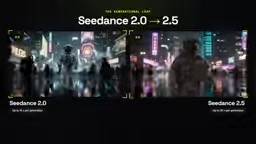
This trade-off reveals a common dilemma: as models get stronger, the improvement often shows up in image texture and consistency, while execution of compound instructions with multiple events and actions may actually regress. For creators who need precise storyboard reproduction, a version upgrade doesn't necessarily mean less hassle.
The Deciding Round: Kling 4.0 Wins 35 to 33
The final showdown came down to Kling 4.0 versus Seedance 2.5. Kling 4.0 took the highest score overall at 35, with the four dimensions at 8, 9, 9, and 9. Its camera movement was the smoothest of the eight, and the head-turn action requested in the prompt actually happened. Seedance 2.5 scored 33, with outstanding spacesuit and lighting texture and 9s in both consistency and realism, but both the splashes and the head turn were absent, giving it only 7 for prompt accuracy.
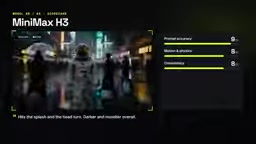
On the final leaderboard, Kling 4.0 led alone, with Gemini Omni Flash 1.1, Minimax H3, and Seedance 2.5 tied for second at 33. The creator also rated Kling 4.0 and Seedance 2.5 as the two with the strongest realism. You might not have noticed, but this was a sponsored video — yet the testing process was open and transparent: all models on the same platform, with the same parameters and the same prompt, with the entire switching process visible. That makes it more useful as a reference than most comparisons that only show curated clips.
Consistency is an easily underestimated metric in AI video. It refers to whether the same subject maintains identity stability within a shot — including face, costume details, and body proportions not drifting over time. In long shots, or when a character turns and is occluded and then reappears, diffusion-based video models are prone to "face-swapping the same character" or abrupt changes in spacesuit texture. Poor consistency directly undermines narrative credibility and makes later editing difficult. This evaluation lists consistency as a separate 10-point item precisely because complex continuous shots demand far more subject preservation than single-frame image quality; Seedance 2.5 and Kling 4.0 both scored 9 here, showing that top-tier models can now keep identity drift within a small range, while the subject-loss problems of mid-tier models (such as the astronaut being swallowed by the crowd in Flux 3 Video) are essentially consistency failures at the composition level.
What This Means for Creators
The signals from this hands-on test are quite clear. First, compound prompts are a common weakness of current AI video models; very few can simultaneously handle camera movement, subject action, and environmental interaction, and most drop the ball somewhere. Second, resolution and image quality are not determining factors — the 720p Grok Imagine 1.5 clearly suffered on the motion dimension, while Minimax H3, with only a 2K option, still tied for second thanks to its atmosphere. Third, version iteration does not equal all-around progress — Seedance 2.5 jumped in texture but left gaps in instruction execution.
For practical use, comparing multiple models on the same platform is an effective way to quickly build intuition. Running the same prompt across candidate models and scoring them on prompt accuracy, motion, consistency, and realism is a better way to judge which suits your current project than watching official demo reels. Choose high prompt accuracy for precise storyboard reproduction, and strong realism for atmosphere and texture — this approach was fully validated in this test.
Related articles

Anthropic's IPO Crisis: Why $16.8B in Revenue Can't Buy a High Valuation
Anthropic posted $16.8B in Q3 revenue with 85% gross margin yet faces a cut to its IPO valuation. A deep dive into halved growth, the token price war, circular financing, and the clash between safety ideals and capital reality.

Anthropic Races Toward the Largest IPO in History: Can a $100 Billion Raise Ignite the AI Investment Boom?
Anthropic may file its prospectus as early as October 23, aiming to raise up to $100 billion at a valuation of up to $2 trillion, potentially the largest IPO ever. Q3 revenue hit $16.8 billion, up nearly 50% quarter over quarter, with adjusted profitability, but slowing growth has led some investors to cut valuation to $1.5 trillion. The IPO is a key test of whether the AI investment boom can continue.

Bessemer Partner on Anthropic IPO: The Public's First Direct Investment in AI Software
Bessemer partner Byron Theta on the Anthropic IPO: why it's called the moment everyone's been waiting for, the $650M four-round investment, the LP liquidity bind, and expectations of a 2027 IPO wave—plus open-source model pricing pressure, existential risk disclosures, and what the founders' 50.1% voting structure means for ordinary investors.