Bessemer Partner on Anthropic IPO: The Public's First Direct Investment in AI Software

Anthropic files S-1, seen as a key moment for AI software IPOs and breaking the LP liquidity freeze.
Bessemer partner Byron Theta called Anthropic's S-1 filing "the moment everyone has been waiting for," marking the public market's first pure AI software-layer investment exposure; Bessemer has invested $650M across four rounds. The article covers three main threads: industry DPI at historic lows, with Anthropic seen as the unlock point and SpaceX and OpenAI potentially following, with the floodgate effect possibly extending to 2027; S-1 risk disclosures on open-source price pressure and specialized model competition, interpreted by investors as layered coexistence of frontier, degraded, open-source, and specialized models; and the inclusion of AI existential risk in the prospectus plus the PBC governance arrangement with seven founders holding 50.1% voting power. The editor's observation notes that the IPO simultaneously tests public market valuation willingness, whether the LP bind can be broken, and whether an AI company with risk disclosures and founder control can be accepted by mainstream investors.
Why This IPO Is Called "The One Everyone's Been Waiting For"
According to an interview video on Bilibili, Bessemer Venture Partners partner Byron Theta said after Anthropic filed its S-1: "This is the moment everyone has been waiting for. AI is the super-trend of the coming decades, and this is the first real opportunity to get pure software-layer exposure."
Bessemer invested in the Claude developer as early as 2024, putting in $650 million across four rounds. For early shareholders, this IPO means substantial returns; for the broader market, it marks the AI investment theme formally extending from the hardware and infrastructure layer to the software application layer. Theta described Anthropic as "a behemoth on the software side"—previously, the AI targets available to public market investors were mostly concentrated in compute and infrastructure, with pure model and software companies almost absent.
The LP Liquidity Bind and Expectations of a "Floodgate" Opening
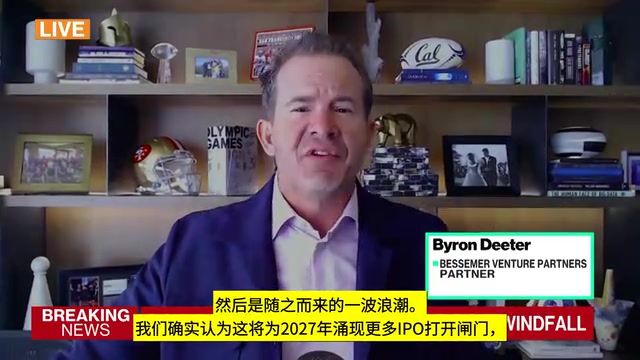
Theta offered a key judgment in the interview: industry value growth has been enormous, but DPI (distributed to paid-in capital) is at historic lows. He contrasted this with the current IPO market—deal value is three times higher than before, but the number of issuances is only one-third, and almost no distributions have occurred yet.
Against this backdrop, Anthropic is seen as the first "unlock point," with SpaceX potentially following closely, OpenAI perhaps next year, and then a wave of listings. Theta stated explicitly that this could "open the floodgates" through 2027, bringing more AI companies into the public markets. He also explained the scarcity of the time window: Q4 must avoid the election, Thanksgiving, and the Christmas holidays, leaving a very narrow usable window, so almost no company is willing to challenge Anthropic's slot at this time.
He mentioned Bessemer's upcoming AI 100 list—according to his "spoiler," every company on it is a multi-billion-dollar entity, and this batch of high-quality private companies represents the "backlog" that public market investors previously could not access.
DPI (Distribution to Paid-In Capital) is one of the core performance metrics for private equity and venture capital funds, measuring the proportion of cash actually returned to LPs (limited partners, i.e., the investors) relative to the capital they have contributed. A DPI of 1.0 means LPs have recovered all their principal; only above 1.0 does it represent true net gains. Alongside it are TVPI (total value to paid-in capital, including the book value of unrealized holdings) and IRR (internal rate of return). In an environment of rising interest rates and narrowing exit channels, many funds have acceptable paper returns (TVPI) but DPI that has long remained low, meaning LPs are not receiving real cash and their willingness to commit to new funds is affected. For this reason, the opening of the IPO floodgates matters to the venture ecosystem not only for individual project returns but also as a key link in restoring the entire industry's capital cycle.
How to Read the Risk Disclosures: Open-Source, Specialized, and Frontier Models in Layers
The risk factors section of the S-1 mentions that open-source models could pressure pricing and that specialized models could win on specific workloads. Bessemer has investments in these areas as well, and Theta's interpretation is "layered coexistence":
- Frontier models continue to set the industry pace, and companies with the most advanced projects will rely on them for many years to come;
- Frontier labs will offer degraded models as customer alternatives with better unit economics;
- Open-weight models have already secured an important place in the value chain;
- Specialized small models target scenarios such as physical AI—he cited Waymo's autonomous driving, defense tech company Saronic, and medical technology devices, whose applications may be based in part on frontier models but more often use small models focused on specific tasks.
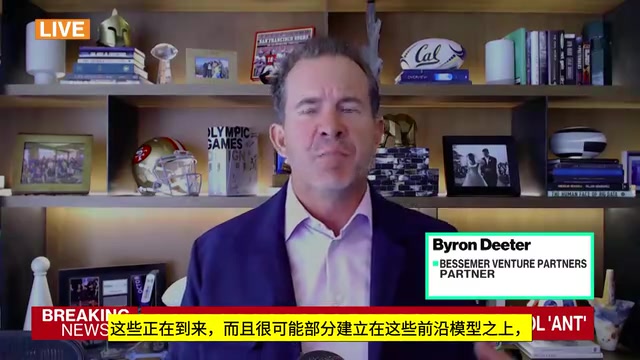
This layered picture of "frontier + degraded + open-source + specialized" explains why Anthropic, while acknowledging in its risk disclosures both open-source price pressure and specialized model competition, is still seen by investors as a core beneficiary of long-term demand.
Open-source models (open-weight models) generally refer to models whose parameters can be publicly downloaded, locally deployed, and fine-tuned, such as Meta's Llama series, Mistral, and DeepSeekAd. Unlike closed-source frontier models accessible only via API, open-weight models allow enterprises to build their own inference infrastructure with significantly lower marginal costs, making them competitive in price-sensitive or data-compliance-intensive scenarios. Specialized small models refer to models trained or distilled for specific tasks (such as autonomous driving perception, medical imaging, or industrial control), with smaller parameter counts, lower latency, and better unit economics, but limited generalization. This is precisely why the S-1 risk disclosures mention both types of competition: they erode the market space of frontier models along the dimensions of price and scenario, while frontier labs defend their customers by offering "degraded models" with slightly lower performance but lower cost.
What It Means That "Human Extinction Risk" Is Written into the Prospectus
The S-1 includes language about AI posing an existential threat to humanity. As a private market investor, Theta's response was that this disclosure "is there for a reason." Dario's team has for years publicly discussed AI's capabilities, risks, and responsibilities, and this was precisely what struck Bessemer most when it first engaged with the team—it is one of the company's founding principles.
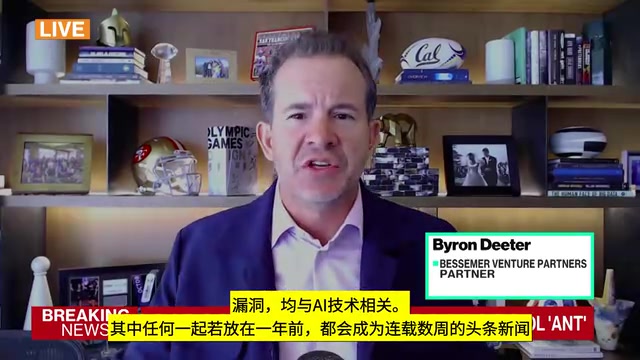
Theta also expressed confidence that this team will "lead this wave responsibly" and thanked them for their transparency. He added an observation: last week there were dozens of safety incidents related to AI technology, any one of which a year ago would have dominated headlines for weeks, and the public's perception of technological capability is becoming dulled. He expects society's adaptation process—technological, economic, and at every level—to be "bumpy."
The PBC Structure and Founders' 50.1% Voting Power: What Ordinary Investors Should Know
Anthropic maintains a public benefit corporation (PBC) structure, with seven founders collectively holding 50.1% of shareholder voting power. Theta believes this structure gives the founding team exceptionally strong leadership and governance rights; investors did not make this concession lightly, but when the leadership team is strong enough, it can unleash enormous energy—SpaceX and Meta are precedents.
For long-term investors, the key logic is that such structures allow the company to practice an extended time horizon, similar to Bezos's emphasis on being "willing to be misunderstood for long periods of time." Theta's conclusion is that public market structure and long-termism can coexist, and this governance arrangement is one way to ensure the former.
PBC (Public Benefit Corporation) is a corporate form under the laws of some U.S. states (notably Delaware) that requires a company to pursue shareholder financial returns while enshrining a specific public benefit mission in its charter and periodically disclosing its progress on that mission. Unlike traditional B Corp certification, PBC is a legal entity category rather than a third-party certification. Its significance: the board of directors is legally permitted to weigh mission alongside profit rather than being bound solely to maximizing shareholder value, providing a degree of "mission protection" when the company faces short-term performance pressure. For public market investors, this means a layer of non-financial objectives is embedded in corporate governance that must be considered in valuation and risk assessment.
Editor's Observation
The significance of this IPO goes beyond one company going public. It simultaneously tests three things: whether public markets are willing to assign a valuation to the pure AI software layer; whether the long-standing low-DPI LP bind can be broken; and whether an AI company with existential risk disclosures and founder control structures can be accepted by mainstream public investors. Theta's interview presents the optimistic version, but the risk clauses in the S-1 remind us that this "floodgate opening" will still be accompanied by turbulence.
Related articles

DeepSeek Harness Quick Start Guide: From Installation to 5 Real-World Cases
What is DeepSeek Harness? Based on a Bilibili tutorial, this article covers how this AI Agents software works, installation and setup, four working modes, and five real-world cases: a 3D racing game, official website, music player, science animation, and self-developed plugin—plus token money-saving tips.

Breaking Down DeepSeek's Super-agent Architecture: How Router+Worker Solves the Multi-Session Management Bottleneck
An analysis of DeepSeek's Super-agent paper: how the Router+Worker two-tier architecture uses Fast Pass, Chain of Recall, and storage-compute separation to solve multi-AI-session management bottlenecks, and how much it truly alleviates the human attention bottleneck and what engineering trade-offs it makes.

19K Stars in 5 Days: Why DeepSeek's Open-Source AI Programmer Went Viral
DeepSeek's open-source AI programmer hit 19K GitHub stars in 5 days. Why it went viral: the agent boom, AI writing its own code, and the shift from Q&A tools to AI employees.