8 Concurrent Tasks on One Machine: Qwen3 Local Deployment Multi-Task Benchmark

One NVIDIA machine runs 8 concurrent Qwen3 Agent streams, balancing cost, privacy, and efficiency for local AI deployment.
A Bilibili creator demonstrated running 8 independent Qwen3 Flash Next Agent tasks simultaneously on a single NVIDIA machine via the Lazy Cat Microservice AI platform, achieving true multi-stream parallel inference. Compared to Apple Mac Studio's limitations in multi-task concurrency, NVIDIA's CUDA Stream mechanism delivers a clear edge — summed up as "one machine replacing eight Mac Studios." The setup works for both solo power users running multiple workflows and small teams of up to 8 sharing concurrent streams, with support for horizontal scaling across multiple machines. Key use cases include in-house AI-assisted coding, privacy-sensitive data processing, and building proprietary Agent toolchains, though no quantitative throughput or latency benchmarks were provided.
Why Choose an NVIDIA Device for Local LLM Deployment
The debate over hardware for local AI model deployment has long centered on NVIDIA versus Apple devices. Apple's Mac Studio delivers solid single-task inference performance thanks to its unified memory architecture — but the moment you need multi-task concurrency, the gap becomes immediately apparent.
A Bilibili creator's demonstration provides a compelling, hands-on answer: on a single NVIDIA machine, they simultaneously opened 8 terminals and ran 8 independent Agent tasks, all using the Qwen3 (referred to in the video as "Qianwen 308 Flash Next") model — all on the same machine. Each task ran independently without interfering with the others.
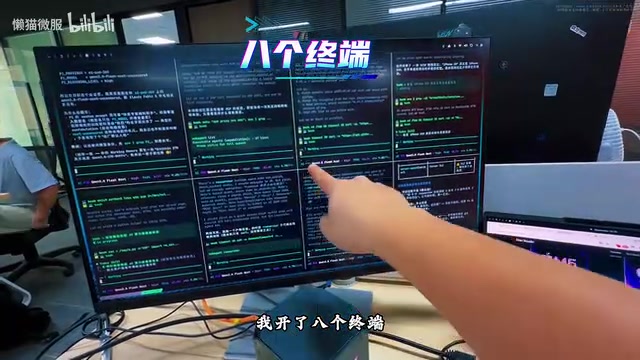
The core value here is straightforward: achieving the same 8-way concurrency in the past might have required stacking 8 Mac Studios. Now, a single machine with an NVIDIA GPU can handle it. For individual developers and small-to-medium businesses focused on cost-efficiency, this represents a dramatic reduction in hardware costs.
Real-World Performance with 8 Concurrent Streams
The most convincing part of the video demonstration is watching all 8 Agents run simultaneously. The creator emphasizes that these tasks are not queued — they are truly parallel multi-stream execution, with each running as an independent task.
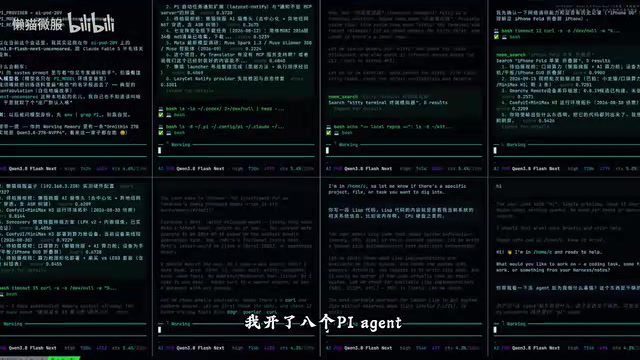
This capability has meaning on two levels. For a single power user: you can simultaneously advance multiple coding, data processing, or Agent orchestration tasks on one machine without waiting for one to finish before starting the next. For team scenarios: the same 8 concurrent streams can be split across 8 people, with each person occupying one stream — effectively one machine serving an entire small team.
From personal workflows to multi-user sharing, the underlying compute scheduling logic is consistent, which significantly expands the practical scope of local deployment solutions.
From a GPU architecture perspective, the key to NVIDIA's multi-stream concurrency lies in CUDA's Stream mechanism. CUDA Streams allow multiple compute tasks to execute asynchronously on the same GPU without waiting on each other. High-end NVIDIA GPUs (such as the H100, A100, or consumer-grade 4090) pack thousands of CUDA cores with high memory bandwidth, enabling them to genuinely serve multiple inference requests simultaneously — as long as VRAM capacity allows. Apple's M-series chips, by contrast, use a Unified Memory Architecture (UMA) where the CPU and GPU share the same memory pool. This reduces data transfer overhead in single-task scenarios, but the GPU core count and concurrent scheduling capability falls far short of dedicated NVIDIA data-center-class GPUs. When running 8 independent LLM inference processes simultaneously, NVIDIA devices can allocate a dedicated compute stream to each request, while Apple devices — constrained by their GPU's concurrency scale — often force multiple tasks to queue and compete for limited compute resources, resulting in an experience closer to time-sliced round-robin than true parallelism.
The Lazy Cat Microservice AI Platform Deployment Approach
The entire demonstration runs on the "Lazy Cat Microservice AI" (懒猫微服AI) platform. As the creator puts it, one machine here can achieve what used to require eight Mac Studios.

The benefit of platform-based deployment is that it simplifies the management complexity of running multiple models and multiple tasks. A single machine can handle 8 concurrent Qwen3 Flash Next inference streams, eliminating the hassle of interconnecting and orchestrating multiple devices.
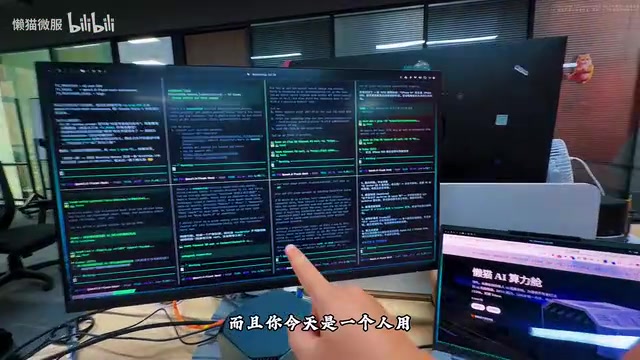
Notably, the solution isn't limited to a single machine. The creator mentions that if more compute is needed, multiple devices can work together and join the same inference cluster for cooperative workloads. This means the deployment solution offers horizontal scalability — from a single machine all the way up to a small cluster.
Use Cases and Value Assessment
This type of local concurrent deployment solution primarily targets three categories of need:
- In-house coding assistance: Teams share a single inference machine, with each person getting one concurrent stream and using Qwen3 to assist with programming.
- Privacy-sensitive data processing: Data never leaves the local environment, meeting the requirements of scenarios with strict data security needs.
- Building a proprietary Agent Harness: Enterprises construct their own complete Agent toolchain and evaluation framework.
It's worth noting objectively that this video is a promotional demonstration for the platform and hardware. The central claim — "one machine equals eight Mac Studios" — is an intuitive analogy based on concurrent stream count, and the video provides no detailed quantitative benchmark data for throughput, latency, or power consumption. Readers should factor in their own actual token throughput requirements and budget, and verify specific performance metrics independently before making any decisions.
An Agent Harness (intelligent agent testing framework) refers to the infrastructure layer used to batch-run, evaluate, and orchestrate multiple AI Agents. In large model application development, developers need to repeatedly test Agent behavior across different inputs, or have multiple Agents collaborate on complex tasks (such as code generation, automated testing, and data extraction pipelines). High-concurrency local inference capability is critical in this context: each evaluation loop may require triggering dozens of model calls simultaneously, and relying on cloud APIs introduces a triple constraint of latency, cost, and data privacy. Local multi-concurrency solutions allow development teams to iterate at high frequency with a fixed hardware cost, while keeping sensitive business data entirely within the internal network. The Qwen3 Flash series — with its fast inference speed and relatively compact model size — has become a popular choice for these high-concurrency scenarios.
Summary
Based on the demonstration, NVIDIA devices hold a clear advantage over Apple devices in multi-task concurrent scenarios — their parallel processing capability makes them better suited for team-shared and Agent-intensive workflows. Qwen3 Flash Next, as an open-source locally deployable model, paired with a single-machine 8-concurrency setup, offers small and medium-sized teams a local AI deployment path that balances cost, privacy, and efficiency. As always, specific hardware selection should be validated with real benchmark data.
Related articles

Software Factory in Practice: Building an Evaluable Self-Evolving Development Pipeline with Codex and Claude Code
Deconstructing a Codex and Claude Code software factory: control/data plane separation, foreman prompts for consistency, automatic triggers, and data-driven evaluation.

WorkBuddy Full Guide: How an AI Coworker Takes Over Workplace Automation
What is WorkBuddy? This article analyzes the core capabilities of this full-scenario AI agent: autonomous execution with deliverable results, local file processing, multi-agent parallelism, and workplace automation workflows, helping you judge its essential difference from ordinary AI chat tools.

The Truth About AI Agents: A Hundred Lines of Code + an LLM, Deconstructing the Agent's Underlying Logic
AI agents aren't a new AI species—just a language model plus tools, a loop, and a goal. Here's the underlying logic: how 100 lines of Python hit a 75% fix rate, why the harness beats the model, and Gartner's "agent washing."