8-Year Designer Earns $130 in First Month with Claude Code Side Project

An 8-year UI/UX designer independently built a peripheral recommendation tool with Claude Code, earning $130 in first-month affiliate revenue—validating a low-cost AI-assisted startup path.
An 8-year UI/UX designer shared on Reddit how he built ShapeFinder, a PC peripheral recommendation site, with Claude Code, earning $130 via affiliate links in month one. The need came from friends constantly asking for peripheral advice, and the site matches peripherals by hand shape and grip style. Traffic came almost entirely from the first Reddit post, with user comments driving iteration. The author stresses that differentiation lies in interactive, responsive information presentation rather than feature lists, uses AI for low-cost multi-direction exploration, and warns that LLM outputs easily homogenize—UX judgment remains the human moat.
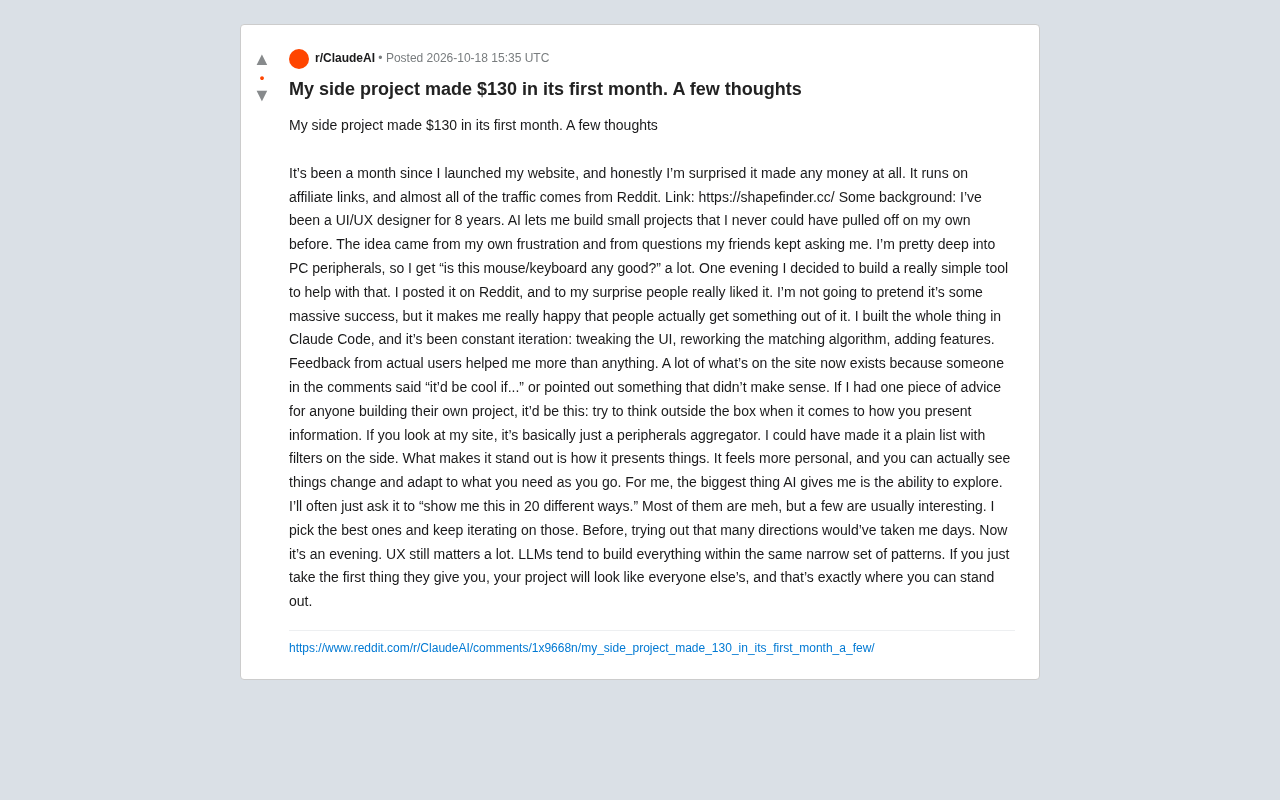
A UI/UX designer with 8 years of experience shared his side-project experiment on Reddit: he used Claude Code to build a PC peripheral recommendation tool, and earned $130 through affiliate links in its first month online. That number isn't impressive, but the method behind it is worth examining—especially for those who want to use AI to quickly validate product ideas.
A Small Tool That Grew Out of a Personal Pain Point
The project's starting point was simple. The author has long been immersed in the PC peripheral community, and friends frequently asked him, "Is this mouse/keyboard actually any good?" So he built a website called ShapeFinder, which uses a matching algorithm to help users filter peripherals based on hand shape, grip style, and other conditions.
This need wasn't imagined out of thin air—it came from high-frequency questions in real social scenarios. The author emphasizes that he was previously limited by his development skills, and many ideas could only stop at the sketch stage; AI coding tools enabled him to independently push ideas all the way to launch.
Affiliate Link is a performance-based promotion model: content creators or site owners embed product links from e-commerce platforms in their articles, and when users complete a purchase through that link, the creator receives a percentage of the sales as commission. Amazon Associates is the earliest and most well-known example, and in the PC peripheral space it's common to see promotion programs from platforms like Newegg and Best Buy. The advantage of this model is that there's no need to build your own e-commerce or carry inventory, making it suitable for small-traffic tool sites to monetize during cold start; the disadvantage is that commission rates are usually low (mostly between 1% and 10%), and it depends on users' actual purchase conversions, so revenue fluctuates greatly. The $130 first-month income precisely illustrates that this type of model has limited early monetization capability—it's more a signal validating that the demand genuinely exists.
Built Entirely with Claude Code, Iterated Based on User Comments
The website was built entirely with Claude Code. After launch, the main work wasn't writing new features but continuous iteration: adjusting the UI, rewriting the matching algorithm, and adding features based on feedback. The author states outright that user feedback is more useful than anything—many features on the site now originally came from a single comment saying "It would be great if it could..."
It's worth noting that almost all of the project's traffic came from Reddit. He didn't run ads or do SEO; the launch post alone brought the first wave of users and revenue. This is directly related to the high activity level of peripheral discussions in the Reddit community.
Claude Code is a command-line AI coding agent tool launched by Anthropic. Unlike chat-based completion, it can directly read and write code in the local file system, run commands, execute tests, and self-correct, making it suitable for building complete projects from scratch. Compared with IDE plugin forms like Cursor, Claude Code leans more toward an "agentic" workflow: developers describe goals in natural language, and the tool autonomously plans and implements multi-file changes. This is precisely the key to why the designer in this article could independently complete website construction without an engineering background—it shifted the barrier of "writing code" to "describing requirements clearly," and the latter happens to be a UI/UX designer's strength.
The Real Differentiation Lies in How Information Is Presented
One core piece of advice the author gives to peers: figuring out how information should be presented is more important than piling on features.
He gives an example: ShapeFinder is essentially just a peripheral aggregator, and the easiest approach would be to list a catalog with filters on the side. But he chose to make the interface change in real time with user input and gradually converge the recommendations, making the whole process feel more like a conversation than a lookup table. This "responsive" presentation style became the key differentiator from similar tools.
In other words, data sources and feature lists are easy to copy; the interaction narrative is the moat.
The Core Value of AI Is Exploration, Not Generation
The author's approach to using AI coding tools is quite inspiring. He often asks the model to "show the same thing in 20 different ways." Most results are mediocre, but a few open up new ideas, and he picks the best ones to refine further.
He notes by comparison that in the past, trying so many directions would take days; now it can be done in a single evening. This low-cost exploration changed the pace of his product decisions.
At the same time, he pours some cold water: LLMs tend to build things within a fixed set of patterns, and if you directly accept its first output, the project will end up looking exactly like everyone else's. UX judgment still remains in human hands—that's exactly where the gap is created.
LLM Output Homogenization (Mode Collapse) refers to large language models' tendency to converge on the most common, "safest" expression patterns in their training data, causing different people using similar prompts to get highly similar results. In coding scenarios, this manifests as the model always preferring similar component libraries, similar page layouts, and similar naming conventions. For indie developers, this means products that "directly adopt AI's first output" are very likely to look like the large number of AI-generated projects on the market. There are usually two ways to break through: one is to actively ask the model for multiple differentiated solutions, as the author in this article does, and then manually select; the other is to inject specific domain constraints and unconventional requirements into the prompt to force the model off the default path. This also explains why domain experience and aesthetic judgment are actually more valuable in the AI era.
What $130 Means
First-month revenue of $130 isn't a commercial success by any measure, and the author himself explicitly says he "won't pretend this is some huge achievement." But this case offers a referenceable path: people with domain experience use AI to fill engineering gaps, start from real social needs, cold-start through communities, and let feedback drive iteration.
For indie developers, this is more like a low-cost market validation—get the product running first, then decide whether it's worth continuing to invest.
One-line Summary
An 8-year UI/UX designer independently built a peripheral recommendation tool with Claude Code, earning $130 in affiliate revenue in the first month and validating a low-cost AI-assisted startup path.
Paragraph Summary
A UI/UX designer with 8 years of experience shared his side-project experiment on Reddit: he used Claude Code to build a PC peripheral recommendation website called ShapeFinder, earning $130 through affiliate links in its first month. The need came from the real social scenario of friends frequently asking for peripheral recommendations, and the site uses a matching algorithm to filter peripherals based on hand shape and grip style. Traffic came almost entirely from the first Reddit post, and user comments directly drove feature iteration. The author emphasizes that differentiation lies not in the feature list but in interactive information presentation that changes in real time with user input. His use of AI is low-cost exploration across multiple directions, while he cautions that LLM outputs easily become homogenized and UX judgment remains a human moat. Although $130 isn't impressive, it provides a referenceable path for low-cost market validation.
Related articles

Chain of Thought Isn't Just for AI: How Humans Can Use CoT to Improve Thinking Quality
Chain of Thought isn't just a prompt trick for large models. Starting from a Hacker News discussion, this article analyzes why CoT works for human thinking too, breaks down actionable ways to transfer it, and highlights the key differences between human CoT and machine CoT.
Cloudflare Teams Up with OpenAI: Closi…
Cloudflare Teams Up with OpenAI: Closing the Loop from Vulnerability Discovery to Defense with AI
Cloudflare uses OpenAI Daybreak to investigate security vulnerabilities and generate reviewable remediation plans, while developers use Codex to boost coding efficiency and quality.

Orca Multi-Agent Orchestration in Practice: A Guide to Parallel Collaboration with Claude and Codex
Orca is Stable AI's free open-source agent workbench supporting 34 agents like Claude Code and Codex in parallel. Learn its Git worktree isolation, multi-model orchestration, and mobile management.