8000+ GitHub Stars: Deep Dive into the Most Comprehensive LLM Learning Resource Repository

awesome-LLM-resources is the most comprehensive LLM learning resource collection for the Chinese community.
The GitHub project awesome-LLM-resources (8,200+ Stars) is one of the most comprehensive LLM resource collections in the Chinese-speaking community, covering ten core modules including multimodal generation, AI Agents & MCP protocol, AI-assisted programming, model training & inference, o1 reasoning enhancement, small language models, and data processing. It spans from foundational theory to cutting-edge applications, forming a complete knowledge graph suitable for beginners, engineers, and researchers as a one-stop learning navigator.
Project Overview: The Most Comprehensive LLM Resource Collection for the Chinese Community
Large Language Model (LLM) technology evolves at breakneck speed, yet learning resources remain scattered across paper repositories, blogs, code repos, and other corners of the internet. For developers and researchers, systematically mastering full-stack LLM knowledge has always been a real pain point.
Large Language Models are deep neural network models based on the Transformer architecture, pre-trained on massive text data. Since Google published the "Attention Is All You Need" paper in 2017, introducing the Transformer architecture, language model parameters have rapidly scaled from BERT's 340 million to GPT-3's 175 billion, and reportedly to GPT-4's trillion-level parameters. The core capability of LLMs comes from a two-stage paradigm of "pre-training + alignment": first learning statistical patterns and world knowledge from large-scale corpora, then aligning behavior with human expectations through instruction fine-tuning and Reinforcement Learning from Human Feedback (RLHF). This technical approach has given rise to products like ChatGPT, Claude, and Gemini, while also driving the flourishing development of open-source models such as LLaMA, Qwen, and DeepSeek.
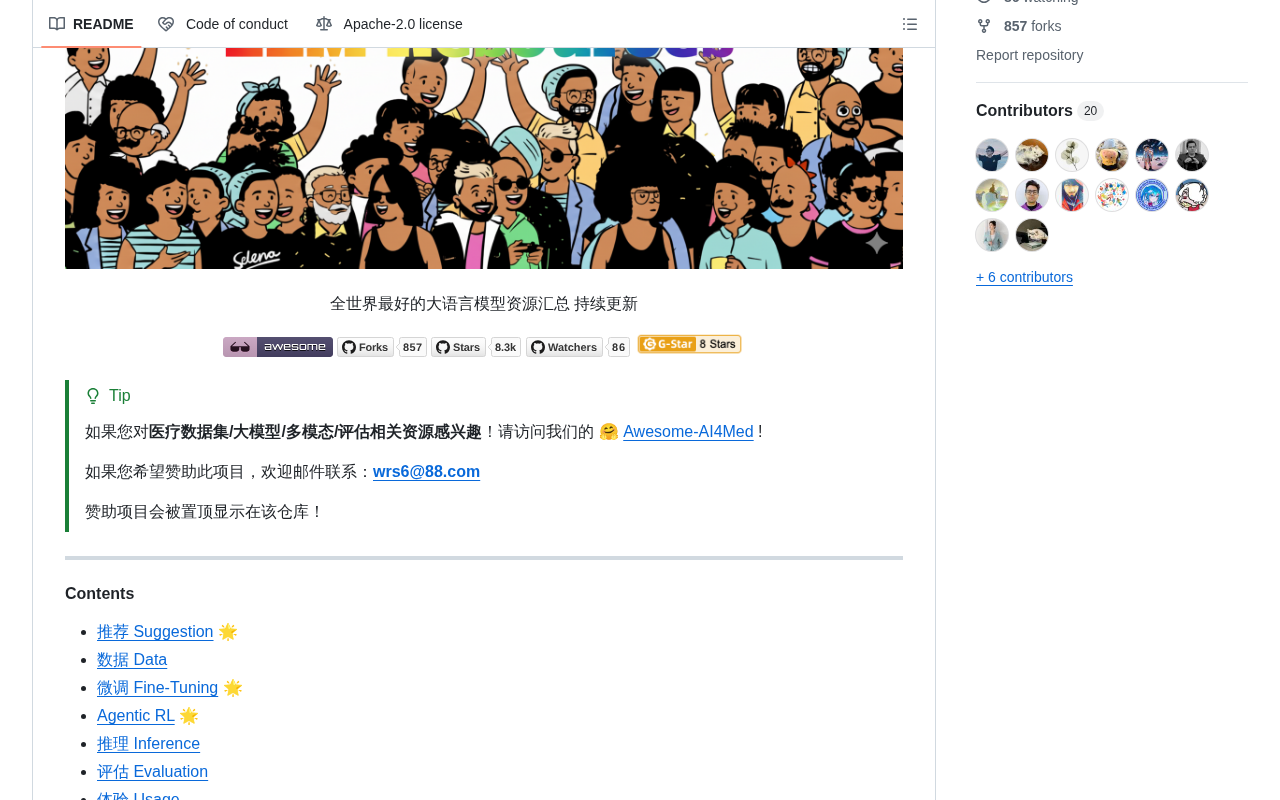
The awesome-LLM-resources project on GitHub (maintained by WangRongsheng) was created to solve this problem. With over 8,200 Stars and 844 Forks, it's one of the most comprehensive LLM resource collections in the Chinese-speaking community.
Positioned as "the world's best LLM resource compilation," the project covers a complete knowledge graph from foundational theory to cutting-edge applications — whether you're a newcomer just getting started or an experienced practitioner, you can use it as a one-stop learning navigator.
Breaking Down the Ten Core Modules
Multimodal Generation and Vision-Language Models (VLM)
Multimodal AI is one of the hottest directions in the field right now. The project features dedicated sections for Multimodal Generation and Vision-Language Models (VLM), covering papers, tutorials, and practical resources ranging from GPT-4V and Gemini to open-source models like LLaVA and Qwen-VL.
The core challenge of multimodal AI lies in enabling models to simultaneously understand and generate information across different modalities — text, images, audio, and video. Vision-Language Models (VLMs) represent the most mature direction, with three main technical approaches: first, like GPT-4V, fusing a visual encoder (e.g., ViT) with a language model through cross-modal attention mechanisms; second, like LLaVA, using simple linear projection layers to map visual features into the language model's embedding space; third, like Gemini, natively supporting multimodal input from the pre-training stage. Qwen-VL represents China's frontier exploration in this direction, supporting image understanding, document parsing, visual grounding, and more. The importance of multimodal capabilities lies in the fact that real-world information is inherently multimodal — pure text models cannot handle chart analysis, medical imaging, autonomous driving, and numerous other practical scenarios.
This granular categorization is necessary — multimodal capability has evolved from a "nice-to-have" to a "must-have" for LLMs, and dedicated sections make it easy for readers to dive deep as needed.
AI Agent and MCP Protocol
AI Agent is widely considered the key path for LLM deployment in production. The project compiles resources on core topics including Agent architecture design, tool calling, and memory mechanisms.
An AI Agent refers to an AI system capable of autonomously perceiving its environment, formulating plans, executing actions, and learning from feedback. Unlike simple conversational LLMs, Agents possess three core capabilities: Planning — decomposing complex tasks into executable sub-steps using methods like ReAct and Plan-and-Solve; Tool Use — extending capability boundaries by calling external tools like search engines, code interpreters, and databases through APIs; Memory — including short-term memory (conversation context) and long-term memory (historical experience stored in vector databases), enabling Agents to maintain consistency across multi-turn interactions. Current mainstream Agent frameworks include LangChain, AutoGPT, and MetaGPT, all of which essentially build a "perceive-think-act" loop architecture on top of LLMs.
Notably, the project also features a dedicated MCP (Model Context Protocol) module. MCP is a model context protocol proposed by Anthropic that is becoming the new standard for Agent-tool interaction. Giving MCP its own chapter demonstrates the maintainer's keen awareness of industry developments.
MCP (Model Context Protocol) is a standardized protocol open-sourced by Anthropic in late 2024, designed to solve interoperability issues between LLMs and external data sources and tools. Before MCP, every AI application needed custom integration code for different tools and data sources, resulting in massive duplication and a fragmented ecosystem. MCP adopts a client-server architecture: AI applications act as MCP clients to initiate requests, while various tools and data sources expose their capabilities by implementing the MCP server interface. The protocol defines three core primitives — Resources (such as files and database records), Tools (such as API calls and code execution), and Prompts (prompt templates). MCP is to AI Agents what the USB protocol is to peripherals — it provides a universal "port" that allows any protocol-compliant tool to plug and play. Currently, products like Cursor and Claude Desktop have already adopted MCP support, and the ecosystem is expanding rapidly.
AI-Assisted Programming Tools
From GitHub Copilot to Cursor to Devin, AI-assisted programming is profoundly transforming software development workflows. This section aggregates comparative analyses, usage tips, and underlying technical principles for various coding assistants — extremely practical for engineers looking to boost development efficiency.
Model Training and Model Inference
These are the two core pillars of LLM engineering:
- Model Training Module: Covers key technologies including pre-training, fine-tuning (SFT / RLHF / DPO), and distributed training
- Model Inference Module: Focuses on acceleration strategies like quantization, pruning, KV Cache optimization, and speculative decoding
LLM training typically involves three stages. The first stage is Pre-training, where the model learns language knowledge through next-token prediction on TB-scale text corpora — this stage consumes the most compute, with GPT-3-level models requiring thousands of GPUs running for weeks. The second stage is Supervised Fine-Tuning (SFT), using human-annotated instruction-response pairs to teach the model to follow instructions. The third stage is alignment training, with mainstream methods including RLHF (Reinforcement Learning from Human Feedback, optimizing reward model scores using the PPO algorithm) and DPO (Direct Preference Optimization, which skips reward model training and learns policy directly from preference data). DPO gained widespread adoption in 2024 due to its implementation simplicity and training stability. For distributed training, mainstream frameworks like DeepSpeed and Megatron-LM enable efficient training across hundreds or even thousands of GPUs through data parallelism, tensor parallelism, pipeline parallelism, and ZeRO optimization.
On the inference optimization side, Quantization is the most commonly used technique, compressing model weights from FP16 (16-bit floating point) to INT8 or even INT4, reducing memory usage by 2-4x. Representative methods include GPTQ, AWQ, and GGUF. Pruning reduces model size by removing unimportant weights or attention heads. KV Cache optimization compresses the key-value cache during Transformer autoregressive generation — PagedAttention (the core technology of the vLLM framework) borrows from OS virtual memory management concepts, storing KV Cache in pages to significantly improve GPU memory utilization and throughput. Speculative Decoding uses a small "draft model" to quickly generate candidate token sequences, which are then verified in parallel by the large model, transforming the serial bottleneck of autoregressive generation into parallel verification, achieving 2-3x speedup without sacrificing output quality.
Together, these two modules form a complete pipeline from "training" to "deployment."
o1 Model and Reasoning Enhancement
OpenAI's o1 model pioneered the "slow thinking" paradigm, dramatically improving complex problem-solving through Chain-of-Thought reasoning. The project dedicates a section to this, collecting technical analyses, reproduction attempts, and academic discussions about o1, reflecting the industry's intense focus on reasoning enhancement.
The o1 model, released in September 2024, marks an important turning point in LLM development — shifting from pursuing faster responses to pursuing deeper thinking. Traditional LLMs use a fixed amount of computation per token (i.e., "System 1" fast intuitive responses), while o1 achieves "System 2" slow deep thinking by introducing extensive internal Chain-of-Thought (CoT) reasoning during inference. Specifically, o1 generates numerous hidden reasoning steps before answering questions, decomposing problems, verifying results, and self-correcting. This "test-time compute scaling" strategy has achieved qualitative leaps in tasks requiring multi-step logic, such as math competitions, programming, and scientific reasoning. o1 approaches gold medal level on International Mathematical Olympiad qualifying problems and reached the 89th percentile on Codeforces programming competitions. This paradigm has inspired subsequent open-source reproduction efforts like DeepSeek-R1 and Qwen-QwQ, and reasoning enhancement has become one of the core research directions for 2024-2025.
Small Language Models (SLM)
Not every scenario requires a model with hundreds of billions of parameters. The Small Language Models section focuses on lightweight models like Phi, Gemma, and Qwen-mini, exploring how to achieve cost-effective AI applications with limited compute. For edge deployment and cost-sensitive business scenarios, this section offers high reference value.
Small Language Models (SLMs) typically refer to language models with parameters in the single-digit billions or less. Representative works include Microsoft's Phi series (Phi-3's smallest version has only 3.8B parameters), Google's Gemma (2B/7B), and Alibaba's smaller Qwen2.5 variants. The core technical approach of SLMs is "trading data quality for parameter scale" — by carefully curating and synthesizing high-quality training data, small models can approach or even surpass larger models on specific tasks. For example, Phi-3-mini (3.8B) outperforms the earlier LLaMA-2-70B on multiple benchmarks. SLM use cases include: on-device deployment on smartphones and IoT devices (such as the on-device models used by Apple Intelligence), latency-sensitive real-time applications, cost-constrained AI solutions for SMEs, and serving as draft models in speculative decoding to accelerate large model inference. As model distillation and structured pruning techniques mature, SLMs are becoming an important driving force for AI democratization.
Data Processing and AI Paper Review
"Data is the new oil" remains true in the LLM era. The data processing module covers practical topics including data cleaning, deduplication, and quality assessment.
AI Paper Review is a distinctive section specifically targeting academic scenarios, providing tools and methodologies for using LLMs to assist with paper reviewing and writing — very helpful for researchers.
Value Analysis: Why It's Worth Bookmarking
- Systematic: Unlike scattered blog posts, the project is organized by technical dimensions, forming a clear knowledge framework
- Timely: Continuously updated, keeping pace with the latest technical trends like MCP and o1
- Practical: Beyond just paper links, it includes tutorials, tools, and code repositories, balancing theory and practice
- Chinese-friendly: The project is primarily in Chinese, making it immediately accessible to Chinese-speaking developers
Usage Recommendations for Different Roles
- Beginners: Start with the model training and inference modules to build foundational understanding, then expand into Agent and multimodal directions
- Engineers: Focus on the AI-assisted programming, model inference, and MCP modules to quickly boost daily productivity
- Researchers: The o1 model, vision-language model, and small language model sections provide rich indices of frontier papers
- Everyone: Star the repo and revisit regularly — treat it as a "living dictionary" for the LLM field
Conclusion
With its comprehensive coverage, clear organizational structure, and continuous maintenance, awesome-LLM-resources has become an invaluable LLM learning resource repository for the Chinese-speaking community. The 8,000+ Star count is itself a community vote of confidence in its quality.
If you're learning or working in the LLM space, regardless of your stage, this project deserves a spot in your bookmarks — browse through it periodically, and you'll always discover something new.
Related articles
 Tutorials
ChatGPT Plus Subscription Guide: Are GPT-5.5, image-2, and Codex Worth the Upgrade?
A detailed look at ChatGPT Plus features — GPT-5.5, image-2, and Codex — with a Plus vs Pro comparison and a complete step-by-step subscription guide for users outside the US.
 Tutorials
Harness AI Engineering in Practice: Using Claude Code to Master Enterprise-Level E-Commerce Development
Deep dive into Harness AI Engineering: master enterprise e-commerce development with Claude Code using the Rules, Skills, Wiki, and Changes framework.
 Tutorials
Cursor + Codex Dual-IDE Collaboration: A Practical Methodology for Open-Source Project Customization
A complete methodology for open-source project customization based on real-world experience, detailing the Cursor+Codex dual-IDE workflow, seven-stage process, MVP validation, and AI source code reading techniques.