86% Vocabulary but Only 38% Comprehension? The Anime Language Understanding Paradox
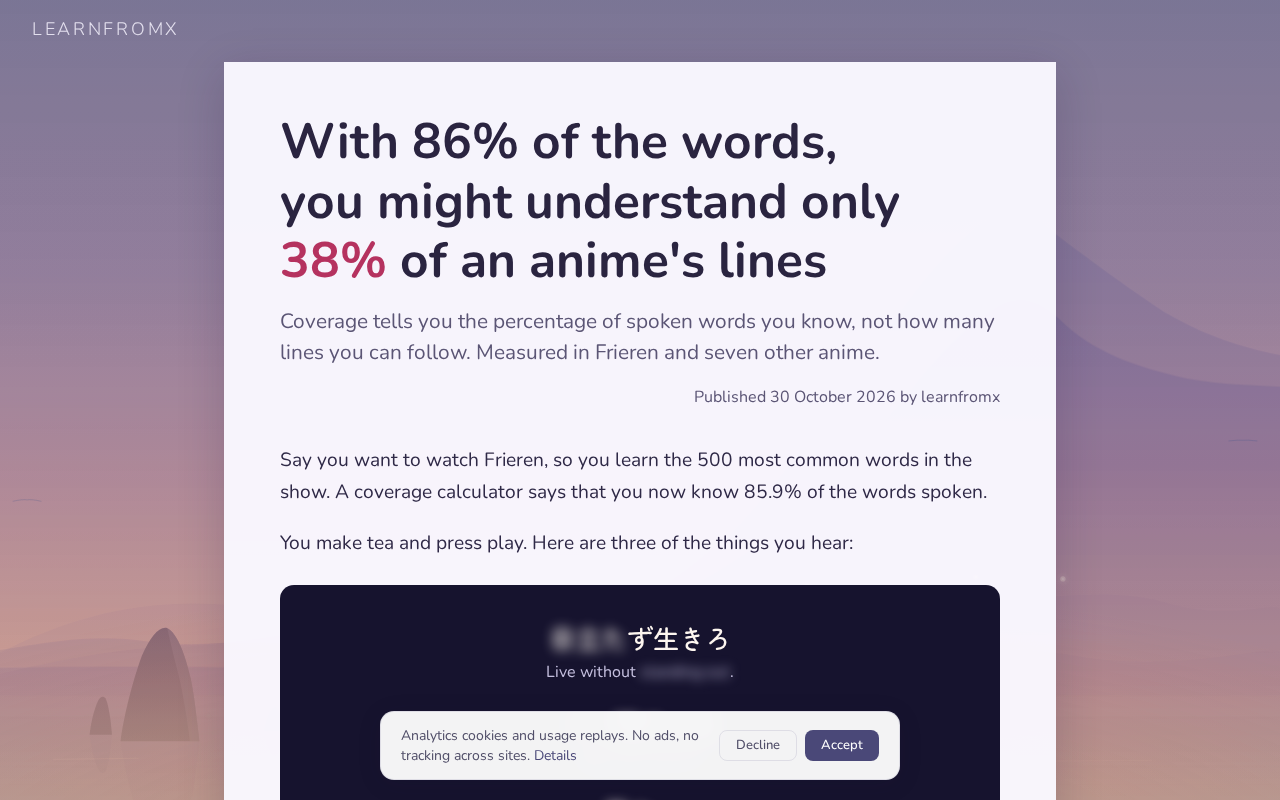
86% vocabulary coverage corresponds to only 38% dialogue comprehension, revealing the nonlinear nature of language understanding.
Starting from a Hacker News discussion about "knowing 86% of words in anime but only understanding 38% of dialogue," this article analyzes the nonlinear relationship between vocabulary coverage and comprehension. The core reason lies in the long-tail effect of word frequency distribution—high-frequency function words dilute the coverage metric, while low-frequency high-information words are the semantic key; meanwhile, grammatical ellipsis and pragmatic inference constitute ignored comprehension costs. Experiences from multiple language learning communities and the performance of large language models in AI cross-corroborate the universality of this paradox. The article accordingly offers implications for language learning tools and AI translation products: focus on contextualized training rather than mere vocabulary accumulation, and AI translation needs to incorporate context awareness and domain adaptation. The ultimate conclusion is that language understanding is a multi-layered complex process, requiring a shift from "recognizing words" to "understanding intent."
Introduction: A Counterintuitive Language Learning Phenomenon
In language learning communities, there's often an optimistic assumption: master enough of a language's common vocabulary and you'll understand most everyday conversation. However, a discussion on Hacker News raised a sobering observation: even if you know 86% of the words in a given anime, you might only understand 38% of the dialogue.
This headline quickly sparked a discussion with 22 upvotes and 13 comments (data from the Hacker News page). It reveals not only a cognitive bias in language learning but also touches on deep challenges in natural language processing (NLP) and AI's understanding of human language.
The Gap Between "Recognizing Words" and "Understanding Dialogue"
Why does 86% vocabulary coverage correspond to such a low comprehension rate? Multiple developers and language learners in the comments pointed out that the key lies in the uneven distribution of word frequencies and the complexity of context dependence.
The "Long Tail Effect" of High-Frequency vs. Low-Frequency Words
In anime dialogue, high-frequency words (such as pronouns, particles, and basic verbs) may cover the vast majority of total word count, but these words often carry low information content. What truly determines the meaning of dialogue are often the low-frequency but semantically critical nouns, adjectives, and idiomatic expressions. When you only know 86% of the words, what you're missing are precisely those "low-frequency but high-information" words.
Zipf's Law is the key background for understanding this phenomenon. The law states that in natural language, a word's frequency of use is inversely proportional to its rank in the frequency table: the word ranked 1st appears about twice as often as the word ranked 2nd, three times as often as the word ranked 3rd, and so on. This means that a small number of high-frequency words (like "the," "is," "I") account for a large proportion of total text, while a large number of low-frequency words each appear only a few times. Therefore, even when vocabulary coverage reaches 86%, the remaining 14% of unknown words are likely spread across hundreds or thousands of different low-frequency words—and these are precisely the words that carry specific semantic information. Zipf's Law explains why "knowing most words" doesn't equal "understanding most content"—the numerator of coverage is heavily diluted by high-frequency function words.
Grammar and Pragmatics: The Ignored 62%
Even if you know every word, full comprehension of dialogue also depends on grammatical structure, ellipsis, inversion, and character-specific tone and slang. Anime dialogue often contains large amounts of colloquial ellipsis and character-setting expressions that often have no direct equivalent in standard dictionaries. According to views in the Hacker News comments, language understanding is not simple word addition but requires the combined action of syntactic analysis and pragmatic reasoning.
Pragmatic Inference refers to the process by which speakers use context, shared knowledge, and communicative intent to derive the meaning of an utterance, going beyond the combination of literal semantics. In anime dialogue, pragmatic inference is everywhere: a character might use "いいよ" (sure) to express sarcastic refusal, or use an elliptical sentence "ちょっと…" (a little…) to imply a negative attitude that can't be stated directly. Understanding these lines requires not only vocabulary and grammar knowledge but also inferring the character's social relationships, emotional state, and the implicit premises of the conversation. The "Cooperative Principle" and "Conversational Implicature" theories in pragmatics point out that a large amount of information in everyday communication is not stated explicitly but is actively inferred and completed by the listener. This is precisely the "hidden comprehension cost" that vocabulary coverage cannot reflect, and it's also a deep challenge faced by both language learners and AI systems.
Multi-Source Perspectives: A Shared Challenge for Language Learning and AI Understanding
This phenomenon is corroborated across multiple independent sources. According to experience shared by language-learning content creators on Bilibili and analyses from Japanese learning channels on YouTube, learners commonly go through a stage when watching anime where "I know all the words, but I can't piece together the meaning of the sentence." Cross-validation from multiple sources shows that the relationship between vocabulary coverage and comprehension rate is not linear but exhibits a steep threshold effect.
In the AI field, this paradox holds equally true. Large language models are exposed to massive amounts of text during training, but when faced with colloquial content in specific domains (such as anime dialogue), they may still exhibit situations where "every word is known, but the overall semantics are not accurately grasped." This suggests that current AI still has room for improvement in pragmatic understanding and commonsense reasoning.
Implications for Language Learning Tools and AI Products
Vocabulary Size Is Not the Only Metric
For language learning applications, simply pursuing growth in "vocabulary size" may be misleading. Product design should focus more on vocabulary usage in context and sentence-level comprehension training. For example, shadowing, fill-in-the-blank, and retelling exercises using anime clips can improve practical comprehension more than isolated word memorization.
Directions for Improving AI Subtitles and Translation
Current machine translation systems often produce stiff literal translations and lose tone when handling anime dialogue. Based on the discussion in the Hacker News comments, improvement directions include: incorporating character dialogue history as context, recognizing colloquial elliptical structures, and building anime-domain-specific slang dictionaries. These directions align closely with research on context-aware translation and domain adaptation in natural language processing.
Domain Adaptation is an important concept in machine learning, referring to the technique of adapting a model trained on one data distribution (source domain) to a different distribution (target domain) through fine-tuning or adjustment. In the context of anime dialogue translation, general machine translation models are mainly trained on written corpora such as news and formal texts, while anime dialogue belongs to the "target domain" of colloquial speech filled with slang and character-specific expressions. Common methods of domain adaptation include: continued pre-training or fine-tuning on in-domain corpora, incorporating domain dictionaries or glossaries, and using small amounts of annotated data for parameter-efficient fine-tuning. This is methodologically consistent with the "building anime-domain-specific slang dictionaries" and "incorporating character dialogue history" mentioned in the original text—essentially both aim to narrow the gap between the training distribution and real-world usage scenarios.
Conclusion: Rethinking the Definition of "Understanding"
The phenomenon of "86% vocabulary but only 38% dialogue comprehension" reminds us that language understanding is a multi-layered complex process. Vocabulary is only the entry point; grammar, pragmatics, cultural background, and contextual reasoning together determine the ultimate level of comprehension. For language learners and AI developers alike, this is both a challenge and a clear direction: moving from "recognizing words" to "understanding intent."
(This article is based on a comprehensive analysis of the Hacker News discussion and views from multiple language learning communities. The original discussion link can be found on the source platform.)
Related articles

World's First Humanoid Robot Company Agility Lists on Nasdaq: Buy or Not?
Agility becomes the world's first pure-play humanoid robot company to list on Nasdaq. This article analyzes what the landmark event means for the industry and investors, unpacking the commercialization test and investment framework for the pure humanoid robot sector.

Agent-Browser: A Browser Automation CLI for AI Agents
Vercel Labs open-sources agent-browser, a Rust-built browser automation CLI designed for AI agents, with over 45,000 GitHub stars and command-line-first browser control.

LZ4: The Open-Source Benchmark for Blazing-Fast Compression
Explore the LZ4 blazing-fast compression algorithm: its design philosophy, performance advantages, and wide use in the Linux kernel, databases, and more. How a 12k+ star open-source project became the speed benchmark.