Agent-Browser: A Browser Automation CLI for AI Agents

Vercel Labs open-sources agent-browser, a Rust-written browser automation CLI for AI agents.
Vercel Labs has open-sourced agent-browser, a browser automation command-line tool designed for AI agents and written in Rust, with over 45,000 GitHub stars. The article notes that traditional tools like Puppeteer and Playwright target human developers, while agents need predictable interfaces, clear error feedback, and efficient execution. agent-browser's core design—command-line first, Rust native binaries, and structured output—lowers integration costs and suits batch execution in containers and CI. Its popularity reflects strong community demand for a browser control layer, but the project is still early, and documentation completeness and complex-page coverage remain to be validated.
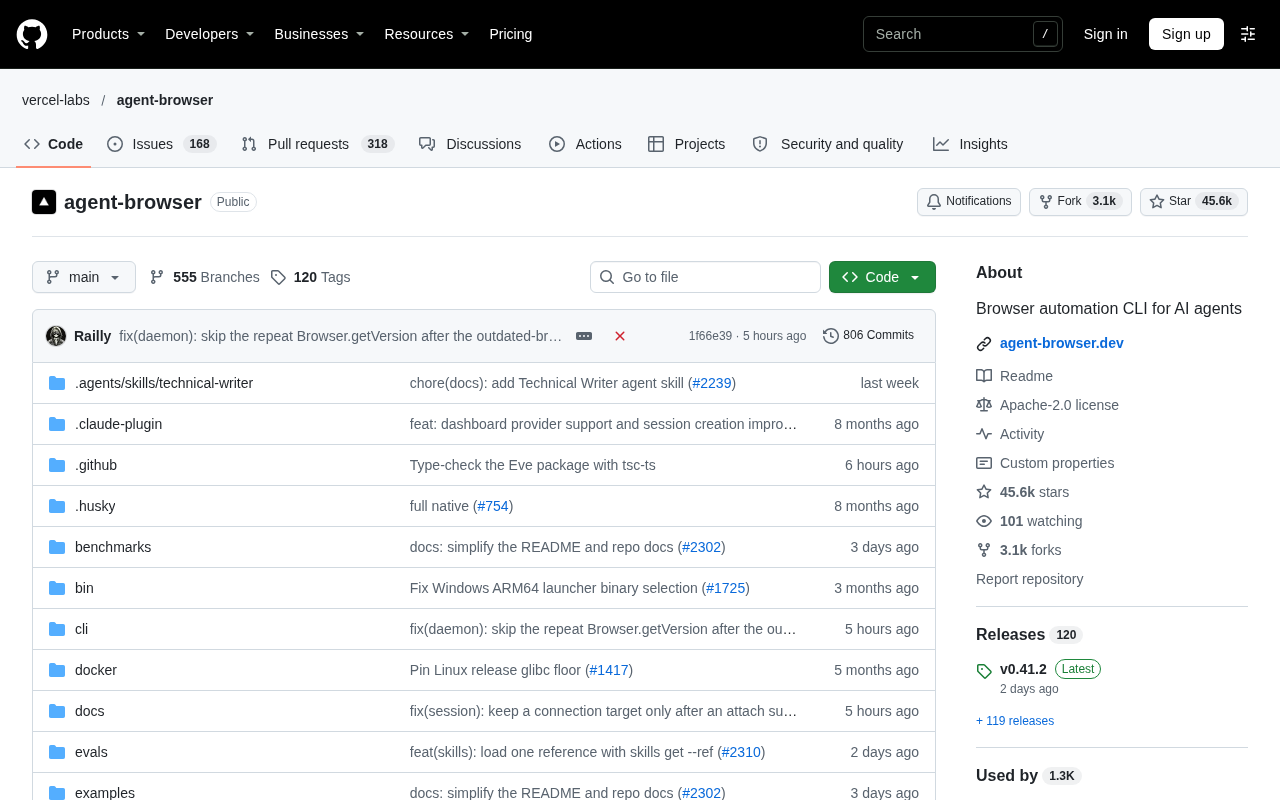
AI agents are moving from conversation to action, and the browser is a key gateway for them to interact with the real world. Vercel Labs' open-source agent-browser project, built in Rust, is a browser automation command-line tool designed specifically for AI agents. It has now garnered over 45,000 stars on GitHub, adding 132 stars today, with热度 continuing to climb.
Why a browser tool built specifically for AI agents
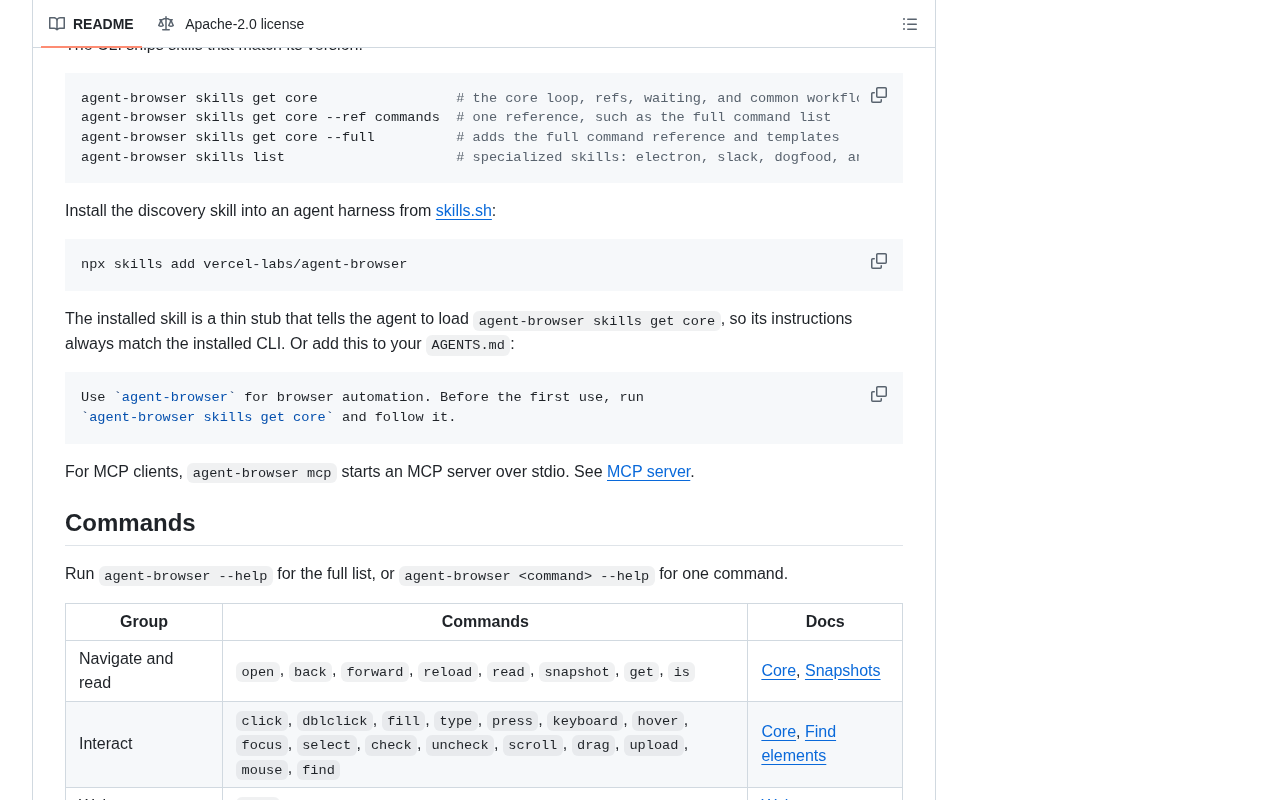
Traditional browser automation tools like Puppeteer and Playwright are mainly aimed at human developers, with script logic written and debugged by people. When AI agents execute tasks, they need tools with predictable interfaces, clear error feedback, and efficient execution speed. agent-browser starts from exactly this need, packaging browser operations into CLI commands so agents can invoke navigation, clicking, form filling, and other actions via the command line.
According to the project description, it positions itself as a "Browser automation CLI for AI agents," using Rust for both performance and memory safety. For automation scenarios that require frequently launching browser instances, Rust's low-overhead advantage is worth noting.
Puppeteer is a Node.js library maintained by the Google Chrome team that controls headless Chrome via the DevTools protocol; Playwright, launched by Microsoft, supports all three major engines—Chromium, Firefox, and WebKit—and offers cross-language bindings. What both have in common is that they are aimed at developers writing deterministic scripts, with APIs designed around selectors, wait strategies, and assertions, and error messages geared toward human debugging. For agents driven by large models, this kind of interface is too high-level in abstraction: agents need to understand a large amount of API semantics, struggle to recover automatically from errors, and each invocation relies on runtime interpretation with relatively high startup overhead. agent-browser reduces actions to a small set of CLI subcommands and outputs structured state, precisely to lower the cognitive burden and integration complexity for agents.
Core features and design philosophy
Judging from its positioning, agent-browser's design emphasizes three points:
- Command-line first: Agents don't need to parse complex API documentation; they can control the browser through standard CLI calls, reducing integration costs.
- Rust implementation: Compiled into a native binary, it starts fast and uses few resources, making it suitable for batch execution in containers or CI environments.
- Agent-oriented interaction: It outputs structured results, making it easy for AI to parse page state and decide the next action.
These features align closely with the pain points in current AI agent deployment. Many teams building web-operation agents often have to wrap tools like Playwright themselves, while agent-browser offers an out-of-the-box alternative.
Rust's ownership model eliminates data races and dangling pointers at compile time and guarantees memory safety without garbage collection, so the compiled artifact is a statically linked native binary, with cold starts typically in the millisecond range and resident memory far lower than Node.js or Python runtimes. Browser automation often requires frequently spawning processes, parsing the DOM, and maintaining long-lived connections—scenarios sensitive to startup latency and memory usage. Rust's approach can keep the fixed overhead of each task very low, which is especially advantageous in resource-constrained container and CI environments.
When interacting with browsers, AI agents typically follow an "observe—decide—act" loop: first obtain the page's accessibility tree or a simplified DOM, let the model determine the next step, then perform clicks, input, or navigation. For this loop to run stably, tool output must be deterministic structured data (such as JSON), with stable element identifiers so agents don't break due to minor page changes. Structured output also reduces the number of tokens sent to the model, lowers inference costs, and makes failure causes programmatically parseable, enabling automatic retries and fallback strategies.
Ecosystem significance and potential impact
Vercel Labs continues to build out its AI developer toolchain, and agent-browser fills in the "browser control" piece. The 45,000 stars and 3,136 forks show strong developer community demand for this kind of tool. As AI agents move from demos to production, a stable and efficient browser automation layer will become part of the infrastructure.
However, the project is still in its early stages, and the completeness of documentation and examples, as well as coverage of complex page scenarios, still need further community validation. For teams building web automation agents, agent-browser is worth adding to the technology selection list for hands-on testing.
Related articles

Glasshand: Giving AI Agents a Real iPhone and Mac
Glasshand lets AI agents rent real iPhones and Macs, supporting Claude Code, Codex, and more to post, book services, and test iOS apps on real devices. This article explains how it works, its use cases, and potential boundaries.

ChatGPT Images 2.6 Released: GIF Generation, Reference Image Reuse, and 50% Speed Boost
ChatGPT Images 2.6 released: prompt-to-GIF animation with frame-by-frame editing, reusable reference images for yourself, pets, or characters, 50% faster generation, plus Flare and Sunburst API model variants and SVG export for developers.

Rerun: Turn Your AI Subscription into an AI Coworker Team
Rerun, #3 on Product Hunt, turns your ChatGPT or Claude subscription into a team of AI coworkers that run on schedules or triggers, each with tools, a computer, and a shared workspace. It asks before risky actions, is open source (AGPL v3), and supports self-hosting.