8BitDo Launches GC Bluetooth Gamepad: A Modernized Recreation of the GameCube WaveBird

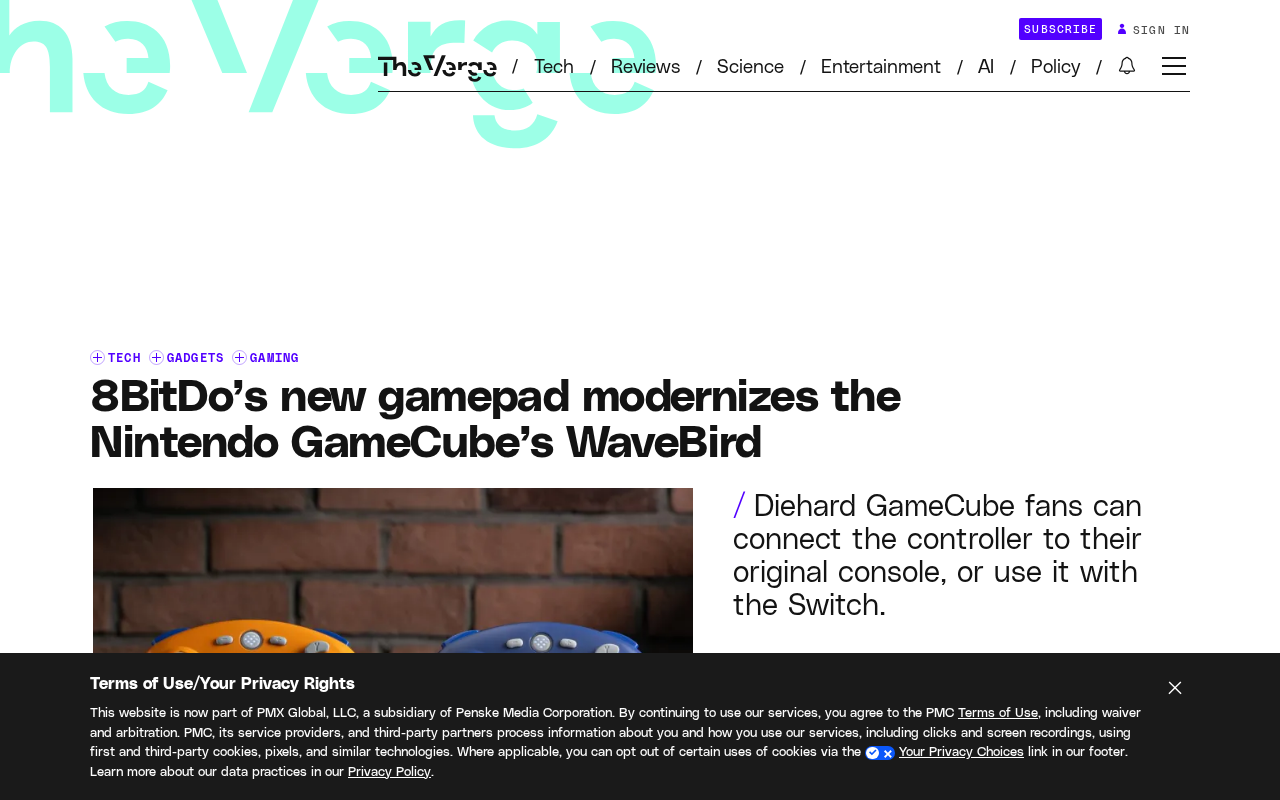
8BitDo's new GC Bluetooth Gamepad stays more faithful to the original GameCube, replacing the WaveBird receiver with Bluetooth.
8BitDo launches the GC Bluetooth Gamepad, turning its recreation efforts to the Nintendo GameCube controller. Unlike the 8BitDo 64's loose remake, this product more faithfully preserves the GameCube's unique button layout and analog stick design, including the large A button, surrounding B/X/Y buttons, and octagonal-gated main stick. It replaces the WaveBird-era dedicated 2.4GHz receiver with universal Bluetooth for easier pairing with modern devices, though Bluetooth may lag behind dedicated solutions in latency and interference resistance. Specific specs like battery life, trigger type, gyroscope support, and compatible platforms haven't been disclosed, and real-world feel awaits review.
8BitDo has taken another step on its path of recreating classic controllers. Following the 8BitDo 64's "loose remake" of the N64's trident-shaped controller, the company has now set its sights on Nintendo's GameCube. According to RSS sources, the new GC Bluetooth Gamepad stays much more faithful to the GameCube controller's distinctive button layout and analog stick design, while replacing the WaveBird-era wireless solution with modern Bluetooth connectivity. For players who miss the original feel but don't want to be tethered to an old receiver, this is a product worth keeping an eye on.
From 8BitDo 64 to the GC Gamepad: A Shift in Recreation Philosophy
The 8BitDo 64 was a "loose remake" of the Nintendo 64 controller—it eliminated the N64's iconic three-prong design and abandoned the centrally positioned analog stick. That change sparked considerable discussion at the time: it was more of a modern controller inspired by the N64 than a strict recreation.
With the GC Bluetooth Gamepad, 8BitDo's strategy has clearly adjusted. The report notes that this product does "much better" at staying faithful to the GameCube controller's design, including its unique button layout and analog sticks. In other words, 8BitDo has chosen to preserve the original's core interaction logic rather than overwriting it with a generic modern controller approach.
This shift reflects a reassessment of user needs. Players who buy retro controllers are often after that authentic feel and muscle memory. Excessive modernization would undermine the product's appeal, and 8BitDo seems to have learned from the feedback on the 8BitDo 64.
The Key to Fidelity: Button Layout and Analog Sticks
The GameCube controller is regarded by many players as one of Nintendo's finest controllers, and that's inseparable from its asymmetrical button layout and distinctive analog stick shape. The large A button, the surrounding B/X/Y buttons, and the octagonal-gated main analog stick together define the GameCube-era control experience.
Based on the report's description, the GC Bluetooth Gamepad remains faithful to these core elements. This is crucial: for games like Super Smash Bros. that demand extremely high precision, button sizes and stick travel directly affect competitive performance, and any "improvement" could disrupt players' established habits.
One detail worth noting: the report doesn't disclose specifics like materials, trigger travel, or rumble feedback—these will be key to judging its recreation quality. But judging purely from the design orientation, 8BitDo has placed "fidelity" ahead of "innovation" this time.
The GameCube controller's button layout is often described as "asymmetrical": the face features only one noticeably enlarged circular A button as the primary action button, with the B button as a small crescent shape nestled to its lower left, while X and Y surround it above and to the right in an irregular arrangement. The main analog stick is ringed by an octagonal gate, providing a distinct physical notch feel when pushed in eight directions—unlike the circular gates on most controllers, this is an important foundation for precise directional input in Super Smash Bros. The C-stick is a smaller yellow mushroom cap used for right-stick input. Additionally, L and R are analog triggers with a longer travel and a "click" digital trigger point at the end—a dual-stage structure that significantly affects racing and shooter games. Whether a recreation can reproduce these feel details is often more important than appearance.
Bluetooth Wireless: A Modern Continuation of the WaveBird Spirit
The original WaveBird was a pioneer of wireless controllers in the GameCube era, using a 2.4GHz receiver for wireless connectivity—but that bulky receiver is also a memory and pain point for many players. The GC Bluetooth Gamepad replaces the dedicated receiver with Bluetooth, meaning a more universal connection method that's easier to pair with modern devices.
However, Bluetooth differs from dedicated 2.4GHz solutions in latency performance, which could be amplified in competitive scenarios. The report doesn't provide specific latency data, so real-world experience still awaits review verification. For casual players, Bluetooth's convenience will likely outweigh this concern; for hardcore players, a more careful evaluation may be needed.
The WaveBird was Nintendo's official wireless GameCube controller launched in 2002, and the first widely adopted wireless controller in home console history. It operated on the 2.4GHz band, communicating through a dedicated receiver plugged into the console's controller port, and pioneered a 16-channel selection mechanism allowing multiple controllers in the same space to avoid interference. The WaveBird ran on two AA batteries with an officially rated battery life of about 100 hours, at the cost of removing rumble functionality. Its receiver was bulky and bound to the console—once lost, it couldn't be paired separately, a long-standing complaint among players. This is precisely why replacing the dedicated receiver with universal Bluetooth represents a clear improvement in compatibility and replaceability.
The latency difference between Bluetooth and dedicated 2.4GHz wireless needs to be understood in context. Classic Bluetooth (BR/EDR) typically has end-to-end latency of around 10ms under ideal conditions, while Bluetooth Low Energy (BLE) and well-optimized proprietary 2.4GHz protocols can achieve 5ms or even lower. The difference stems not just from the radio itself but also from polling rates, controller firmware, and host-side Bluetooth stack processing overhead. Modern controller manufacturers often narrow the gap by increasing polling rates and adopting BLE with custom protocols. However, Bluetooth also faces congestion in the 2.4GHz band—Wi-Fi, USB 3.0 ports, and numerous wireless peripherals all cause interference, so real-world performance is highly dependent on the usage environment.
The Competitive Logic of the Retro Controller Market
8BitDo's product line in recent years has covered multiple classic platforms, establishing a consistent formula of "modern features + retro form." The GC Bluetooth Gamepad continues this approach, but its success depends on a delicate balance: too much modernization alienates purists, while too little makes it hard to convince new users.
Based on current information, this controller leans toward "faithful recreation + wireless modernization," targeting veteran players with GameCube nostalgia who want to continue using a familiar feel on new platforms. Whether it can become a reliable choice on Switch or PC depends on 8BitDo's actual performance in stick precision and connection stability.
Open Questions
The report doesn't elaborate much on specific specs, so the following questions remain to be confirmed: battery life, gyroscope support, whether triggers use analog input, and the specific range of compatible platforms. These details will determine whether the GC Bluetooth Gamepad is a "nostalgia toy" or a "daily-driver main controller."
For players interested in retro controllers, 8BitDo's direction this time is commendable—after the 8BitDo 64, it has chosen a path that better respects the original design. What remains is to wait for hands-on testing to verify the quality of the recreation.
Related articles

From 0 to 1: Vibe Coding an AI Knowledge Base — A Practical Retrospective and Tech Stack Breakdown
A retrospective on building the AI knowledge base OilBook from scratch with Vibe Coding: Next.js+Neon stack, Oil Dev Skill workflow, Stripe paywall security, interview-style writing, AI-flavor control, and Vercel deployment.

GLM-5.4 Hands-On: Native Vision Meets a New Vibe Coding Workflow
Hands-on with Zhipu GLM-5.4: native vision tested across a 3D product demo, pure-code video generation, and remote-control Vibe Coding, compared with GPT-6.2 and Gemini Neon.

AI and Humans Claim to Prove the Riemann Hypothesis: Machine-Verified, Yet Nobody Can Understand It
Anthropic mathematician and AI Claude claim to prove the Riemann Hypothesis with 17 million lines of Lean code, machine-verified but unreadable by humans. This article analyzes the event, the zero proportion record from 41.6% to 67.2%, and the gap between machine verification and human understanding.