8x RTX 3090 Home AI Rig Tested: £600 Each, Performance on Par with a 192GB New Machine

Reddit user builds a 192GB VRAM home inference cluster from 8 used 3090s, with throughput rivaling commercial gear.
A Reddit user shared his 8x RTX 3090 home AI build: eight Gigabyte 3090s bought at £600–700 each before prices surged, 192GB total VRAM, a Romed8-2t server board for PCIe 4.0 x16, water cooling, dual PSUs, and a 270W power limit. A modded NVIDIA driver enables 22GB/s P2P, and vLLM runs quantized Qwen at ~60 tok/sec single-agent and 370 tok/sec with 10 agents. Idle draw is 300W.
A Reddit user shared his experience building an 8-GPU RTX 3090 AI rig. Dubbed the "perfect winter heater," this machine stacks second-hand hardware into inference performance comparable to commercial equipment—and reveals an awkward reality in today's AI hardware market: the value proposition of old-GPU clusters is being re-evaluated.
Why 8x 3090s instead of new cards
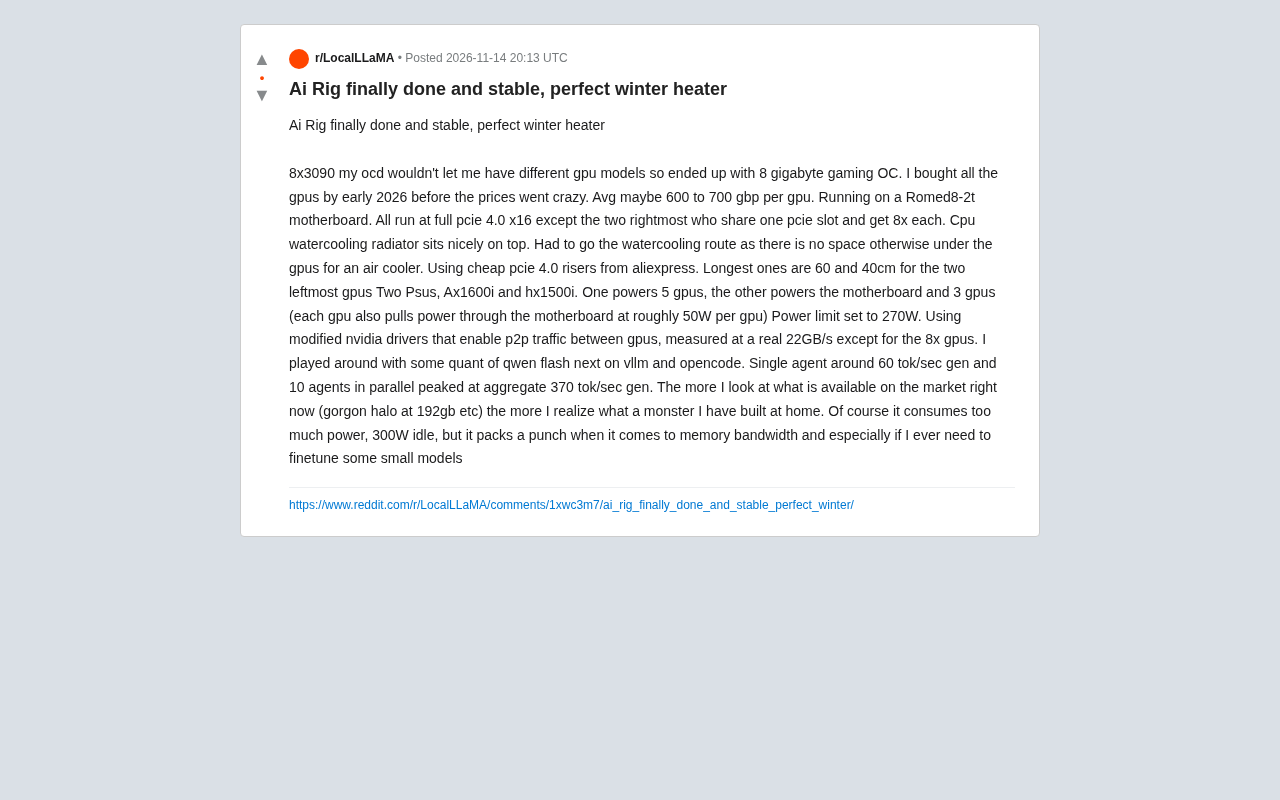
The author bought all GPUs in early 2026, before prices skyrocketed, at an average of £600 to £700 each. He admits his OCD "wouldn't allow mixing different models," so all eight are Gigabyte Gaming OC versions. Behind this choice is a simple calculation: total VRAM reaches 192GB, while new products at the same VRAM level on the market at the time cost far more.
The motherboard is a Romed8-2t, a server-oriented board with native multi-GPU support. Apart from the two rightmost cards sharing one PCIe slot at 8x each, the other six run at full PCIe 4.0 x16. This configuration is nearly impossible on consumer platforms, and it's the core reason the author chose a server motherboard.
RTX 3090 launched in 2020 on the Ampere architecture, with 24GB of GDDR6X VRAM and 936GB/s of memory bandwidth, and was one of the first consumer GPUs to support NVLink. Its key advantage lies in the combination of VRAM capacity and bandwidth: a single card's 24GB far exceeded contemporary consumer cards, and eight in parallel reach 192GB—approaching the VRAM scale of some professional inference servers. By contrast, newer consumer cards are more powerful but offer limited VRAM gains at high prices, which keeps used 3090s attractive on the "large VRAM, low unit price" dimension—at the cost of higher power draw and older architecture efficiency.
Water cooling was the only way
The spacing between GPUs is too tight to fit air coolers, forcing the author down the water-cooling route. The CPU water-cooling radiator sits at the top, using space quite compactly. The riser cables are cheap PCIe 4.0 extensions from AliExpress, with the two leftmost cards using 60cm and 40cm cables respectively.
The power solution is equally pragmatic: two PSUs, an AX1600i for 5 cards and an HX1500i for the motherboard plus 3 cards. Each GPU also draws about 50W extra through the motherboard—a detail often overlooked but with real impact on power distribution. The power limit is set to 270W, balancing performance and heat.
Modded drivers unlock P2P bandwidth
The author used a modified NVIDIA driver to enable direct GPU-to-GPU P2P communication. Measured bandwidth reached 22GB/s, except for the two cards running at 8x. This is crucial for multi-GPU inference—P2P bypasses host memory and significantly reduces inter-GPU data transfer latency.
On the software stack, he ran a quantized version of Qwen Flash with vLLM and opencode. Single-agent generation speed is about 60 tok/sec, and with 10 agents in parallel, aggregated throughput peaks at 370 tok/sec. For a home cluster, that number means serving multiple concurrent requests rather than just running single-turn conversations.
P2P (Peer-to-Peer) direct communication refers to GPUs exchanging data directly over the PCIe bus without routing through the CPU and system memory. In standard consumer NVIDIA drivers, this feature is usually disabled due to product segmentation and stability considerations. With P2P enabled, the inter-GPU communication latency required for tensor parallelism in multi-GPU inference drops significantly, and bandwidth is far higher than routing through host memory. For inference frameworks like vLLM that rely on tensor parallelism, P2P is often the bottleneck for multi-GPU scaling efficiency. The 22GB/s measured here is close to the theoretical limit of PCIe 4.0 x16, showing that the driver mod genuinely opened the direct channel, while the two cards on 8x links are bandwidth-limited by halved lane counts.
vLLM is a high-throughput serving framework for LLM inference whose core innovation is PagedAttention—managing the KV Cache in pages, much like an OS manages memory, to reduce VRAM fragmentation and support larger batch sizes within the same VRAM. The "10 agents in parallel" mentioned here reflects vLLM's continuous batching: multiple requests are dynamically batched, so aggregate throughput far exceeds single-request generation speed. The gap between 60 tok/sec for a single agent and 370 tok/sec for 10 agents reflects the throughput gain from batching, not an improvement in single-request latency.
300W idle draw and self-deprecating "monster"
The author jokes that this is the "perfect winter heater," drawing 300W at idle. But he's also clear-eyed: looking at new products on the market today—such as the Gorgon Halo with 192GB of VRAM—he feels even more like he's built a monster at home.
The value of this machine isn't in benchmark scores but in memory bandwidth and VRAM capacity. If he needs to fine-tune small models in the future, 192GB of VRAM provides ample headroom. For developers on a budget who need large VRAM, a used 3090 cluster remains a viable path—at the cost of power draw, noise, and build complexity.
Practical lessons from a home multi-GPU cluster
This case reflects a structural contradiction in the AI hardware market: new cards keep getting more VRAM, but prices rise accordingly; used old cards were relatively affordable before the price surge, but users must solve cooling, power, and driver issues themselves. The author's success rests on several preconditions—buying before the price hike, being willing to tinker with water cooling, finding a server motherboard, and accepting 300W idle overhead.
For most people, replicating this setup has a high barrier to entry. But it at least proves one thing: in a home environment, an 8x 3090 rig's inference throughput can support multi-agent concurrency, and the P2P driver mod is the key step to unlocking performance.
One-line Summary
A Reddit user built a 192GB VRAM home inference cluster from 8 used 3090s, with throughput rivaling commercial equipment.
Paragraph Summary
A Reddit user shared his experience building an 8-GPU RTX 3090 home AI rig. He bought eight Gigabyte 3090s at £600–700 each before prices surged, reaching 192GB total VRAM, and chose a Romed8-2t server motherboard for multi-GPU PCIe 4.0 x16 connectivity. With insufficient GPU spacing, air cooling was unworkable, so he used water cooling, dual PSUs, and a 270W power limit. On the software side, he enabled GPU-to-GPU P2P via a modded NVIDIA driver, measuring 22GB/s bandwidth, and ran a quantized Qwen model on vLLM—about 60 tok/sec for a single agent and 370 tok/sec aggregate with 10 agents in parallel. The 300W idle draw earns it the "winter heater" nickname, but the author considers 192GB of VRAM still competitive for home use.
Related articles
Gemini 4 Neon Hands-On: Value King or Confident Catastrophe?
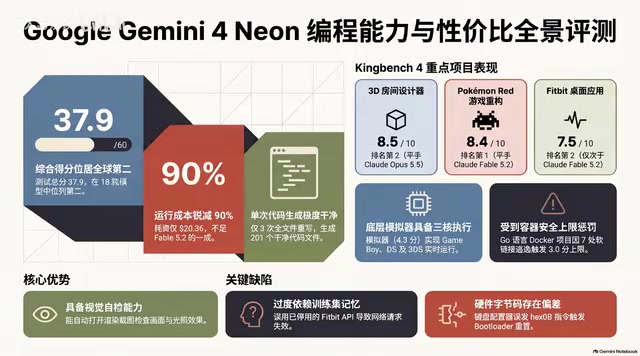
Gemini 4 Neon review: 1M-token context, four thinking levels, 201 files in one KingBench4 pass at one-tenth Fable 5.2's cost—but it hallucinates fake data, leaves 7 symlink escapes, and bricks keyboards.

Google Gemini 4 Neon Hands-On: 6 3D Works That Impress and Fail
Hands-on with Google Gemini 4 Neon on a 3060 laptop: 6 3D works tested. Sunshower Fishing Harbor and mechanical keyboard impress; soft-body physics and faces fall short.
Gemini 4 Neo Web Novel Writing Test: Faint AI Flavor, Textured Dialogue
Bilibili creator's first-look review of Gemini 4 Neo for Chinese web novel writing: testing a Three Kingdoms transmigration opening with faint AI flavor, emotionally textured dialogue, and strong crisis building, plus comparison of 4A/4H/4C models and full workflow demos.