9 AI Voice Recorders Compared: How to Choose Across the ¥198–¥899 Price Range

A full comparison of 9 AI voice recorders from ¥198 to ¥899, with the best pick for every use case.
This article compares 9 mainstream AI voice recorders spanning ¥198 to ¥899 across noise reduction, AI transcription, battery life, and discreetness. It explains the ASR+LLM technology behind smart summarization and offers tailored recommendations for students, executives, journalists, and knowledge workers.
Why AI Voice Recorders Have Become a New Essential for Work and Study
In information-dense work and study scenarios, a voice recorder that can automatically transcribe, summarize, and even generate meeting minutes is evolving from a peripheral accessory into a "second brain" for many people. The pain points of recording on a phone are obvious: incoming calls can interrupt at any time, noise can't be filtered out, and you still have to manually organize everything afterward. A new generation of AI voice recorders uses dual-chip noise reduction, large speech models, and intelligent summarization to seamlessly connect the entire "record–transcribe–distill" pipeline in one step.
This article is based on a year-end comparison video from a digital tech reviewer on Bilibili, examining 9 mainstream AI voice recorders on the market. Prices range from an entry-level ¥198 model to a ¥899 flagship, covering scenarios such as meetings, studying, interviews, and evidence collection. Before diving into the product reviews, let's clarify three key purchasing criteria.
Three Dimensions to Consider Before Buying an AI Voice Recorder
First, sound pickup and noise reduction capability. Whether the device can clearly "extract" human voices from a noisy environment and how well it controls background noise is the fundamental standard for judging hardware quality.
Second, AI transcription and intelligent summarization capability. This is the core watershed between old and new voice recorders—a recorder that can't automatically produce meeting minutes is essentially just an electronic storage card. The "transcription + summarization" capability of an AI voice recorder is essentially the product of chaining together automatic speech recognition (ASR) technology and a large language model (LLM). The speech recognition field has undergone three technological leaps: from HMM (Hidden Markov Models), to deep learning RNN/LSTM, and now to the Transformer architecture. Meanwhile, "intelligent summarization" and "meeting minutes generation" rely on layering a GPT-class large language model on top of the transcribed text to perform summary distillation, keyword extraction, and structured output. This "ASR+LLM" pipeline architecture is the core technological watershed distinguishing next-generation AI voice recorders from traditional recording devices, and it's where each manufacturer's technical barriers are concentrated.
Third, form factor and discreetness. Whether you'll use it openly on a table or discreetly for evidence collection directly determines whether you should choose a bean-shaped body or a card-shaped form factor.
The ¥100 Tier: The Value Battle Among Entry-Level AI Voice Recorders
The sub-¥200 range is the most fiercely competitive price segment, with each product emphasizing different strengths.
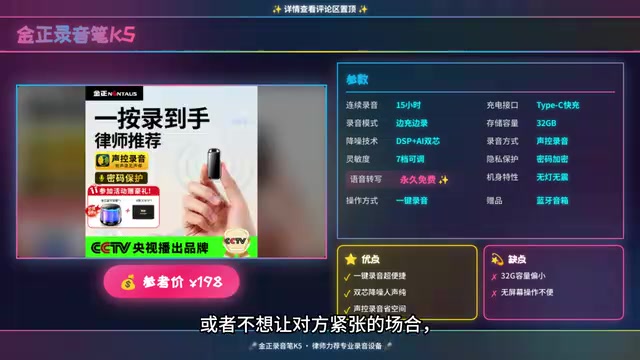
Jinzheng K5 Recording Bean (¥198) focuses on discreetness and foolproof operation. With just a single button and no flashing lights or vibration, it's suitable for evidence collection or situations where you don't want to make the other party feel pressured. The hardware uses DSP+AI dual-chip noise reduction, supports voice-activated recording and 7 levels of sensitivity adjustment, offers 15 hours of continuous recording, 32GB of built-in storage, and provides permanently free speech-to-text services. It's the top choice for budget-conscious users entering this market.
Technical Background: DSP+AI Dual-Chip Noise Reduction The collaborative noise reduction architecture of a DSP (Digital Signal Processor) and an AI chip represents the fusion of two developmental stages of noise reduction technology in recording devices. Traditional DSP noise reduction relies on preset algorithms, using Fourier transforms to break down audio signals into frequency-domain information, then employing filters to eliminate background noise in specific frequency bands—suitable for handling stable ambient background noise (such as air conditioning or fan sounds). AI noise reduction, on the other hand, leverages deep neural networks trained on massive speech samples, enabling the model to distinguish between "human voice" and "non-human voice" and dynamically handle sudden noises (such as the clatter of dishes in a café). When working together, the DSP handles background noise suppression at the hardware level while the AI handles dynamic voice enhancement at the software level, theoretically achieving a better signal-to-noise ratio than either approach alone.
Miji Recording Gadget (¥198) takes a "spy equipment" route, with a built-in 5G transmission chip and BeiDou+GPS dual-mode positioning, supporting remote monitoring via phone and real-time positioning down to 1 meter, with up to 70 days of standby. It's suitable for special scenarios like remote care and anti-loss, but remote monitoring features touch on privacy and compliance boundaries, so please carefully assess before purchasing. In China, Article 1032 of the Civil Code explicitly stipulates that natural persons enjoy the right to privacy; recording others' conversations without consent may constitute infringement. Users are advised to fully understand local laws and regulations before use, and to prioritize compliant recording methods where both parties are informed.
Lenovo C5 (¥199) represents the major-brand business route, with a zinc alloy + leather-faced body, supporting 1536K lossless recording and 45 hours of ultra-long battery life. Its AI capabilities cover 98.6% transcription accuracy, intelligent summarization, mind maps, speaker separation, and translation across more than 100 languages. Brand endorsement and comprehensive after-sales service are important bonus points for students and career newcomers.

The Mid-Range Tier: Form Factor Innovation and Transcription Specialization
Newmine H13 (¥229) stands out for its three-in-one form factor—recorder, wristwatch, and keychain can be switched as needed. It supports 1536kbps PCM lossless recording, 29 hours of battery life, and 360-degree omnidirectional pickup, and can also pair with in-line control earphones to serve as a music player. It comes bundled with a lifetime VIP transcription service originally priced at ¥199, so heavy users can almost "break even."
iFlytek Pokey (from ¥494) is the professional benchmark in the AI transcription field. Thanks to years of accumulated speech recognition technology, iFlytek holds a significant advantage in recognition accuracy for Mandarin Chinese and dialects—stemming from over 20 years of building speech corpora and continuous investment in model iteration, with particularly outstanding performance in niche scenarios such as professional vocabulary and regional accents. The product supports real-time transcription and translation across 11 languages and 12 dialects, with extremely fast transfer speeds—a one-hour recording takes just one minute for fast transfer, about 10 times the speed of Bluetooth transmission. Its AI features cover key summaries, mind maps, meeting minutes, and even personalized Q&A. For interviewing journalists and frequent meeting attendees, iFlytek is an almost unavoidable option.

High-End Flagships: Ecosystem Integration and Deep Knowledge Processing
For products above ¥700, the competitive dimension has shifted from pure hardware specs to ecosystem integration and deep AI capabilities.
SenseNote Business Edition (¥749) focuses on extreme thinness (3mm thick, 29g weight) and secure encryption, supporting an 8-meter recording range, a 2+1 microphone array, and 40 hours of battery life. It offers business opportunity insights and private knowledge base creation, with a quadruple encryption scheme designed specifically for the trade secret protection needs of sales directors and executives.
DingTalk Pro Flagship Edition (¥879) deeply integrates with the DingTalk ecosystem. Its 660mAh battery supports 60 days of standby, and its 5+1 microphone array achieves ultra-long pickup ranges of 5 to 8 meters, filtering out more than 500 types of ambient noise. It comes with 1,300 minutes of permanently free transcription time.
Technical Background: Microphone Arrays and Beamforming The microphone array is the key hardware foundation for high-end AI voice recorders to achieve long-distance, high-precision sound pickup. A single microphone can only capture sound omnidirectionally and cannot determine the direction of the sound source; but when multiple microphones are arranged in a specific geometric configuration, beamforming technology can use the time difference of arrival (TDOA) of the same sound source at each microphone to calculate the direction of the sound, then "focus" on the sound in the target direction at the algorithmic level while suppressing noise from other directions. Take DingTalk Pro's 5+1 microphone array as an example: 5 main microphones handle omnidirectional pickup and directional positioning, while 1 reference microphone specifically captures ambient noise for active noise cancellation (ANC). This is the core hardware foundation enabling the product to achieve 5–8 meter long-range pickup and filter out more than 500 types of noise.
For heavy DingTalk users, its seamless integration with existing workflows is a differentiated advantage that other products struggle to replace.
Dedao Gadget Recording Card (¥888) differentiates itself through "knowledge processing." Backed by ten years of content assets accumulated by Dedao, it adds four AI capabilities: commentary, sprouting, interrogation, and polishing. It doesn't just convert speech to text—it acts more like a mentor helping you extend your thinking, refine your viewpoints, and accumulate knowledge assets.
Technical Background: RAG Architecture and Personal Knowledge Management The underlying implementation of this feature approaches the RAG (Retrieval-Augmented Generation) architecture: when generating an answer, the model retrieves relevant courses and book content from the Dedao knowledge base as contextual reference, thereby producing knowledge extensions with greater professional depth rather than generic, all-purpose answers. This also echoes the core proposition in the PKM (Personal Knowledge Management) field in recent years—recorded content should not be merely archived, but should become searchable, connectable, and iterable knowledge assets, i.e., the so-called "second brain."

WaveNote (¥899) tops the "ultra-thin ranking" with a 2.99mm body thickness and 29g weight. Its biggest highlight is support for WeChat call recording, a high-frequency essential need. It uses mainstream large models like DeepSeekAd to generate intelligent summaries—DeepSeek is a series of large language models developed by DeepSeek Inc., notable for its strong reasoning capabilities and Chinese comprehension, along with relatively low inference costs, making it a viable choice for integrating AI capabilities into consumer-grade hardware devices. For voice recorder scenarios, the advantage of large models lies in stronger contextual understanding—they can grasp meeting context, identify implicit intent, and generate logically coherent structured minutes. The product supports real-time simultaneous interpretation across 112 languages, offers 42 hours of battery life and 98% transcription accuracy, and emphasizes local data protection and a privacy mechanism requiring user authorization for uploads.
It should be noted that the WeChat call recording feature must be used with caution from a legal standpoint: when a party records a call they themselves are participating in, this generally carries a certain degree of legitimacy at the level of civil evidence, but secretly recording without informing the other party may pose legal risks. It's advisable to inform the other party and obtain consent in advance in sensitive scenarios.
Choosing by Scenario: The Best Options for Different User Groups
Based on the overall comparison results, here are the recommendations for different needs:
- Students / Career Newcomers: On a limited budget, choose the Jinzheng K5 or Lenovo C5, balancing value for money with solid transcription basics.
- Multi-Scenario Sports and Commuting: The Newmine H13's three-in-one form factor paired with a lifetime transcription VIP offers the best overall value.
- Journalists / Frequent Meeting Attendees: The iFlytek Pokey's transcription accuracy and ultra-fast transfer are its core competitive strengths.
- Business Executives / Sales Teams: The SenseNote or DingTalk Pro, focusing on encryption security and ecosystem integration.
- Knowledge Workers: The Dedao Gadget's AI knowledge processing capability is unique and worth serious consideration.
- WeChat Call Recording Essential Need: The WaveNote is currently one of the few targeted solutions on the market.
It should be noted that the data in this article is primarily sourced from a single reviewer's comparison video. Some specifications and bundled-gift descriptions carry promotional overtones, so it's advisable to combine more independent reviews and hands-on experience before deciding on the actual noise reduction and transcription performance. When it comes to features like remote monitoring and call recording, be sure to understand local laws, regulations, and privacy compliance requirements.
Conclusion: From "Recording Tool" to "Information Processing Plugin"
The essential value of an AI voice recorder is automating the complete workflow of "hearing–recording–organizing–applying." Empowered by large models, these devices are evolving from mere recording tools into personal information processing assistants. Notably, as the access cost of general-purpose large models like DeepSeek continues to decline, the core competitiveness of AI voice recorders is migrating from "hardware noise reduction specs" toward "model selection and software iteration capability"—meaning that buying an AI voice recorder is essentially also choosing a continuously evolving AI service platform.
Rather than blindly pursuing a pile-up of specs, it's better to first clarify your most core use case—is it high-frequency transcription, multilingual translation, discreet evidence collection, or knowledge accumulation? Only by clarifying your needs can you spend every penny where it truly counts.
Key Takeaways
Related articles

Understanding DeepSeek in 3 Minutes: The Rise from a Quant Hedge Fund to an Open-Source AI Leader
DeepSeek's history in 3 minutes: from High-Flyer Quant's compute build-up to V2's MLA inference cost cuts, V3's $5.576M training bill, R1's open-source global shock, and V4 with a $7B Series A.

Local Creative Writing Model Showdown: Fine-tuned Qwen3.8 27B Wins, DeepSeek v4.1 Underwhelms
Bilibili creator tests seven local creative writing models: Hemingway and HumanLike Chat based on Qwen3.8 27B perform best, DeepSeek v4.1 is plain, Dongfang Shuo ranks last with confused characters. Includes three test prompts, scores, and usage advice.

Liang Wenfeng's Three Big Bets: Why Did DeepSeek Open-Source Its 82% Gross Margin?
Why did DeepSeek open-source DeepInfer, its 82% gross margin inference framework, and then launch a hundred-billion funding round? An analysis of Liang Wenfeng's three big bets and the open-source strategy.