Understanding DeepSeek in 3 Minutes: The Rise from a Quant Hedge Fund to an Open-Source AI Leader

With compute front-loading, cost engineering, and MIT open source, DeepSeek became a global open-source model leader in three years.
The article traces DeepSeek's growth from its 2023 independence to 2026 IPO preparations: starting from High-Flyer Quant's A100 compute and Fire-Flyer cluster, with Liang Wenfeng holding 84% and insisting on no fundraising or commercialization. GRPO and MLA became key technical foreshadowing; V3 matched GPT-4o with a $5.576M compute bill, and R1's MIT open source topped the US App Store, wiping nearly $600B off NVIDIA's market value in a day. R2's delay showed release restraint, V4 launched Flash and Pro with Huawei Ascend support, and a $7B Series A closed at a $52B valuation.
DeepSeek has grown from the compute warehouse of a quantitative hedge fund into a global leader in open-source models in under three years. Its story is not just about technical breakthroughs, but a long-term experiment in route selection, cost control, and open-source strategy.
The Starting Point: An AI Spark Inside a Quant Hedge Fund
In the spring of 2023, a team from Hangzhou quietly took shape. The story traces back to 2015, when Liang Wenfeng founded High-Flyer Quant, using algorithms for investing and accumulating its first batch of NVIDIA GPUs. Starting in 2021, High-Flyer began stockpiling tens of thousands of A100s and built the Fire-Flyer cluster — providing a scarce compute foundation for later model training.
In April 2023, Liang Wenfeng announced the founding of an AGI lab; two months later, on July 17, DeepSeekAd officially became independent, with Liang Wenfeng holding 84%. From the very beginning, the company set its tone: no fundraising, no talk of commercialization — just build the model.

Technical Breakthroughs: From Open-Source Models to GRPO and MLA
In November 2023, DeepSeek LLM and Coder were open-sourced one after another. The largest model, with 67 billion parameters, was trained on 2 trillion tokens — DeepSeek had stepped onto the table for the first time.
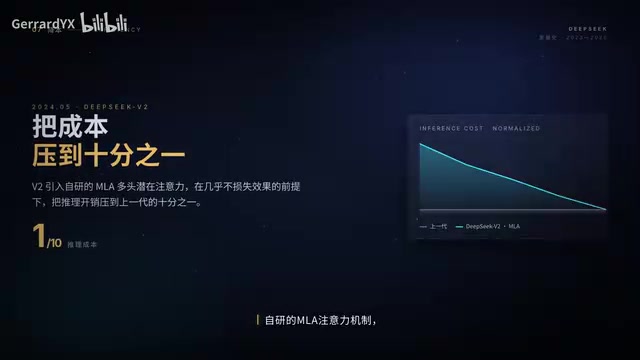
The more critical foreshadowing was planted in February 2024. In the DeepSeek Maths paper, the team casually invented the GRPO reinforcement learning algorithm — a seed that would detonate worldwide 11 months later. In May 2024, V2 arrived, with the self-developed MLA attention mechanism cutting inference costs to one-tenth of the original. That year, everyone was asking the same question: How did they do it?
GRPO (Group Relative Policy Optimization) is a reinforcement learning algorithm used to train large language models for reasoning. Traditional PPO requires training a value network (Critic) of the same scale as the policy model to estimate the baseline, incurring huge memory and compute overhead. GRPO's approach is: sample a group of multiple responses to the same question, use the mean reward within the group as the baseline and the within-group standard deviation for normalization, thereby eliminating the Critic network. This allows sampling more responses and increasing the batch size under the same memory, significantly improving reinforcement learning training efficiency. When DeepSeek proposed this algorithm in the Maths paper, it did not attract much attention, but R1-Zero relied on it to let the model spontaneously develop long-chain reasoning and self-reflection capabilities under pure reinforcement learning, and GRPO thus became one of the de facto standards for the open-source community to reproduce R1.
MLA (Multi-head Latent Attention) targets the KV Cache bottleneck during inference. Standard multi-head attention needs to cache all K and V vectors for each token, and the longer the context, the larger the memory usage. MLA jointly compresses K and V into a low-dimensional latent vector for caching, then projects it back up on demand during inference, while using decoupled RoPE positional encoding to avoid compression losses in expressiveness. Its effect is to compress the KV Cache several times over while maintaining or even exceeding standard MHA performance, thereby greatly reducing the memory and bandwidth costs of long-context inference — this is precisely the underlying reason DeepSeek can push API prices to industry lows.
The Tipping Point: V3's Cost Accounting and R1's Open-Source Shockwave
On December 26, 2024, V3 was released: 671 billion parameters, 37 billion activated, FP8 training, with a compute bill in the paper of only $5.576 million, yet performance matching GPT-4o. This number shook the industry because it proved that extreme engineering optimization can significantly lower the training threshold for frontier models.
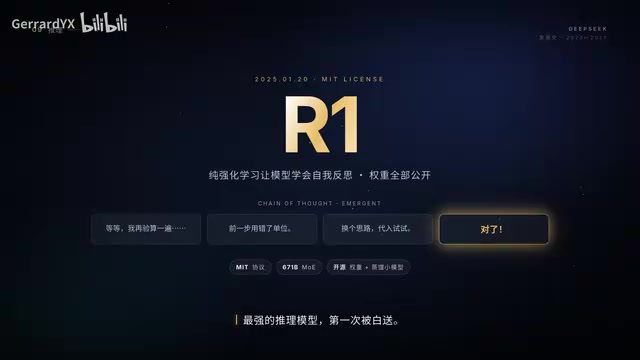
On January 20, 2025, R1 was open-sourced. Pure reinforcement learning taught the model self-reflection, and under the MIT license all model weights were made public — the strongest reasoning model was "given away for free" for the first time. Seven days later, DeepSeek topped the US App Store free chart, NVIDIA's stock price briefly plunged 17%, with nearly $600 billion in market value evaporating in a single day, and within two days the overall US stock market lost about $1 trillion. The capital markets repriced the impact of "open source + low cost" in the most dramatic way possible.
FP8 mixed-precision training is one of the key engineering methods that made V3's cost bill possible. FP8 refers to the 8-bit floating-point format, commonly available in two variants: E4M3 (4-bit exponent, 3-bit mantissa) and E5M2, with dynamic range and precision both lower than BF16/FP16. V3 uses FP8 computation in most matrix multiplications, retaining higher precision only in precision-sensitive stages (such as some accumulations, normalization, and optimizer states), and combines fine-grained block-wise quantization with scaling factors to keep quantization errors within an acceptable range. Compared with BF16, FP8 in theory doubles compute throughput and halves memory usage, with particularly obvious gains on chips like the H800 that have native FP8 support. The MoE (Mixture of Experts) architecture is the source of "671 billion total parameters, 37 billion activated": each token is routed to only a few experts, so the total parameter count determines knowledge capacity while the activated parameter count determines the compute overhead of a single inference — decoupling the two is the mainstream paradigm for low-cost large models.
Trials and Iterations: R2's Delay and V4's Arrival
The real test came in the following year. R21 0528, V3.1 with dual thinking and non-thinking modes, and V3.2 with sparse attention introduced followed one after another, while the much-anticipated R2 was repeatedly delayed. Liang Wenfeng's explanation was "it's not ready yet" — a remark that reveals the team's restraint on release cadence: better to delay than to consume trust with an immature product.
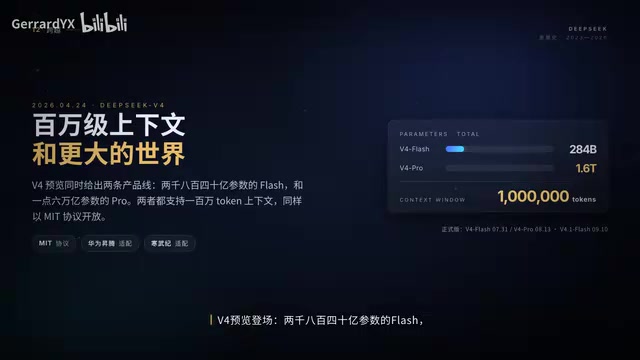
In April 2026, the V4 preview arrived: Flash with 284 billion parameters, Pro with 1.6 trillion parameters, million-level context, all under the MIT license, with Huawei Ascend integrated from day one. In the same month, DeepSeek began negotiating a new funding round; in May, a $7 billion Series A landed at a $52 billion valuation; in July, news broke of preparations for an IPO, potentially listing as early as 2027. On October 20, DeepSeek open-sourced its inference engine DeepInfo, supporting the online service of V4.1 Flash, processing about 155 trillion tokens per node per day, under the Apache 2.0 license, but supporting only SM100 and Ascend 950.
The MIT license is the least restrictive of the permissive open-source licenses: it allows commercial use, modification, redistribution, and even closed-source derivatives, requiring only retention of copyright and license notices, and provides no warranty. For model weights, MIT means enterprises can freely deploy, fine-tune, and integrate them into commercial products without disclosing their own changes — in stark contrast to the Llama series' custom community license and some "research-only" open weights. It is precisely this thorough openness in terms that allowed R1 to be rapidly adapted by cloud providers, chip makers, and startups after release, forming a de facto ecosystem standard. Apache 2.0 is similar to MIT but more formal, additionally containing explicit patent grant clauses; DeepSeek used it to release the inference engine DeepInfo, likewise a choice that encourages commercial adoption.
What This Company Did Right
Looking back at this timeline, DeepSeek's path has several distinctive features. First, compute front-loading: the GPU cluster accumulated from the quant business gave it scarce resources early in the large-model race. Second, cost engineering: MLA, FP8, GRPO, sparse attention — each points to the same goal: do more with less compute. Third, open source in exchange for ecosystem: the MIT license led to widespread adoption of the models and also transmitted pressure to the closed-source camp. Fourth, restraint on release cadence: R2's delay and V4's phased rollout both show the team is unwilling to overdraw its reputation.
From the compute warehouse of a quant hedge fund to a global leader in open-source models, DeepSeek's story has only just begun. Its next step will determine whether the open-source route can truly close the loop commercially.
One-line Summary
With compute front-loading, cost engineering, and MIT open source, DeepSeek became a global open-source model leader in three years.
Paragraph Summary
The article traces DeepSeek's growth path chronologically from its independence in 2023 to its IPO preparations in 2026: the starting point is the A100 compute and Fire-Flyer cluster accumulated over years by High-Flyer Quant, with Liang Wenfeng holding 84% and insisting on no fundraising and no talk of commercialization. Technically, the GRPO reinforcement learning algorithm and MLA attention mechanism became key foreshadowing; V3 matched GPT-4o with a $5.576 million compute bill, and R1 was open-sourced under the MIT license and topped the US App Store, triggering nearly $600 billion in single-day market value evaporation for NVIDIA. Thereafter, R2's delay reflected restraint in release cadence, V4 launched Flash and Pro dual versions and integrated with Huawei Ascend, and in the same year a $7 billion Series A was completed at a $52 billion valuation. The article concludes by summarizing four lessons — compute front-loading, cost engineering, open source in exchange for ecosystem, and restraint in cadence — and notes that whether the open-source route can close the commercial loop remains to be verified.
Related articles

AI Digital Twin in Action: Using DOT to Automatically Track Bugs and User Feedback
DOTS engineers demonstrate how AI digital twin DOT collects cross-platform user feedback, categorizes issue themes, opens threads to investigate bug root causes, and submits PRs—showcasing a complete AI agent workflow for defect triage with auditable design.

Why Transistors Are No Longer Flat: The Evolution from Planar to Gate-All-Around
Transistor evolution from planar to FinFET to gate-all-around: why gates went from three-sided to four-sided wrapping to suppress short-channel effects and leakage current, extending Moore's Law.

Swarm Intelligence = a Single RL Agent? A Proof of Multi-Armed Bandit Equivalence
A paper proves that collective decision-making through local imitation in swarms is mathematically equivalent to single-agent reinforcement learning: N blind imitators act as N parallel environment samples, with an effective learning rate of 1/N. This article explains the derivation and implications of the Maynard-Cross Learning algorithm.