9 Emerging AI Tools to Try: The Best Automation & Agent Platforms of 2025

9 cutting-edge AI tools are reshaping workflow automation, data analytics, and autonomous programming in 2025
This article reviews 9 emerging AI tools across five domains: workflow automation (Active Pieces, Make), data analytics (NOMO AI, AI Business Plans), browser automation (Bardeen, OpenAI Operator), multi-agent collaboration (AutoGen, Mind Studio), and autonomous programming (Devin AI). Together they reveal three major trends: the shift from single tasks to multi-agent collaboration, from developer-exclusive to universally accessible, and from decision support to autonomous execution.
NVIDIA CEO Jensen Huang once predicted that AI will create more millionaires in the next 5 years than the internet did in the past 20. This isn't mere speculation—as AI tools experience explosive growth, more and more early adopters are leveraging them to build automated workflows, rapidly validate business ideas, and even create profitable products from scratch.
This article reviews 9 emerging AI tools spanning browser automation, multi-agent collaboration, no-code development, and autonomous programming—representing the latest trends in the 2025 AI tool ecosystem.
Workflow Automation Tools: From Rigid Rules to Intelligent Decision-Making
Active Pieces: An Open-Source AI Automation Platform
The biggest pain point of traditional automation is rigid rules—once conditions are set, you can only hope nothing goes wrong. Active Pieces, an open-source automation tool, completely changes this paradigm. It connects to over 330 services including Notion, Gmail, and Stripe, and more importantly, supports AI agents making real-time decisions based on predefined conditions.
The platform features built-in scheduled tasks, conditional branching, and Webhook triggers, with GPT-based steps added this year that allow users to embed reasoning tasks directly into workflows. These two key concepts deserve explanation: A Webhook is a real-time server-to-server communication mechanism—when a specific event occurs (such as a user submitting a form or completing a payment), the source system proactively sends an HTTP request to a preset URL, triggering downstream automated processes. Compared to traditional polling, Webhooks are event-driven, offering more immediate responses with lower resource consumption. "GPT-based steps" refer to incorporating large language model reasoning capabilities as a standard node within a workflow—for example, inserting a step in an automated process that has GPT perform sentiment analysis on incoming customer emails, then routing the workflow based on the results. This practice of embedding AI reasoning into automation pipelines is blurring the line between traditional RPA (Robotic Process Automation) and AI agents.
Active Pieces is one of the few automation platforms that combines both a low-code interface and AI logic, enabling non-developers to manage complex automated workflows.
Make (formerly Integromat): Natural Language-Driven Automation
Make has evolved from traditional "if A then B" logic to an AI agent-driven model. Make's predecessor, Integromat, was founded in 2012 and was known for its visual "scenario" editor. After being acquired by Celonis in 2020, it was officially rebranded as Make in 2022. A major highlight of 2025 is the natural language scenario creation feature—users simply describe their needs in plain language, such as "When a new client books a call, send me an email and add them to Airtable," and the system automatically creates the complete workflow. Airtable, mentioned here, is a frequently integrated service in the Make ecosystem—essentially a hybrid of a relational database and a spreadsheet, widely used for CRM, project management, and content calendars.
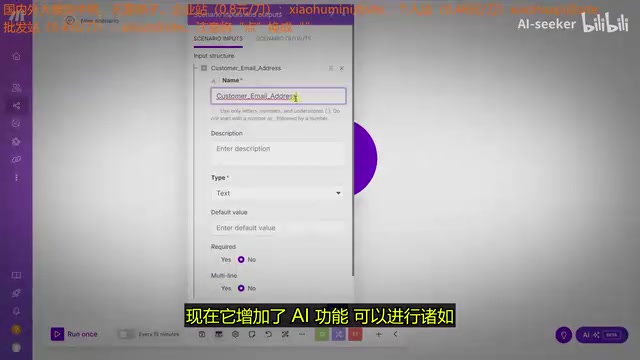
Make supports over 2,500 app integrations and has seen surging usage in no-code and marketing communities since the beginning of the year. Its canvas-based editor uses a node-and-wire visual paradigm where each node represents an operation (such as sending an email or querying a database) and wires represent data flow and execution order. This design draws inspiration from Dataflow Programming concepts, differentiating it from Zapier's linear "Zap" model and allowing users to intuitively adjust workflows. New AI features can also assist with writing emails, extracting data, and generating summaries. Make isn't trying to replace Zapier, but it's continuously evolving from static workflows toward intelligence.
Data Analytics & Business Intelligence: Faster, More Accurate Decisions
NOMO AI: Natural Language-Driven Data Insights
By 2025, enterprises face unprecedented volumes of data, yet most teams still don't know how to use it effectively. NOMO AI integrates large language models into data dashboards, allowing users to ask questions in natural language—not just viewing data, but making decisions from it.
The core technology behind "natural language-driven data insights" is a combination of Text-to-SQL and a Semantic Layer. When a user asks a question in natural language (e.g., "What was the year-over-year sales growth in the East China region last quarter?"), the system first uses a large language model to parse the natural language into a structured SQL query, then executes it against the underlying database and returns results. The semantic layer acts as a translation bridge, mapping business terms (like "active users" or "churn rate") to specific database fields and calculation logic. The challenge in this field lies in the inherent gap between the ambiguity of natural language and the precision of SQL—complex multi-table joins and time-series analysis remain technical difficulties.
According to NOMO's "2025 Data Never Sleeps Report," global AI spending per minute has surged 312% over the past year. NOMO is targeting this trend by enabling operations and finance teams to achieve automated insights and actions without specialized technical knowledge.
AI Business Plans: Complete a Business Plan in 30 Minutes
Starting a company used to begin with spreadsheets and late-night strategy documents. Now platforms like AI Business Plans can handle everything from fundraising pitch decks to social media schedules to landing page copy. A McKinsey report notes that 78% of global enterprises have already adopted some form of AI technology in their operations, and by 2025, this will extend to the planning stages of startup businesses. Business plans that used to take days can now be completed in 30 minutes.
Browser Automation & Web Operations: AI Browses the Web for You
Browser automation has gone through three generations of technology. The first generation, represented by Selenium and Puppeteer, required developers to write precise DOM selectors and operation scripts that would break whenever webpage structures changed. The second generation, represented by RPA tools (like UiPath), lowered the programming barrier by recording user actions to generate scripts, but still relied on fixed page element positioning. We're now entering the third generation—AI-driven browser automation—and the following two tools represent this generational leap.
Bardeen AI: Record Actions to Automate
Browser automation used to mean writing Python scripts or manually operating Chrome extensions. Bardeen changes this—it records your on-screen actions, such as scraping leads from LinkedIn or extracting product information from websites, and converts these steps into reusable automated workflows.
Bardeen integrates seamlessly with tools like Notion, Google Sheets, and HubSpot, and has raised $15.3 million in funding since launch. It's steadily gaining adoption in sales, recruiting, and market research scenarios, particularly popular among non-technical teams looking to reduce repetitive work.
OpenAI Operator: An AI Agent That Browses the Web Like a Human
Operator, released by OpenAI in early 2025, is a revolutionary research preview. It enables AI agents to interact with the web like humans—clicking buttons, filling out forms, and navigating websites without relying on APIs, completing formerly manual tasks through browser operations.
Operator's underlying architecture is called CUA (Computer-Using Agent), combining GPT-4V's multimodal visual understanding capabilities with browser operation APIs. Unlike traditional automation tools that rely on fixed CSS selectors, Operator "sees" the screen like a human, understands page semantics, and then decides on the next action—enabling it to handle dynamically loaded content, CAPTCHA popups, and other scenarios that traditional automation tools struggle with.
Early demos showed the system booking entire trips (including flights and hotels) simply by responding to on-screen prompts. It can parse page layouts, respond to pop-ups, and execute multi-step operations across dynamic web interfaces. This marks a fundamental shift: from language models that answer questions to AI agents that can perform real actions on the web.
Multi-Agent Collaboration & No-Code AI Development
Microsoft AutoGen 0.4: Multi-Agent Teamwork
Most AI tools are designed to work independently. AutoGen enables multiple AI agents to collaborate on the same task. Version 0.4, released in early 2025, introduced key features including asynchronous execution, modular role assignment, and shared memory.
These technical concepts deserve deeper understanding. Asynchronous Execution addresses a core bottleneck in multi-agent systems: in synchronous mode, Agent A must wait for Agent B to complete its task before continuing, resulting in poor overall efficiency; asynchronous execution allows multiple agents to work in parallel, coordinating through message queues and event-driven mechanisms. Shared Memory is another critical component of multi-agent collaboration—it provides all agents with a common context space for storing intermediate results, task states, and reasoning chains, preventing information loss or duplication during inter-agent communication. This architecture draws from the Blackboard Architecture in distributed systems, first proposed by Carnegie Mellon University in their 1980s speech recognition system Hearsay-II. Modular role assignment means each agent can be given specific system prompts, tool permissions, and behavioral constraints, similar to the microservices architecture concept in software engineering.

Developers are testing use cases like contract analysis: one agent summarizes, another verifies, and a third flags inconsistencies—all within a coordinated system. Microsoft has also launched AutoGen Studio, a visual editor that lets users design multi-agent workflows through drag-and-drop.
Mind Studio AI: Build AI Agents with Drag-and-Drop, No Code Required
Mind Studio provides a web-based visual building tool with over a hundred ready-made templates covering document processing, chat automation, customer support, and other workflow scenarios.

Designed for non-technical users, the platform lets you create task-specific AI agents through drag-and-drop components. It supports conditional logic, API calls, and Webhook integration, handling everything from simple to multi-step workflows. Users can also duplicate and reuse agent templates to accelerate cross-team iteration. Designing AI workflows is now as intuitive as creating a presentation.
Autonomous Programming Tools: AI Software Engineers Are Online
Devin AI: The First AI Junior Software Engineer
Devin AI, released by Cognition Labs, is the most disruptive tool on this list. Positioned as an "AI junior software engineer," it can autonomously plan, write, test, and debug code, operating within a sandbox environment equipped with a command line, code editor, and browser.
This Sandbox Environment is a critical design choice for ensuring autonomous programming safety. A sandbox is essentially an isolated virtualized container with a complete development toolchain—a terminal for executing commands, a code editor for reading and writing files, and a browser for consulting documentation and API references. Devin's core capability comes from Long-horizon Planning: rather than generating code line by line, it first understands the entire task context, formulates a step-by-step plan, then dynamically adjusts its strategy during execution based on feedback (such as test failures or compilation errors). This is fundamentally different from traditional code completion tools (like GitHub Copilot)—Copilot provides line-level suggestions while humans write code, whereas Devin takes over the entire development task end-to-end.
In early public demonstrations, Devin successfully resolved complete GitHub Issues, creating Pull Requests and submitting code end-to-end. On the SWE-bench benchmark, Devin solved 13.86% of real GitHub Issues at launch. While this number may seem modest, it marks the first time AI completed the full loop from problem understanding to code submission without human intervention. It can also consult documentation, find bugs, and adjust its approach mid-task without human involvement. Some companies, including Goldman Sachs, have begun experimenting with Devin to assist in software development, and in some cases, it has even handled real production engineering tickets.
Devin isn't meant to replace engineers, but it's fundamentally changing how software teams think about task allocation and development efficiency.
Three Key Directions in the 2025 AI Tool Ecosystem
Looking across these 9 AI tools, three clear evolutionary directions emerge:
- From single tasks to multi-agent collaboration: AutoGen and Devin represent AI's leap from "answering questions" to "collaboratively completing complex tasks."
- From developer-exclusive to universally accessible: No-code tools like Make, Mind Studio, and Bardeen are eliminating technical barriers, enabling non-technical users to build complex AI workflows.
- From decision support to autonomous execution: OpenAI Operator and Devin signal AI's transformation from "advisor" to "executor," capable of independently completing actions in real-world environments.
For individuals and teams looking to capitalize on the AI dividend, the key isn't waiting for the perfect tool to emerge—it's starting to experiment, combine, and iterate right now. The barriers to entry for these tools are dropping rapidly, and getting hands-on early means gaining a first-mover advantage.
Related articles
 Product Reviews
The Programmer's Desk Setup Guide: Building a Workspace That Feels Like Home
Discover how programmers build productive, comfortable workspaces. From multi-monitor setups to ergonomic design, explore the desk philosophy that drives focus and flow.
 Product Reviews
Qoder vs Cursor Real-World Comparison: Which $20/Month AI IDE Is Better?
Hands-on comparison of Qoder vs Cursor AI IDEs: Agent autonomy, human interaction count, and architecture decisions. Qoder needed only 2 interactions vs Cursor's 8.
 Product Reviews
Cursor Cloud Agent Demo: Eliminating Bottlenecks Across the Entire Software Development Lifecycle
Deep analysis of Cursor's Cloud Agent demo showing how cloud VMs, automated test artifacts, and a full-chain control plane systematically eliminate human bottlenecks across the software development lifecycle.