98% of Households Don't Pay for AI: Is Consumer AI a Real Opportunity or an Illusion?

Only 2.2% of U.S. households pay for AI — is the other 98% a future market or a permanent ceiling?
a16z's seventh consumer AI report reveals a stark divide: only 2.2% of U.S. households pay for AI subscriptions, yet the top 1% of paying users spend $903/month on average — equal to the bottom 50% combined. Power users concentrate on building, automation, and creative tools. Meanwhile, Microsoft and Meta cut Claude usage as their own models mature, and the industry debates whether the 98% non-paying majority represents untapped potential or a fundamental limit. Entertainment monetization (Suno) and AI advertising (ChatGPT) point to paths beyond traditional SaaS subscription logic.
The latest consumer AI data has arrived, painting a striking picture of contrasts. According to a16z's seventh edition of its Top 100 Consumer AI Apps report, the top 1% of paying AI users spend as much in total as the bottom 50% combined. Even more striking: only 2.2% of U.S. households pay for AI subscriptions — meaning 98% of American families currently don't spend a dime on AI.
This raises a billion-dollar question: Is that 98% "not yet paying" or "never going to pay"? If it's the latter, major AI companies may need fundamentally different product formats or business models to reach these users.
The Enormous Gap Between Power Users and Casual Users
According to data cited by a16z, the top 1% of paying AI users spend an average of $903 per month, while the median user spends just $25. Note that this top 1% isn't the top 1% of all AI users — it's the top 1% of those willing to pay, who are themselves a tiny fraction of all AI users.
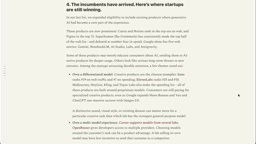
Where do these high spenders put their money? The answer is clear: building and automation tools, content creation tools, and work-related products. They purchase Notion at over 9x the average rate; video generation platforms Runway and Higgsfield at 10x and 15x respectively; and automation tool n8n at a staggering 23x. The first real market for consumer AI belongs to people who use it to build, create, and get things done.
In terms of report structure, a16z breaks the Top 100 into the top 50 by monthly web visits and top 50 by monthly mobile active users — and for the first time this edition, a top 50 by monthly revenue. Interestingly, many apps rank very differently across these dimensions. Only 11 new products made it onto the list this round, the fewest across all seven editions, perhaps signaling that consumer AI is moving from a phase of proliferation toward some degree of consolidation.
a16z (Andreessen Horowitz) is one of Silicon Valley's most influential venture capital firms. Its consumer AI report has been published twice a year since 2023 and has become a key industry benchmark for tracking AI application adoption. Web traffic data comes from third-party estimation tools like SimilarWeb; mobile data from platforms like Sensor Tower; revenue figures are aggregated from multiple sources rather than official company disclosures, so all numbers should be treated as order-of-magnitude references rather than precise financial data. ARR (Annual Recurring Revenue) is a standard health metric for SaaS and subscription products, calculated by multiplying monthly subscription revenue by 12 — it reflects business scale but does not equal actual annual revenue.
The LLM Landscape and Startup Survival Strategies
At the top of the LLM stack, the relative positions of ChatGPT, Gemini, and Claude remain stable. Consumer data shows Claude has caught up to Gemini in paying U.S. subscribers, though both trail far behind ChatGPT. Claude is better at converting users into higher-tier subscriptions and at one point led ChatGPT in net new subscriptions — but has been overtaken again in the last two months, with ChatGPT showing a clear advantage in net new subscriptions in July and August.
As the leading players consolidate their positions, breakout paths for startups are becoming clearer. a16z identifies three: owning a differentiated proprietary model (like music generation platform Suno or voice synthesis platform ElevenLabs); providing a multi-model experience (like Cursor, which supports multiple models, or OpenRouter, which aggregates multiple providers for developers); or hyper-focusing on a specific niche audience (like OpenEvidence for doctors or Venice for privacy-conscious users).
The community's first reaction to the rankings is often surprise — many people have never heard of some of the highest-ranked apps. Take Plod, a walk-and-record note-taking tool. The author admits to only learning about it while preparing a show, and it wasn't until an interior designer pulled it out during a home visit that the value of "capturing thoughts on the go" in real work scenarios became obvious. Suno ranks 7th on the revenue chart, and many assume the paying customers are professional musicians — but in reality, a large share of usage is purely for entertainment. People make funny songs for friends and family, enjoy the process, and are happy to pay for it.
The startups mentioned here represent different differentiation strategies. Suno is an AI music generation platform where users input text descriptions to get full songs, validating the monetization potential of "entertainment AI." ElevenLabs is a leader in voice cloning and synthesis, offering high-fidelity multilingual voice generation APIs used widely by podcasts, audiobooks, and accessibility applications. Cursor is an AI-powered code editor with built-in interfaces to multiple large models, widely used by developers for coding assistance. OpenRouter is an API aggregation gateway that lets developers call models from OpenAI, Anthropic, Google, and others through a unified interface, reducing vendor lock-in risk. What these companies share is finding verticals that general-purpose LLMs haven't deeply addressed, and building moats at the experience layer.
Agent Fleets and Shifting Enterprise Procurement
Beyond consumer data, several notable industry developments have emerged recently. A group of "agent fleet trackers" reported detecting thousands of agents using Tencent AI infrastructure sending bulk requests to Alibaba's mapping service AMAP. Researchers deliberately avoided the term "agent swarm" since there was no evidence of coordination between the agents, preferring "agent fleet" instead.
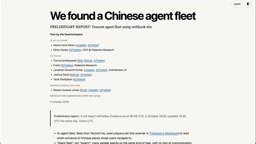
These agents appeared to be bulk-requesting information about local landmarks like parks, zoos, and hospitals. At worst, this amounts to bypassing API rules for bulk data scraping. But this kind of tracking research is becoming a growing field, helping us understand what these agents are actually doing across the web.
Enterprise procurement is also seeing dramatic shifts. According to The Information, Microsoft cut its internal Claude budget by one-third, with programmers required to limit their usage and shift toward Microsoft's own models. Meta's Claude usage dropped by half — at its peak, roughly 60,000 employees were using Claude Code, but after a 10% headcount reduction and the launch of Meta's in-house tool MetaCode, that number fell to 30,000, while MetaCode picked up roughly 30,000 users of its own. Meta's monthly spending on Anthropic has dropped to approximately $105 million.
These changes come as Anthropic prepares for an IPO, with Wall Street closely scrutinizing its financials. Disclosures show that just two customers account for a quarter of Anthropic's 2025 revenue. Still, it's worth keeping Microsoft and Meta's cuts in perspective — they are competing labs that were only reluctantly using Anthropic's models because they were simply too good. Once their own models catch up, switching is a natural choice, and this doesn't reflect the behavior of typical enterprise customers.
The distinction between "Agent Fleet" and "Agent Swarm" reflects the caution around terminology in current AI safety research. "Swarm" implies coordination and communication — suggesting some form of centralized command or peer-to-peer collaboration between agents. "Fleet" simply describes scale without implying coordination. This distinction also matters legally and regulatorily: coordinated bulk scraping may violate platform terms of service and even anti-competition regulations in some jurisdictions, while uncoordinated high-frequency access is closer to a standard traffic anomaly. As AI agents are deployed for increasingly autonomous web tasks, defining, detecting, and regulating such behavior is becoming a new challenge for platform governance and AI safety.
On the enterprise data: Meta's Claude Code usage dropping from ~60,000 to ~30,000 users, perfectly mirrored by MetaCode's growth to ~30,000 users, clearly illustrates the classic pattern among large tech companies: "buy externally to validate, then internalize and replace." Anthropic's IPO preparations make these customer concentration figures especially scrutinized by Wall Street — two customers accounting for a quarter of revenue signals significant revenue concentration risk, a factor institutional investors typically discount heavily in valuations.
The Great Debate: "Never Will Pay" vs. "Haven't Yet"
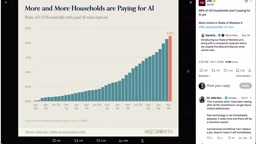
Back to the core question. Optimists frame this as purely an early-adoption phenomenon. Some cite historical data: in the U.S., household penetration from 2% to 50% took computers 19 years, cars 15 years, and smartphones just 6.5 years — meaning AI is simply early. Others draw comparisons to other paid categories: 25% of households pay for SiriusXM, 55% pay for cloud storage, and 91% pay for at least one streaming service.
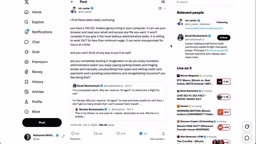
Microsoft's Nicholas Bustamante takes an even more provocative stance: "Nobody is using AI. We're living in a bubble. Even friends who pay — ask them to open ChatGPT and show their query history, and it's just a few basic operations. Most people have no idea they can upload a photo and ask questions, connect Gmail and let an agent read and send emails, or have an agent open a browser and handle check-in."
But the counterarguments are equally sharp. Lawyer Basil Musharbash puts it bluntly: "I'm a capable adult — why would I need AI to handle my check-in? I'm literate — why would I need AI to read and write my emails? For the vast majority of people, there's simply no meaningful utility here." He dissects the oft-cited "booking a flight" use case: check-in has never taken him 20 minutes, and about 55% of American adults don't fly at all in a given year. His most pointed observation: "People in tech constantly mistake their own high-travel, high-email, high-admin lifestyles for universal human workloads."
Investor Nick Carter fires back from the other end: "You have a 150+ IQ assistant living in your computer, who can use your browser, read your email, access any file, never complains about tedious tasks, and is willing to work 24/7 at below minimum wage — and you can't think of a single use for it?"
Why "Consumers Don't Pay" Doesn't Necessarily Undermine the Industry's Logic
Even granting that ordinary consumers have a ceiling on AI payment willingness, this doesn't necessarily invalidate the entire industry's financial narrative — for two reasons.
First, unlike traditional SaaS, AI has an extraordinarily high consumption ceiling. SaaS typically tops out at a couple hundred dollars per month for the highest tier, while AI power users can justifiably spend thousands or even tens of thousands per month with positive ROI.
Second, consumer AI doesn't have to monetize only through productivity, or only through subscriptions. Suno is generating hundreds of millions in ARR, with a significant portion coming from "ordinary people" who treat it as an entertainment platform. And advertising — that love-hate model that powers half the internet — is now entering the picture. OpenAI just announced visually integrated ads within ChatGPT, moving beyond text-only advertising. Meanwhile, ChatGPT now reaches 1.2 billion people weekly, a 20% increase since announcing the 1 billion milestone in late July.
One of the most thought-provoking charts in the a16z report illustrates the remaining growth space for consumer AI: today, AI applications are heavily concentrated in productivity tools, search and Q&A, content creation, and image/video generation — while in streaming, retail, social communication, travel, personal finance, job searching, real estate, gaming, and dating, there are almost no AI platforms in the Top 100.
Early adopters saying "we're still early" can easily become a reflexive excuse for mediocre numbers. But assuming today's landscape is the endgame several years from now is equally misguided. The real answer likely lies somewhere between the two extremes of "never will pay" and "haven't paid yet."
OpenAI introducing visual ads into ChatGPT marks the formal entry of generative AI into advertising-based monetization. Traditional internet advertising (search ads, feed ads) relies on user intent signals and high-frequency click paths, while advertising formats for AI conversational interfaces are still being explored — how to insert commercial messages without breaking the conversational experience is a major product design challenge. AI advertising also faces new attribution problems: when users make purchase decisions through an AI assistant rather than directly clicking an ad link, traditional click-attribution models can't accurately measure ad effectiveness. If ChatGPT's weekly reach of 1.2 billion is accurate, its ad inventory is large enough to compete with major social platforms — but whether its monetization efficiency (CPM/CPC levels) can approach Google or Meta remains to be seen.
Related articles

How Big Can Stars Really Get? The Physical Limits of the Largest Stars
Red supergiants are the largest stars by volume, with radii up to 2,000 times the Sun, engulfing the inner solar system. But there is no precise upper limit on stellar size—models predict up to 15,000 solar radii. The most massive blue stars are far smaller than red supergiants—biggest and heaviest are two different things.

Apple HomeView Smart Display Full Feature Breakdown: Wall-Mount or Desktop, $299
Apple launches HomeView, a $299 smart display with wall-mount and desktop options, 12MP camera for facial recognition, smart home control, music playback, and recipe step-by-step cooking. Full breakdown of watch faces, apps, privacy, and cooking integration.

Where Did the Promised New Studio Go? Craft Computing Answers After Five Years
Craft Computing's host responds to viewer questions: the new studio promised five years ago was shelved as construction costs soared from $30,000 to $75,000, and was replaced by a 168-square-foot garage conversion.