A $5,000 n8n Project With Zero AI: Why Automation Is Worth More Than AI

A $5,000 n8n project with no AI proves businesses pay for time savings, not technology labels.
This article documents a case where a B2B order automation workflow built with n8n sold for $5,000 — with zero AI involved. Starting from a business audit that quantified 8 hours of daily manual labor, the author built a deterministic rules-based flow for invoicing, used a live prototype to close the sale in 10 seconds, and only introduced an AI Agent node at the edges where natural-language inputs couldn't be handled by rules alone. The core argument: value comes from measurable business outcomes, and knowing when not to use AI is itself a professional skill.
A developer friend saw one of my invoices and asked: "$5,000 — what AI did you build for them?" My answer: "No AI. Just an n8n automation that moves orders from email into an accounting system."
That answer sounds counterintuitive. In an era where AI has become the centerpiece of every marketing pitch, a project with zero AI selling for $5,000 reveals a truth that's easy to overlook: companies don't pay for AI — they pay to get their time back.
The Customer's Real Pain Point Isn't AI
This B2B client never once asked about AI. Their need was simple — stop making their team manually re-enter the same orders every day. Three people spent their days copying every order email by hand into QuickBooks, checking inventory, and sending confirmation replies to customers.
Classic "boring but necessary" work. Before writing a single line of code, I took one critical step: auditing where the customer's time actually went, not looking at their website. Many technical solutions fail because the conversation jumps straight to tech stacks and models without ever understanding which specific task is eating up the team's hours.
This step is really a business diagnosis. Only by quantifying "how painful is the pain" can you build a rational case for pricing and solution design.
Putting a Price Tag on Boring Work
The second step was to "price" the repetitive labor. Each order took about 6 minutes to process, and the client handled roughly 80 orders per day. Do the math: just entering orders consumed about 8 hours daily — the equivalent of one full-time position.
These numbers are the foundation of the entire pricing rationale. They translate an abstract "hassle" into a calculable labor cost: one full-time headcount. When you can show a client that "this machine replaces a full-time employee," the $5,000 quote shifts from "expensive" to "a bargain."
This is also why the project stands on its own without an AI angle — the value comes from quantifiable time savings, not the novelty of the technology.
When Rules Are Clear, Automation Beats AI
Step three reveals an important technical judgment: when the rules are well-defined, use deterministic automation — not AI.
Every step follows rules written in advance, so the same order always produces the same output. I want to flag a specific risk here: AI hallucinates. In a scenario like generating invoices with precise dollar amounts, one hallucination is one costly mistake.

This is a calm rebuttal to the "AI solves everything" narrative. Finance, invoicing, and inventory reconciliation demand reliability and reproducibility far more than they demand "intelligence." The stability of a rules engine is precisely what AI currently cannot guarantee. Choosing the right tool matters more than chasing the hottest technology.
n8n is an open-source workflow automation platform, similar in positioning to Zapier or Make (formerly Integromat), but with support for self-hosted deployment. It uses a visual node-and-connection interface to build workflows: each node represents an action (such as reading an email, calling an API, or writing to a database), and the connections between nodes define data flow and trigger logic. Compared to pure-code solutions, n8n dramatically lowers the barrier to integrating multiple SaaS systems; compared to purely no-code tools, it retains enough flexibility to allow JavaScript inside nodes for handling complex logic. For an order-entry scenario like this one, n8n can monitor an email inbox, parse attachments or message bodies, create invoices via the QuickBooks API, and trigger reply emails — the entire chain requires no human intervention, and every step's behavior is fully defined by the developer in advance, making results predictable and auditable.
Closing the Sale with a Live Prototype
Step four is about how to actually sell it. In the meeting with the client, I took one of their real sample orders and ran it through the workflow live, using their own inbox.
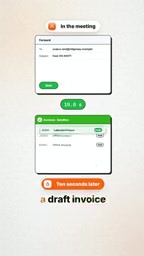
10 seconds later, the invoice was in QuickBooks.
A "see it work right now" prototype demo is more convincing than any slide deck. It turns an abstract automation promise into a result the client can witness with their own eyes — using their own data, inside the interface they already know. For B2B clients who respond to results, this step is often what closes the deal.
Bring AI In Only Where Rules Fall Short
The final step is where I actually define AI's role: use AI only at the edges where rules can't reach.
In practice, some customer emails are written casually — things like "same as last time but double the quantity." That kind of vague phrasing is hard for a pure rules engine to handle. This is where adding an AI Agent node in n8n (backed by a model like Claude) makes sense: it translates these "soft" natural-language emails into clean, structured orders.
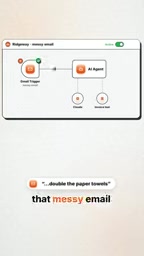
This is a pragmatic hybrid architecture: the deterministic flow handles the main path; AI only handles long-tail ambiguous inputs. It preserves the reliability of the core process, uses AI to cover the blind spots of rules, and keeps the risk of AI hallucination confined to non-critical steps.
An AI Agent node is a way of embedding a large language model (LLM) into an automation workflow. Unlike a direct LLM API call, the Agent pattern typically gives the model "tool-calling" capability — it can decide based on context whether to invoke external functions (like querying a database or formatting output) and feed results back into the flow. In n8n's implementation, an AI Agent node can be backed by Claude, GPT-4, or other models and configured with a set of callable tool functions. The use case described here is a classic "extract and structure" scenario: the model reads an ambiguous natural-language email and outputs a fully populated, well-formatted JSON order object, which downstream nodes then process using deterministic rules. This design isolates the LLM's inherent non-determinism at the entry point of the flow, preventing it from directly affecting high-risk steps like amount calculations or invoice generation.
The Question Worth Asking
The next time someone asks "what AI did you build?", the honest answer might just be: "Only as much as needed."
The real takeaway from this case is that the value anchor of a technical solution should be the business outcome, not the technology label. Companies spend money on efficiency, on saved labor, on time reclaimed. AI is one tool for achieving those goals — but it's not the only answer, and it's certainly not a mandatory ingredient.
In a world where everyone is stuffing AI into every project, knowing when not to use AI might be the rarest professional skill of all. Have you ever been pressured to bolt AI onto a project just for the label?
Related articles

Chain of Thought Isn't Just for AI: How Humans Can Use CoT to Improve Thinking Quality
Chain of Thought isn't just a prompt trick for large models. Starting from a Hacker News discussion, this article analyzes why CoT works for human thinking too, breaks down actionable ways to transfer it, and highlights the key differences between human CoT and machine CoT.
Cloudflare Teams Up with OpenAI: Closi…
Cloudflare Teams Up with OpenAI: Closing the Loop from Vulnerability Discovery to Defense with AI
Cloudflare uses OpenAI Daybreak to investigate security vulnerabilities and generate reviewable remediation plans, while developers use Codex to boost coding efficiency and quality.

Orca Multi-Agent Orchestration in Practice: A Guide to Parallel Collaboration with Claude and Codex
Orca is Stable AI's free open-source agent workbench supporting 34 agents like Claude Code and Codex in parallel. Learn its Git worktree isolation, multi-model orchestration, and mobile management.