A 9th Grader Proves a Geometry Conjecture with Claude's Help: The Rupert Property of an Archimedean Solid

A 9th grader and Claude proved an Archimedean solid can't pass through a copy of itself, settling an open conjecture.
A self-described ninth grader shared on Reddit how they used Claude to prove that the rhombicosidodecahedron — a 62-faced Archimedean solid with 120 symmetries — lacks the Rupert property, meaning it cannot pass through a hole cut in a copy of itself. The proof divides all possible orientations into ~12.3 million boxes verified via interval arithmetic (~38 CPU hours), with four singular configurations requiring exact algebraic arguments involving √5. Claude handled derivations, coding, and drafting; the student steered the work and caught errors through repeated re-verification. Two independent researchers reached the same conclusion separately, and one of the original conjecture's authors endorsed the paper for arXiv submission.
A Math Proof Built by a High Schooler and an AI
In mathematics, there exists a class of problems that appear simple yet are notoriously hard to prove: can a convex geometric solid pass through a hole cut in a copy of itself? This property is known as the Rupert property. Shapes that possess it are called "Rupert," and finding a convex shape that definitively lacks this property has long been a goal for researchers.
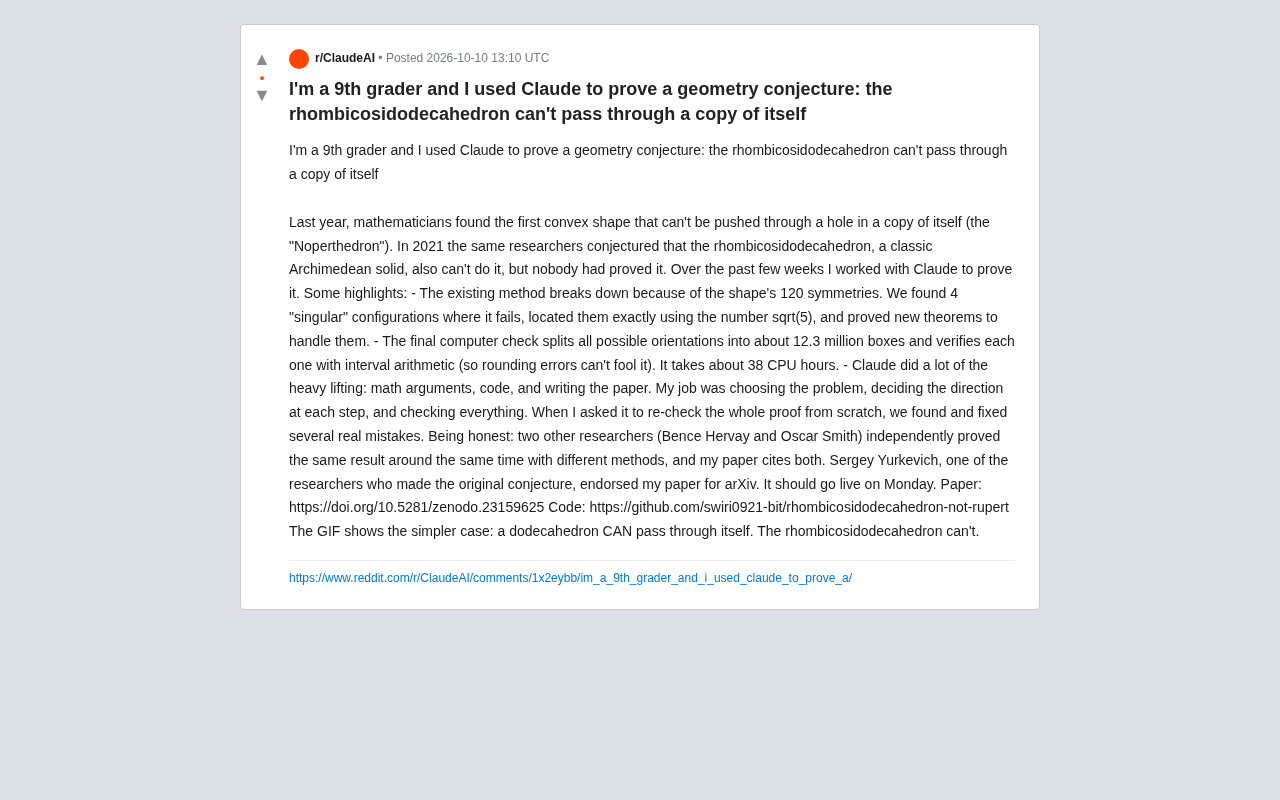
Recently, a Reddit user claiming to be a ninth-grader shared a remarkable result: working with the AI assistant Claude, they proved that the classical Archimedean solid known as the rhombicosidodecahedron cannot pass through a copy of itself — a conjecture that had remained unresolved until now.
Background: What's at Stake
To appreciate the significance of this work, some context is helpful. Mathematicians had previously identified the first convex shape proven incapable of passing through a copy of itself, playfully dubbed the "Noperthedron" (as in, "nope, can't do it"). The same team of researchers then conjectured that the rhombicosidodecahedron — a classical Archimedean solid with 62 faces — likewise lacks the Rupert property. But before this high schooler stepped in, no complete proof had been given.
The author openly acknowledged that conventional methods "break down" here. The reason: this solid has as many as 120 symmetries, which causes existing proof frameworks to collapse in certain configurations. Working with Claude, the author identified 4 "singular" configurations — the exact positions where standard methods fail — pinpointed them using the irrational number √5, and proved new theorems to handle these special cases.
The Rupert property is named after Prince Rupert of the Rhine, a 17th-century nobleman who posed the famous question: can you cut a hole in a cube large enough for an equal-sized (or even larger) cube to pass through? The answer is yes — tilting the cube slightly produces a cross-section wide enough to allow it. Mathematicians later generalized this: if a convex solid can pass through a hole cut in a copy of itself, it is said to have the Rupert property. Many familiar shapes — the cube, regular tetrahedron, regular octahedron — have been proven to possess it. For a long time, no convex shape lacking this property was known, and some researchers speculated that all convex bodies might have it. The discovery of the Noperthedron shattered that assumption, and it made the conjecture about the rhombicosidodecahedron all the more worth pursuing.
Exhausting 12.3 Million Directions by Computer
The core of the proof is a large-scale computational verification. The entire approach divides all possible orientations of the solid into roughly 12.3 million "boxes", each verified using interval arithmetic.
The key value of interval arithmetic is that it guarantees rounding errors in floating-point calculations cannot "fool" the proof. Each step produces an interval guaranteed to contain the true value, rather than a potentially distorted approximation. This makes numerical computation approach the reliability of a rigorous mathematical proof. The full verification consumed approximately 38 CPU hours.
Interval arithmetic is a numerical method that replaces single values with intervals during computation. Ordinary floating-point arithmetic introduces small rounding errors at each step, which can accumulate over many iterations until a false conclusion appears valid. Interval arithmetic addresses this by representing each number as a closed interval [a, b] guaranteed to contain the true value, and designing arithmetic operations so that output intervals always contain all possible true results. No matter how long the chain of computation, the final interval still provides a strict containment guarantee for the true value. In geometric proofs, this means that whenever an interval calculation for a given orientation clearly shows "passage is impossible," that conclusion is mathematically rigorous — not merely "true within the limits of floating-point precision." This approach is widely used in computer-assisted proof, and similar frameworks underpin landmark results like the four-color theorem and the proof of the Kepler conjecture.
What Role Did AI Play?
The most thought-provoking part of the post is the author's honest account of the human-AI division of labor. By their description, Claude shouldered much of the "heavy lifting": mathematical argumentation, code writing, and even drafting the paper. The author's own role was to choose the research problem, decide the direction at each step, and verify all results.
One particularly illuminating detail: when the author asked Claude to re-verify the entire proof from scratch, the two of them "found and corrected several real errors." This shows that AI-generated mathematical reasoning is not inherently reliable — repeated cross-checking and critical human review remain indispensable. In this collaboration, AI functions more like a highly capable but supervision-dependent collaborator, not an automated truth machine.
An Honest Disclosure
The author proactively disclosed a key fact: two other researchers, Bence Hervay and Oscar Smith, independently proved the same result at roughly the same time using different methods, and their paper cites both works. This transparency actually strengthens the credibility of the result — multiple independent paths reaching the same conclusion is itself strong evidence that the result is correct.
Additionally, Sergey Yurkevich, one of the researchers who originally proposed the conjecture, vouched for the paper, enabling it to be submitted to the arXiv preprint server. Both the paper and the code are publicly available (paper DOI: 10.5281/zenodo.23159625; code hosted on GitHub).
The Broader Significance
Beyond the result itself, this case reflects a new paradigm for AI-assisted research. A high school student, armed with a clear sense of the problem and a rigorous attitude toward verification — plus AI support for the heavy lifting of derivation and coding — completed work that requires serious mathematical expertise.
This both demonstrates the potential of large language models on structured mathematical tasks and exposes their limitations: without human guidance in choosing directions and identifying errors, AI tends to produce reasoning that looks correct but isn't. The real value lies not in AI "replacing" researchers, but in lowering the barrier to frontier exploration — allowing more people with good ideas to push problems to the point of verifiability.
Of course, results like this still require the rigorous scrutiny of peer review. But as a vivid example of AI-assisted mathematical research, it is well worth attention.
The rhombicosidodecahedron is one of the 13 Archimedean solids, systematically described by the ancient Greek mathematician Archimedes. It has 62 faces (20 equilateral triangles, 30 squares, and 12 regular pentagons), 120 edges, and 60 vertices. Its symmetry group has order 120, making it one of the most symmetric Archimedean solids. It is precisely these 120 symmetries that demand careful handling of "singular configurations" during exhaustive verification — at these special orientations, standard numerical methods lose their discriminating power due to symmetry degeneracy and require additional analytic arguments. This is the technical crux of the proof's difficulty: not a matter of insufficient brute-force computation, but of high symmetry creating blind spots for numerical methods at specific positions, which must be handled separately using exact algebra (such as irrational expressions involving √5).
Related articles

Kimi K3.1 Hands-On Test: Open-Source Model Nears Opus, Video Generation Steals the Show
Kimi K3.1 completed motion graphics, 3D rendering, mini-games, and video generation in a live test. Analysis of its 2.8T MoE architecture, gap vs Opus/GPT, and hidden video generation.

Sam Altman: Why Life's Biggest Advice Should Still Come from Humans
OpenAI CEO Sam Altman on the limits of AI advice: AI can talk you out of an impulsive email, but life's biggest advice should still come from humans.

"Black October": Did AI Uncover 3% of All Critical Vulnerabilities Ever?
A Reddit post claims 3% of all critical software vulnerabilities ever were found in the past month, dubbed 'Black October.' We break down the statistical issues, how AI-assisted code auditing accelerates discovery, and how developers should respond.