"Black October": Did AI Uncover 3% of All Critical Vulnerabilities Ever?

Reddit's 'Black October' claims 3% of all critical vulnerabilities ever were found in one month — data is questionable but reveals AI accelerating vulnerability discovery.
The article examines a Reddit post claiming '3% of all critical software vulnerabilities ever recorded were discovered in the past month.' The author notes the claim lacks public methodology — database scope, severity definitions, and time windows are unspecified — so it's a signal, not precise data. Setting aside the numbers, vulnerability disclosure is indeed accelerating due to AI-assisted code auditing and fuzzing, lower tool barriers, and mature vendor processes. For enterprises, this means shorter patch windows, repriced legacy code risk, and prioritizing by actual exposure rather than CVSS alone. The real risk is whether remediation can keep pace with discovery.
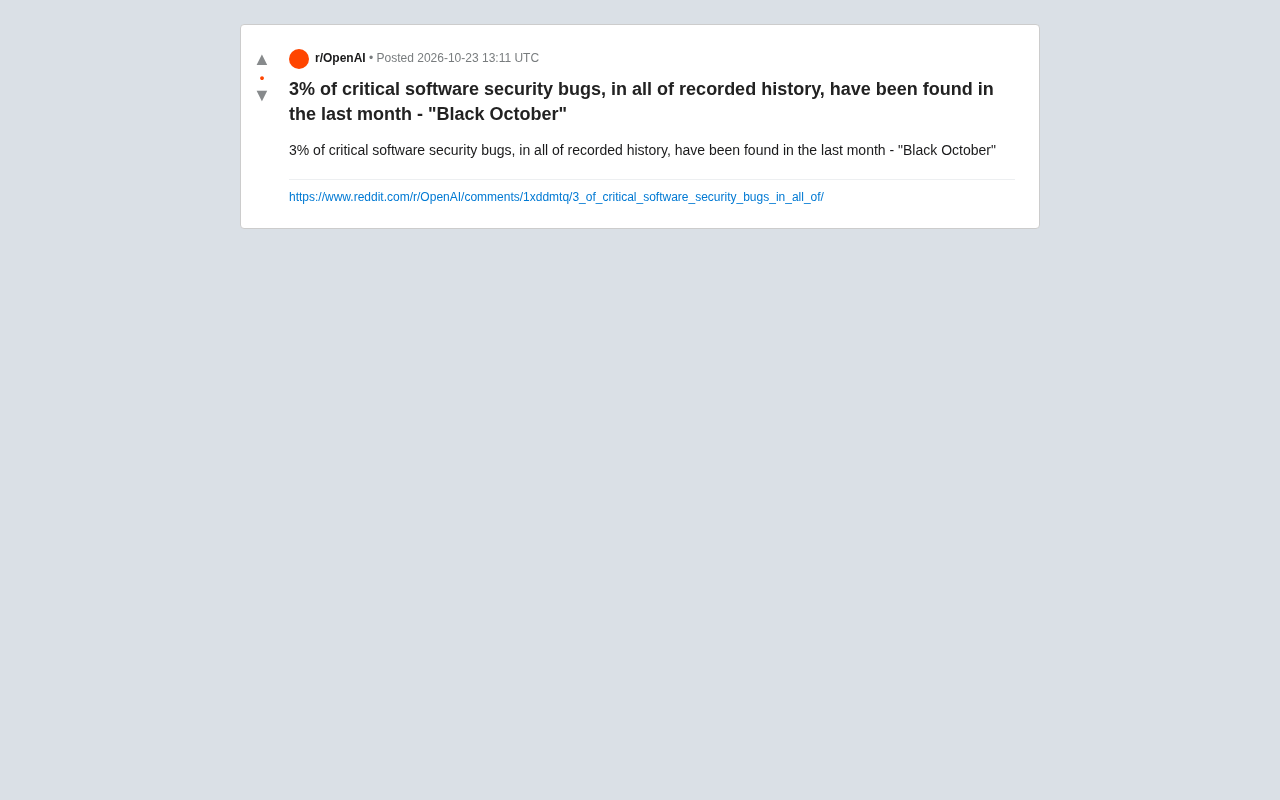
A recent Reddit post has sparked considerable discussion with a rather eye-catching title: "3% of all critical software security vulnerabilities ever recorded were discovered in the past month," which the poster dubbed "Black October." The claim sounds like a doomsday prophecy, but it may also point to a trend worth taking seriously: AI is unearthing long-dormant vulnerabilities at a pace far beyond what humans can achieve.
Where does the "3%" figure come from?
The original post offers no detailed data source or statistical methodology — it's more of a sensational assertion. To assess whether it's credible, we need to break down a few key questions:
- What does "ever recorded" mean? Is it the CVE database, NVD, or some vendor's internal vulnerability repository? Different databases have vastly different inclusion criteria.
- How is "critical" defined? Is it based on a CVSS score of ≥9.0, or a vendor-defined critical rating? Different definitions could shift the denominator by an order of magnitude.
- Does the "past month" statistical window include batches of vulnerabilities disclosed in concentrated fashion? The security community occasionally sees vendors issuing fixes and announcements in bulk, which can easily create short-term peaks.
Without a clear methodology, "3%" is better understood as a signal rather than a precise statistic — it reflects a structural shift in vulnerability discovery speed, not an industry data point that can be directly cited.
The relationship between CVE and NVD is worth clarifying first: CVE (Common Vulnerabilities and Exposures) is a vulnerability numbering system maintained by MITRE, where each record contains only a unique identifier and a brief description; NVD (National Vulnerability Database) is operated by NIST and supplements CVE records with structured information such as CVSS scores, affected product configurations (CPE), and reference links. The two do not synchronize their intake timelines — a CVE often takes weeks or even months from being assigned an ID to entering NVD with a completed score. Therefore, any statistic using "the past month" as a window will show significant deviation if it mixes the intake times from both databases.
The meaning of CVSS scores is also frequently misunderstood. CVSS (Common Vulnerability Scoring System) currently has version 3.1 as the mainstream standard, with base scores from 0–10, where 9.0–10.0 is defined as Critical. However, CVSS measures the technical severity of a vulnerability itself and does not reflect whether a specific organization is actually exposed or whether the vulnerability has been exploited. The same 9.8-score vulnerability poses far less risk on an internal network system with no internet exposure than on an edge device facing the public internet. This is also why the article later emphasizes "prioritizing based on actual exposure surface."
Why has vulnerability discovery suddenly accelerated?
Setting aside specific numbers, there are several observable factors driving the recent acceleration in vulnerability disclosure pace.
The proliferation of AI-assisted code auditing
Large language models are increasingly being used for code review and fuzzing. Compared to manual auditing, AI can scan massive codebases 24/7 and won't miss edge cases due to fatigue. Some security teams have begun using LLMs to batch-review historical code, bringing long-overlooked legacy modules back into scrutiny.
Fuzzing is the key background for understanding this section. The basic approach is to continuously feed large amounts of randomly or semi-randomly constructed data to a program, monitoring whether it crashes, fails assertions, or exhibits abnormal behavior, thereby locating potential memory overflows, null pointer dereferences, parsing errors, and other issues. Traditional fuzzing relies on coverage feedback (such as the edge coverage instrumentation used by AFL) to guide mutation direction — it's efficient but requires longer run times and better seed corpora.
The introduction of large models changes two aspects of this: first, seed generation — LLMs can directly construct format-valid inputs that penetrate deep into parsing logic based on function signatures and code semantics, reducing the waste of random mutations being blocked at format validation; second, crash triage — when facing large numbers of crash samples, models can quickly cluster them and determine which stem from the same root cause and which have security implications, reducing manual triage workload. Note that fuzzing excels at finding "what the program can't do" (crash-type defects) but is essentially powerless against logic vulnerabilities such as missing authorization checks or privilege escalation — this precisely corresponds to the complementary relationship between AI and human judgment mentioned in the article.
Lower barriers to automated tools
Vulnerability hunting is no longer the exclusive domain of a few top researchers. Automated scanning tools, open-source fuzzing frameworks, and AI-assisted PoC generation have enabled more developers to participate in vulnerability discovery. This "democratization" of discovery capability directly drives up disclosure numbers.
Maturation of vendor response processes
More and more vendors have established bug bounty programs and rapid response channels, compressing the cycle from discovery to public disclosure. Issues that might have been held internally for months now enter the public eye much faster.
Bug bounty programs and CVD (Coordinated Vulnerability Disclosure) are the institutional foundations behind this section. Bounty programs are established by vendors to pay external researchers based on vulnerability severity, with platforms like HackerOne and Bugcrowd handling matchmaking and escrow. CVD refers to researchers reporting vulnerabilities privately to vendors first, with both parties agreeing on a repair and disclosure timeline (commonly 90 days, the disclosure policy promoted by Google Project Zero), after which the vulnerability is publicly disclosed regardless of whether it's been fixed.
The side effect of this mechanism is precisely the "concentrated disclosure" mentioned in the article: when multiple vendors adopt similar 90-day windows that happen to expire in the same period, public channels see short-term peaks in vulnerability announcements, easily misread as "vulnerabilities suddenly increased." Additionally, the CNA (CVE Numbering Authority) system allows more vendors to assign CVE IDs themselves, and lower intake thresholds also inflate total numbers. When evaluating any claim of a "vulnerability surge," these procedural factors need to be stripped away first.
What does this mean for developers and enterprises?
If vulnerability discovery speed has truly entered a new order of magnitude, traditional security management rhythms will come under pressure.
First, patch windows are shrinking. As vulnerability disclosure becomes denser, attackers are also using AI to analyze patches and reverse-engineer exploits faster. Enterprises need to make the "discover—assess—remediate" loop faster rather than waiting for quarterly security audits.
Second, the risk of legacy code is being repriced. For modules that have gone unmaintained for years, the侥幸 — er, the gamble — that "nobody's looking so nobody's attacking" is failing. AI scanning won't overlook them.
Third, security teams need new triage mechanisms. An increase in vulnerability count doesn't mean every one deserves immediate action. Prioritization based on actual exposure surface and exploitation conditions will matter more than simply looking at CVSS scores.
Patch windows are commonly measured in the industry by "the time gap between patch release and in-the-wild exploitation," and this metric has been steadily narrowing in recent years, with some high-severity vulnerabilities seeing public PoCs within days of patch release. Attackers using AI for patch diff analysis (comparing code differences before and after fixes to infer vulnerability points) has become a standard technique, significantly raising the risk of "observe first, patch later" strategies.
Correspondingly, there's the promotion of SBOM (Software Bill of Materials). SBOM lists all components and versions contained in software in standardized formats (such as SPDX, CycloneDX), enabling enterprises to quickly determine whether they're affected when new vulnerabilities are announced, without manually checking each repository. In an environment of increasing vulnerability disclosure density, SBOM combined with automated dependency updates forms the infrastructure prerequisite for accelerating the "discover—assess—remediate" loop, and directly addresses the article's judgment on repricing legacy code risk.
Skepticism to maintain
Returning to the "Black October" claim itself, it's more of a community meme than a rigorous conclusion. The original post provides no reproducible statistical method, and the 3% figure cannot be independently verified. Treating it as a reminder is reasonable: the supply side of vulnerability discovery is changing; but treating it as established fact to cite carries the risk of exaggeration.
The real concern isn't any specific percentage, but whether remediation capacity can keep up after discovery capability improves. If discovery speed increases by an order of magnitude while remediation processes remain the same, that's what truly deserves worry.
Frequently Asked Questions
Is this "3%" figure credible?
There is currently no public methodology supporting it. It's best to treat it as an exaggerated expression in community discussion rather than industry statistics.
Can AI really find vulnerabilities that humans miss?
AI has clear advantages in pattern matching and batch scanning; but for logic vulnerabilities requiring business context understanding, human judgment is still needed. The two are complementary.
What should ordinary developers do?
Keeping dependency libraries updated, following security announcements for frameworks you use, and conducting regular automated scans of code you maintain are the most practical actions right now.
One-line Summary
Reddit's "Black October" claims 3% of all critical vulnerabilities ever were found in one month — data is questionable but reveals AI accelerating vulnerability discovery.
Paragraph Summary
The article examines the Reddit hot post claiming "3% of all critical software vulnerabilities ever recorded were discovered in the past month." The author points out that the claim lacks public statistical methodology — database scope, severity definitions, and statistical windows are all unspecified — so it can only be viewed as a signal, not precise data. Setting aside the numbers, the pace of vulnerability disclosure is indeed accelerating, driven by the proliferation of AI-assisted code auditing and fuzzing, lower barriers to automated tools, and maturation of vendor response processes. For enterprises and developers, this means shorter patch windows, repriced legacy code risk, and the need to prioritize based on actual exposure surface rather than CVSS scores alone. The article ultimately emphasizes that the real risk isn't discovery speed, but whether remediation capacity can keep pace.
Related articles

M&M's Spent Millions Replacing Artificial Blue Dye — Why Is It So Hard?
Mars spent millions trying to replace artificial blue dye in M&M's with spirulina, but thick material clogs pipes and residue risks mold, forcing a full production-line rebuild. Here's the engineering behind the reformulation.
Teammate Wanted for Meta Global AI Developer Hackathon: Computer Vision & Medical AI
A Reddit developer seeks teammates for the Meta Global AI Developer Hackathon, focusing on computer vision and medical AI. This article analyzes the track logic, skills-complementarity needs, and topic selection strategy behind this teaming signal.
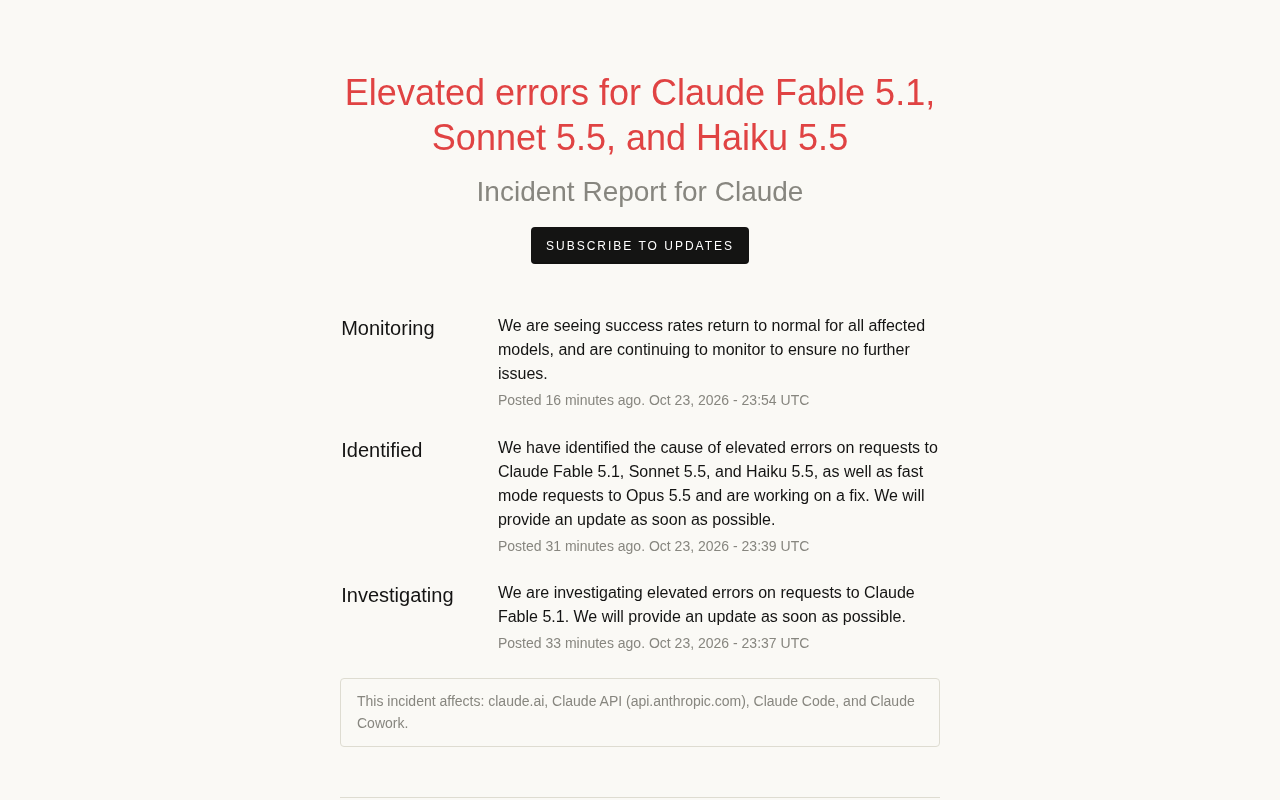
Multiple Claude Models Hit by Errors: A Postmortem of Fable 5.1, Sonnet 5.5, and Haiku 5.5
Claude Fable 5.1, Sonnet 5.5, Haiku 5.5, and Opus 5.5 fast mode saw elevated errors; Anthropic identified and resolved the issue in 17 minutes. This postmortem covers the timeline, the technical reasons for the multi-model cascading failure, and practical lessons for retry and degradation strategies.