A Bag of Concepts or a Relational Graph? Role Binding Is Missing from Language Model Workspaces

Workspaces carry role directions that influence output but not the representations the model uses to compute role assignments, creating a monitoring blind spot.
The study tests whether the verbalizable workspaces of Qwen3.6-27B, Gemma-3-12B, and Gemma-3-27B-IT carry role-filler binding, using J-lens and R-lens families plus difference-of-means and LRE-gradient fitting. The core result is a clean double dissociation: linear probes recover role information from the residual stream near ceiling but score below rank-matched random controls when reading the workspace; steering along fitted directions is no more effective than intensity-matched controls. Ablation shows binding-specific damage only in Gemma-3-27B-IT, confounded with scale and instruction tuning. The authors conclude the workspace is more "a bag of concepts" than "a relational graph," and monitors built on it miss the model's own role representations, leaving a blind spot for relational safety propositions.
Introduction: When Safety Monitoring Meets the "Bag of Concepts" Problem
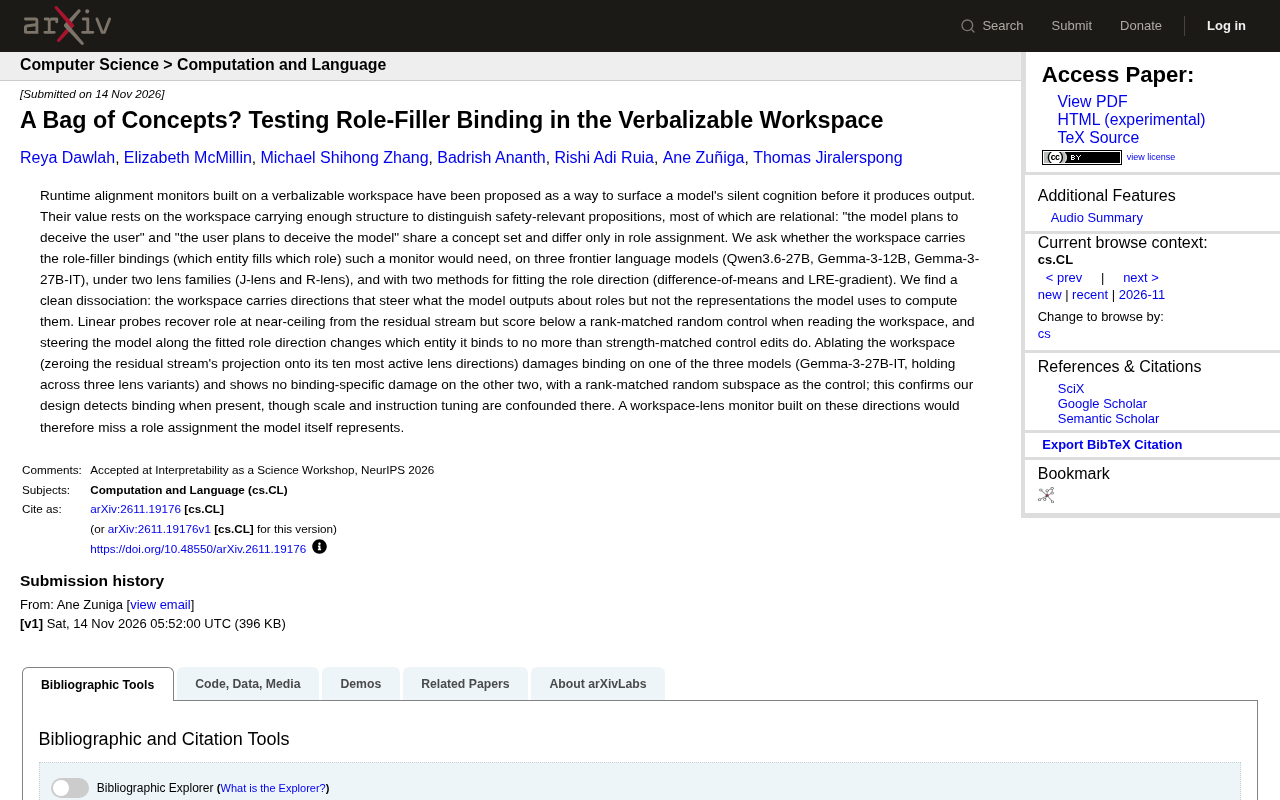
Runtime alignment monitors based on the verbalizable workspace have been proposed to capture a model's "silent cognition" before it produces output. The value of such monitors depends on whether the workspace carries enough structure to distinguish safety-relevant propositions—and the vast majority of safety propositions are relational: "the model plans to deceive the user" and "the user plans to deceive the model" share the same set of concepts, differing only in who plays which role.
A recent study directly interrogates this point: does the workspace carry the role-filler binding that monitors need—that is, information about "which entity fills which role"? The study tests three frontier language models and reaches conclusions that pose a substantive challenge to current alignment-monitoring approaches.
Verbalizable workspace is a hypothetical construct in mechanistic interpretability research: a small subset of representations inside the model that both participates in current computation and can, in principle, be "read out" and transcribed into natural-language descriptions. The alignment-monitoring route hopes to read this workspace via external probes or lenses, thereby predicting a model's intent before it outputs. The concept resembles "global workspace theory" in cognitive science, but here it specifically refers to a subspace within the Transformer residual stream that can be located by linear directions and that correlates with what the model explicitly reports. The key controversy is whether being readable equals being usable for computation—which is precisely what this paper tests.
Experimental Design: Three Models, Two Lens Families, Two Fitting Methods
The study covers three models—Qwen3.6-27B, Gemma-3-12B, and Gemma-3-27B-IT—using two lens families (J-lens and R-lens) and two methods for fitting role directions: difference-of-means and LRE-gradient.
To validate the design itself, the researchers set up strict controls: a linear probe that reads role information from the residual stream, and a rank-matched random control. Ablation experiments test whether binding is impaired by projecting the residual stream onto the ten most active lens directions in the workspace and zeroing them out.
Lens here refers to a family of methods for extracting specific semantic directions from the residual stream: J-lens typically locates the directions with the greatest influence on output based on Jacobian matrices or gradient information, while R-lens may rely on regression or contrastive constructions in representation space. Difference-of-means estimates a role direction by computing the mean difference in activation space between two classes of samples (e.g., "playing the deceiver" vs. "playing the deceived"); LRE-gradient instead uses gradient optimization of a Linear Relation Estimator to fit the same direction. Using both fitting methods in parallel is intended to rule out artifacts from direction estimation itself. Rank-matched random control refers to constructing random directions with the same rank or the same subspace dimensionality as the real direction, to calibrate whether probe scores are genuinely above chance.
Core Finding: A Clean Double Dissociation
The most important result is a "clean dissociation": the directions carried by the workspace can steer what the model "says" about a role, but they do not carry the representations the model uses to "compute" the role.
Specifically, a linear probe reads role information from the residual stream at near-ceiling levels, but when reading from the workspace, its score falls below the rank-matched random control. Steering the model along the fitted role directions changes entity binding no more effectively than intensity-matched control edits. In other words, the directions in the workspace are more like "handles on the output side" than "circuits on the computation side."
This dissociation means that a workspace-lens monitor built on these directions would miss the role assignments that the model itself actually represents.
Residual stream is the backbone activation vector running through all layers of a Transformer, aggregating the outputs of attention and feed-forward networks, and is generally regarded as the carrier of the model's "currently available information." A linear probe is a simple linear classifier trained on the residual stream to test whether some type of information is linearly decodable. The key asymmetry in this paper is that the same information is decodable at near-ceiling levels from the residual stream by a probe, yet its decodability along workspace lens directions is below the random control. This suggests that workspace directions capture "handles" relevant to output generation rather than the computational variables the model uses internally to distinguish roles—the latter exist in the residual stream but are not structurally represented in the workspace.
Ablation Validation: The Design Works, but the Signal Appears Only in One Model
Ablation experiments provide evidence from another angle. After zeroing out the residual stream's projection onto the ten most active lens directions of the workspace, binding was impaired in only one of the three models (Gemma-3-27B-IT), and this result held across three lens variants; the other two models showed no binding-specific impairment.
The researchers used rank-matched random subspaces as a control, confirming that the experimental design can indeed detect binding when it is present. But they also explicitly note that in the positive result on Gemma-3-27B-IT, two factors—model scale and instruction tuning—are confounded and cannot be attributed independently. This preserves the possibility that "the workspace may carry binding" while limiting the generalizability of the conclusion.
Ablation here refers to zeroing out the residual stream's projection onto a specific direction subspace and then observing whether downstream behavior or probe performance is impaired, thereby judging the causal necessity of that subspace for the target function. This paper selects the subspace formed by the ten most active lens directions of the workspace for zeroing out, using a rank-matched random subspace as a control: if zeroing the real subspace causes significantly greater damage than zeroing a same-dimensional random subspace, the subspace is functionally relevant. Binding-specific damage observed only in Gemma-3-27B-IT means the causal evidence is highly model-dependent, and that model's positive result is confounded with scale and instruction tuning, so it is impossible to determine which factor produces the workspace structure.
Implications for Alignment Monitoring
The significance of this study lies not in refuting the workspace-monitoring route but in precisely identifying its current capability boundary. Safety-relevant judgments mostly depend on role assignment: who is deceiving whom, who is concealing what, whose intent is directed at which object. If a monitor reads only a set of concepts rather than relational structure, it is inherently unable to distinguish the semantic reversal that occurs when subject and object are swapped.
More concerning is the asymmetry that "probes can read it from the residual stream but not from the workspace." It suggests that workspace readability does not equal visibility into the model's internal computation. Monitoring built on the workspace may overestimate its coverage of the model's true cognitive state.
Methodological Contributions
Beyond the conclusions themselves, the study's methodological framework also deserves attention. Treating "role binding" as an independent probe target, simultaneously setting up rank-matched random controls and intensity-matched controls, and cross-validating across multiple lens families and fitting methods—this design provides a reusable, rigorous benchmark for future workspace research. The fact that the ablation experiment holds on one model but not the other two, and the honest presentation of this heterogeneity, is also more informative than a blanket claim that "the workspace encodes relational structure."
Conclusion
The verbalizable workspace currently resembles "a bag of concepts" more than "a relational graph." It carries directions that can influence output, but not the representations the model uses when computing role assignments. For the route that relies on the workspace for runtime alignment monitoring, this means that until the role-filler binding problem is solved, monitors may remain blind to the relational safety propositions that most need to be captured. The binding signal appearing in Gemma-3-27B-IT suggests the workspace is not entirely devoid of structure, but its confounding with scale and instruction tuning, along with the negative results on the other two models, indicates that this is not an assumption that can be taken for granted.
Related articles

Prompt Engineering for Beginners: From Writing Prompts to Engineering Thinking
Starting from the essence and four functions of prompts, this article systematically explains the six-step process, four success criteria, learning value, and practical limitations of prompt engineering to help you build a complete understanding.

Anthropic Launches Nasdaq IPO: AI Giant's Listing and Risk Disclosures
Anthropic officially launches its Nasdaq IPO under ticker ANT, with market valuation expected to potentially exceed SpaceX's record. The prospectus devotes nearly 100 pages to AI risks, while first-half revenue grew over 14x but net losses widened sharply, reigniting the AI bubble debate.

Rust cURL Clone Uses 4,832 unsafe Blocks—Is the Memory Safety Myth Broken?
A Rust cURL clone uses 4,832 unsafe keywords, challenging Rust's memory safety narrative. We analyze what unsafe really means, compare Fil-C, and examine rewrite motives.