A Beginner's Guide to Deep Learning: The Optimal Learning Path — Intuition Before Math

A proven beginner's roadmap to deep learning: intuition first, math second, code third.
This article outlines an optimal learning path for deep learning beginners: start by building visual intuition with 3Blue1Brown videos and TensorFlow Playground, then take structured courses from Andrew Ng or fast.ai, and finally dive into the math with resources like Michael Nielsen's online book. The key insight is that the entry barrier is often artificially raised by learning in the wrong order.
Why Does Getting Started with Deep Learning Feel So Intimidating?
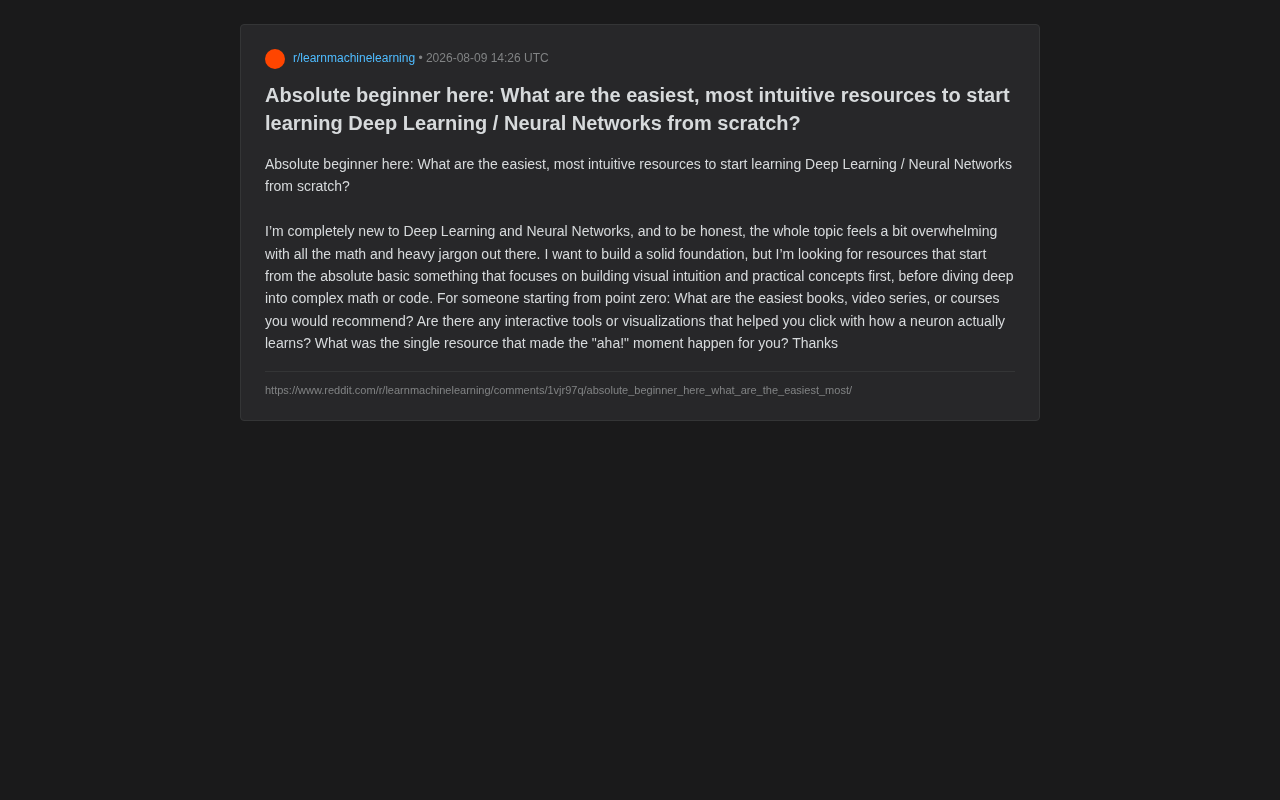
Recently, in Reddit's machine learning community, a complete beginner posted a plea for help: overwhelmed by the flood of mathematical formulas and jargon surrounding deep learning and neural networks, they felt lost. They wanted to build a solid foundation but were looking for resources that start from the most basic concepts, prioritizing visual intuition and hands-on understanding rather than hitting you with complex math from the get-go.
This question is incredibly representative. Deep learning isn't inherently mysterious, but its learning curve is often steepened by two factors: the mathematical prerequisites (linear algebra, calculus, probability theory) and the "insider jargon" found across frameworks, terminology, and papers. For the vast majority of beginners, what actually holds them back isn't ability — it's choosing the wrong entry path. Diving into the hard stuff too early makes it all too easy to give up before the "aha moment" ever arrives.
This article distills the community's collective wisdom into a learning roadmap built around "intuition first, math second, code third."
Step 1: Build Neural Network Intuition with Visual Tools
For someone starting from zero, the most important thing isn't understanding the chain rule behind backpropagation — it's forming a mental picture of "what a neural network is actually doing."
3Blue1Brown's Neural Networks Video Series
The first resource recommended by nearly every experienced practitioner is the 3Blue1Brown YouTube channel's Neural Networks series. Creator Grant Sanderson uses stunningly beautiful animations to visualize abstract concepts like "how neurons activate," "what weights and biases mean," and "how gradient descent finds the optimal solution step by step." After watching these four or five videos, you won't immediately be able to write code, but you'll truly "see" how a network learns for the first time. This is often what people describe as their "aha moment."
TensorFlow Playground: Interactive Experimentation
Another virtually zero-barrier tool is TensorFlow Playground (playground.tensorflow.org). It's a browser-based interactive environment where you can drag sliders to adjust the number of layers, neuron counts, and learning rate, then watch in real time as decision boundaries shift and loss decreases. Without writing a single line of code, you can get a hands-on feel for overfitting, underfitting, and the increased expressiveness that comes from adding more neurons. For building deep learning intuition, this kind of "play and explore" approach is more effective than reading ten pages of equations.
Step 2: Build a Knowledge Framework Through Structured Courses
Once you have that intuition, you're ready to move into systematic learning. There are two mainstream paths here — choose based on your personal preference.
Andrew Ng's Deep Learning Courses
Andrew Ng's courses are practically the "default answer" for getting into machine learning. His Machine Learning Specialization and Deep Learning Specialization on Coursera are known for their gradual pacing and patient explanations. Ng excels at breaking complex concepts into small steps, introducing the necessary math when it's needed rather than drowning you in notation from the start. For beginners who want a complete, structured knowledge framework, this is the safest bet.
fast.ai's Practice-Oriented Course
If you prefer a "get the code running first, understand the theory later" approach, fast.ai's Practical Deep Learning for Coders is a better fit. Its teaching philosophy is top-down: it gets you training a working model in just a few lines of code, giving you that sense of accomplishment, then gradually peels back the layers to reveal the underlying principles. This approach is incredibly friendly to learners who are easily discouraged by theory and need positive feedback to stay motivated.
Step 3: Classic Deep Learning Resources for Going Deeper
When "knowing how to use it" is no longer enough and you want to understand the math behind it all, you can gradually introduce more hardcore resources.
Michael Nielsen's Neural Networks and Deep Learning
"Neural Networks and Deep Learning" by Michael Nielsen is a free online book widely regarded as one of the best introductory texts that balances intuition with rigor. Using clear language and interactive examples, it walks you through the derivation of the backpropagation algorithm step by step — delivering depth without sacrificing readability.
The Deep Learning Textbook (Advanced Reference)
"Deep Learning" by Goodfellow, Bengio, and Courville (commonly known as the "flower book" in the Chinese ML community) is the authoritative textbook in the field. However, it's theory-heavy and math-intensive, making it unsuitable as your first book. It's best used as a reference manual once you've progressed further, not as a starting point.
Practical Tips for Learning Deep Learning from Scratch
Drawing from the community's collective experience, here are a few key principles:
- Progress gradually — don't skip ahead: Start with animations to build intuition, move on to structured courses, and only then tackle the hard math. Doing it in reverse is a recipe for burnout.
- Doing beats reading: Whether it's playing with Playground or getting your first model to run, hands-on experience builds understanding far beyond passive reading.
- Math is a tool, not a barrier: You can pick up the linear algebra and calculus you need as specific concepts arise — there's no need to complete an entire math curriculum before you begin.
- Find your personal "aha resource": Everyone's key to unlocking understanding is different. Some people light up with 3Blue1Brown; others need to tweak hyperparameters with their own hands. Try a few approaches and find the one that clicks for you.
Conclusion
The barrier to entry for deep learning is, to a large extent, artificially raised by learning things in the wrong order. For absolute beginners, the optimal path isn't grinding through formulas — it's building intuition first with visual tools and quality videos, then constructing a framework through structured courses, and finally filling in the math as needed. The moment you first watch a network's decision boundary slowly take shape during training and think "so that's how it works" — that instant makes everything that follows fall naturally into place.
Related articles

Chain of Thought Isn't Just for AI: How Humans Can Use CoT to Improve Thinking Quality
Chain of Thought isn't just a prompt trick for large models. Starting from a Hacker News discussion, this article analyzes why CoT works for human thinking too, breaks down actionable ways to transfer it, and highlights the key differences between human CoT and machine CoT.
Cloudflare Teams Up with OpenAI: Closi…
Cloudflare Teams Up with OpenAI: Closing the Loop from Vulnerability Discovery to Defense with AI
Cloudflare uses OpenAI Daybreak to investigate security vulnerabilities and generate reviewable remediation plans, while developers use Codex to boost coding efficiency and quality.

Orca Multi-Agent Orchestration in Practice: A Guide to Parallel Collaboration with Claude and Codex
Orca is Stable AI's free open-source agent workbench supporting 34 agents like Claude Code and Codex in parallel. Learn its Git worktree isolation, multi-model orchestration, and mobile management.