A Beginner's Guide to Machine Learning: From Course Selection Confusion to a Systematic Learning Path

A systematic guide for ML beginners covering course evaluation, free resources, and an actionable learning roadmap.
This article helps machine learning beginners navigate the overwhelming landscape of learning resources. It evaluates the pros and cons of paid Udemy courses, recommends proven free resources like Andrew Ng's course, Kaggle Learn, fast.ai, and 3Blue1Brown, and provides a step-by-step learning roadmap from Python basics to deep learning. Key advice includes avoiding course hoarding, prioritizing hands-on practice, and leveraging community support.
Starting with a Common Dilemma
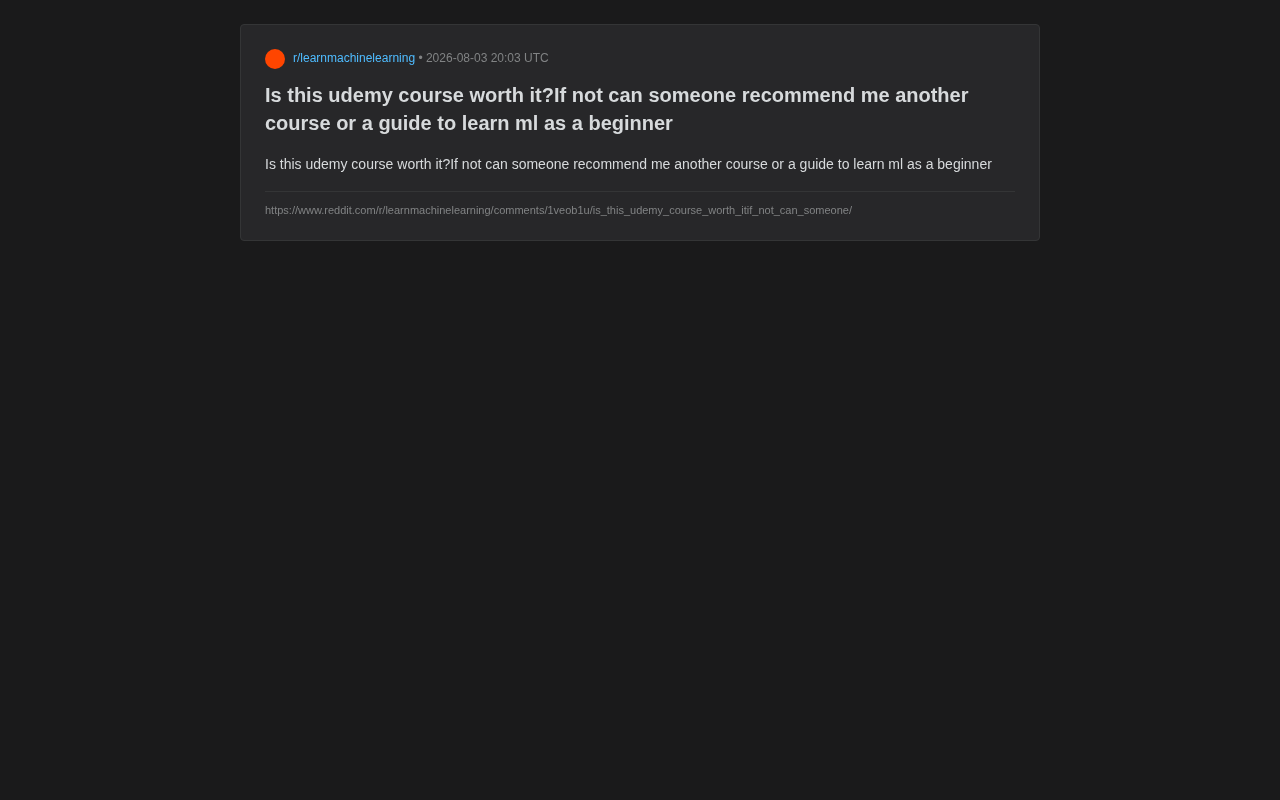
In Reddit's machine learning communities, a recurring question keeps popping up: "Is this Udemy course worth buying? If not, can someone recommend a good machine learning course or study guide for beginners?"
The question seems simple, but it reflects a real struggle faced by countless beginners—with so many paid courses, free tutorials, and tech blogs available, where should you actually start? Are paid courses truly worth the money? Or are better resources actually hiding in plain sight among free, publicly available materials?
This article addresses this topic by outlining a relatively systematic and actionable approach to getting started with machine learning, helping beginners avoid common pitfalls.
Are Paid Courses Really Worth It?
Dimensions for Evaluating a Course
Before deciding whether to purchase a Udemy course, consider evaluating it along these dimensions:
- Instructor background: Does the instructor have real industry or academic experience? Course pages typically list the instructor's professional history.
- Last updated date: The machine learning field evolves rapidly. A course recorded years ago that has never been updated may already be behind current toolchains and best practices.
- Review authenticity: Don't just look at the overall rating. Focus on reading the critical reviews (1-3 stars)—these often reveal the course's real weaknesses, such as "only teaches API calls without explaining principles" or "the code no longer runs."
- Syllabus depth: Quality courses balance theory and practice, rather than just walking you through a few
scikit-learnexamples.
Common Characteristics of Udemy Courses
Objectively speaking, machine learning courses on Udemy vary wildly in quality. Udemy is one of the world's largest online course marketplaces, founded in 2010, operating on an open platform model—anyone can create and sell courses on it. The double-edged sword effect of this model is very apparent: on one hand, it dramatically lowers the barrier to knowledge dissemination; on the other hand, it means course quality lacks a unified review standard. Unlike platforms such as Coursera and edX that partner with prestigious universities, Udemy courses don't offer academic credit certification, and pricing follows a high-frequency discount strategy (courses listed at $199 are routinely sold for $12-15).
Its advantages lie in low cost, low barrier to entry, and suitability for building initial awareness. But the disadvantages are also clear: many courses remain at the "library-calling tutorial" level, lacking in-depth explanations of mathematical principles and internal model mechanisms. "Library-calling tutorial" refers to courses that only teach how to call interfaces like model.fit() and model.predict() without delving into the mathematical derivations and design philosophy behind the algorithms. The risk of this teaching approach is that learners find themselves helpless when facing model tuning, anomaly diagnosis, or scenario migration in real engineering work, due to a lack of foundational understanding. Take scikit-learn as an example—it's the most popular traditional machine learning library in the Python ecosystem, offering a one-stop API from data preprocessing to model training and evaluation, with its underlying implementation in C and Cython for computational efficiency. If you only learn to call its high-level interfaces without understanding the underlying optimization objectives and assumptions, you'll struggle when facing dirty data and complex scenarios in the real world.
For those who just want a quick overview of "what machine learning can do," a well-reviewed Udemy course is perfectly sufficient. But if your goal is to become a competent machine learning practitioner, these courses alone are far from enough.
Free and High-Quality Machine Learning Learning Resources
In fact, many of the best learning resources in machine learning are free. Here are classic paths repeatedly recommended by the community:
Beginner-Level Resources
-
Andrew Ng's Machine Learning Course (Coursera / DeepLearning.AI): Almost universally recognized as the starting point for all beginners. Andrew Ng is a professor in the Department of Computer Science at Stanford University, co-founder of the Google Brain project, and former Chief Scientist at Baidu. His free online machine learning course launched at Stanford in 2011 directly gave birth to the Coursera platform, with cumulative enrollment exceeding several million learners. In 2022, he completely overhauled the course, migrating from the original Octave/MATLAB environment to Python/TensorFlow, and redesigned the course structure into three specialization courses that better align with current industry tech stacks. The course explains core concepts like linear regression, logistic regression, and neural networks in an intuitive way, with moderate mathematical prerequisites, making it ideal as the first step in systematic learning.
-
Kaggle Learn: Offers free micro-courses paired with real dataset exercises, balancing theory and hands-on practice—perfect for learning by doing. Kaggle is the world's largest data science competition and community platform, acquired by Google in 2017. The platform offers not only competitions at various difficulty levels (from beginner tutorials to million-dollar prize competitions), but also free Jupyter Notebook computing environments (with GPU quotas), hundreds of thousands of public datasets, and user-shared Notebooks (called Kernels). For beginners, Kaggle's core value lies in this: you can see other participants' complete problem-solving approaches, from data exploration to feature engineering to model ensembling. This "open-book exam" style learning environment is something traditional classrooms cannot provide.
Advanced-Level Resources
-
fast.ai's "Practical Deep Learning for Coders": Uses a "top-down" teaching approach—first getting you to run a working model, then gradually diving into the principles. It's especially suitable for learners with programming experience who are intimidated by math. fast.ai was founded by Jeremy Howard and Rachel Thomas in 2016, with a core teaching philosophy inspired by language acquisition theory: children learn to use language first, then understand grammar rules. Similarly, fast.ai has learners train an image classification model with excellent ImageNet performance in the very first lesson, then gradually reveals the underlying mechanisms. fast.ai also maintains an open-source deep learning framework of the same name, built on top of PyTorch, which dramatically simplifies model training workflows through high-level abstractions while preserving the ability to "unwrap" layer by layer to access low-level details.
-
"Dive into Deep Learning" (D2L): An open-source e-book that integrates code, formulas, and explanations, available in both Chinese and English. Written by Amazon scientist Mu Li and others, all code examples can be run directly in Jupyter Notebooks, with support for PyTorch, TensorFlow, and MXNet framework versions.
Strengthening Mathematical Foundations
Machine learning inevitably involves linear algebra, probability theory, and calculus. 3Blue1Brown's visual math videos and Khan Academy's related courses are excellent resources for building mathematical intuition. 3Blue1Brown is a mathematics education YouTube channel created by Grant Sanderson, renowned for its beautiful animated visualizations. Its production tool, Manim (Mathematical Animation Engine), is itself an open-source project. The channel's "Essence of Linear Algebra" series uses geometric intuition to explain vector spaces, linear transformations, eigenvalues, and other concepts, while the "Essence of Calculus" and "Neural Networks" series are equally well-regarded. For machine learning learners, the value of these videos isn't in teaching you to compute, but in building "spatial intuition" for mathematical concepts—understanding why matrix multiplication is a spatial transformation, why gradients point in the steepest ascent direction. These intuitions are crucial for later understanding backpropagation, optimization algorithms, and more.
An Actionable Machine Learning Beginner's Roadmap
For complete beginners, the recommended progression is:
-
Build a solid Python programming foundation: The mainstream machine learning ecosystem is built on Python. Start by mastering the trio of NumPy, Pandas, and Matplotlib. These three libraries form the foundational toolchain for Python data science. NumPy provides efficient multi-dimensional array operations, implemented in C under the hood, running tens to hundreds of times faster than pure Python loops, and serves as the cornerstone for virtually all higher-level scientific computing libraries. Pandas builds on NumPy, providing the DataFrame data structure that makes tabular data cleaning, transformation, and aggregation extremely convenient—its design was inspired by R's data.frame. Matplotlib is Python's most classic visualization library; while its API is relatively low-level, nearly all advanced visualization libraries (such as Seaborn and Plotly) are compatible with or built upon it. Mastering these three means you have the complete foundational capability for "loading data → processing data → visual analysis."
-
Learn classic machine learning algorithms: Start with traditional algorithms like linear regression, decision trees, and random forests, and understand the complete "train-validate-test" workflow. This is the most fundamental experimental paradigm in machine learning engineering: data is typically split into three parts—the training set for fitting model parameters, the validation set for tuning hyperparameters (such as learning rate, regularization strength, tree depth, etc.) and model selection, and the test set used only once for final evaluation to simulate the model's true performance on unseen data. The core goal of this workflow is to prevent "overfitting"—where a model performs excellently on training data but fails to generalize to new data. More rigorous practices also include cross-validation (k-fold cross-validation), which repeatedly divides training data into k folds for rotational validation to obtain more stable performance estimates.
-
Build hands-on experience through projects: Find beginner-level competitions on Kaggle (such as the Titanic prediction challenge) to put your knowledge into practice. The Titanic competition is the most classic beginner project on Kaggle, where the task is to predict whether passengers survived the disaster based on features like age, gender, and cabin class. While simple, this project covers the complete machine learning workflow: missing value handling, feature encoding, model training, cross-validation, and result submission.
-
Enter the deep learning domain: After mastering the fundamentals, move on to learning neural networks, CNNs, Transformers, and other modern architectures. CNN (Convolutional Neural Network) is the foundational architecture for deep learning in computer vision, efficiently extracting hierarchical spatial features from images—from edges and textures to semantic objects—through local receptive fields and weight sharing mechanisms. Representative models include AlexNet (2012) and ResNet (2015). Transformer is an architecture proposed by Google in the 2017 paper "Attention Is All You Need," originally designed for natural language processing. Its core is the Self-Attention mechanism, which models dependencies between arbitrary positions in a sequence. Today, Transformers have become the foundational architecture for large language models (such as GPT and LLaMA) and are gradually expanding into vision (Vision Transformer), multimodal, and other domains, becoming the most mainstream architectural paradigm in current deep learning.
-
Continuously follow cutting-edge developments: Maintain sensitivity to the latest advances through papers, tech blogs, and open-source projects. Recommended sources include the machine learning sections on arXiv (cs.LG, cs.CV, cs.CL), the Papers With Code website (which links papers to their open-source implementations), and the Hugging Face community (a hub for large models and datasets).
Tips for Machine Learning Beginners
Don't fall into "course hoarding." Many people buy over a dozen courses but never finish a single one. This phenomenon is known in psychology as the "Productivity Illusion"—the act of purchasing courses creates a false sense of "I'm making progress," but actual learning never occurs. Committing to one or two high-quality resources, finishing them thoroughly while practicing alongside, far outweighs repeatedly switching between superficial samplings.
Hands-on practice matters far more than watching videos. Machine learning is a practical discipline—watching without doing equals not learning. After learning each concept, try to reproduce it in code. Cognitive science research shows that Active Recall and application yield memory retention rates several times higher than passive viewing. When you implement a gradient descent algorithm by hand or debug a tensor dimension mismatch error, your depth of understanding far exceeds what any video lecture can achieve.
Leverage community resources. Reddit's r/learnmachinelearning, Stack Overflow, and various open-source communities are invaluable resources for solving specific problems. When you're stuck, a precise question can often save hours of fumbling. Questioning technique matters too: clearly describe your goal, what you've tried, and specific error messages. This structured questioning approach (also known as "XY Problem" awareness) can significantly increase your chances of receiving effective answers.
Conclusion
Back to the original question—"Is this Udemy course worth it?" The answer depends on your goals and existing background. But one thing is certain: getting started with machine learning has never lacked resources—what's lacking is a clear path and the perseverance to follow through. Rather than agonizing over a single paid course, build a systematic learning plan that combines free classic resources with hands-on practice. What truly determines how far you can go is never which course you bought, but how many lines of code you've written and how many models you've successfully trained.
Related articles

Qwen3-Max Deep Dive: A Comprehensive Analysis of Its Coding and Collaboration Capabilities
Alibaba releases Qwen3-Max flagship model positioned as a new benchmark for coding and collaboration. Deep analysis of its capabilities, open-source strategy, and competitive landscape.

Midjourney Medieval Scene Prompt Techniques: Breakdown & Practical Guide
Deep analysis of a high-quality Midjourney medieval castle Prompt, breaking down keywords like medieval and empty, plus --raw, --stylize 750, and --ar 16:9 parameter techniques with practical tips.

TIME Feeds AI Crawlers Exclusive Web Pages with Embedded Ads: A New Monetization Strategy for Media
TIME magazine serves AI crawlers exclusive web pages with embedded ads, exploring new content monetization paths in the AI era. Analysis of differential serving technology, publisher dilemmas, and industry implications.