A Beginner's Guide to Vibe Coding: The Practical Path to Building Software with AI from Scratch

A practical guide to building software with AI using natural language — no coding experience required.
This guide explains Vibe Coding — a new AI-driven development paradigm coined by Andrej Karpathy — where you describe what you want in natural language and let AI write, run, and debug the code. It covers why this approach matters, compares key tools like OpenAI's Codex and Anthropic's Claude Code, and provides a practical path for complete beginners to get started through iterative collaboration with AI.
What Is Vibe Coding
AI is no longer just a chatbot toy you make small talk with. It's transforming from a content generation tool into a genuine productivity engine. Across major video platforms, you'll often see scenes like this: someone with absolutely zero programming background builds a complete application in half a day using AI, or a seasoned developer at a big tech company knocks out in half a day what used to take a full month to deliver.
This entirely new approach to development is what's known as Vibe Coding — a term that's exploded in popularity over the past two years. The concept was first coined by Andrej Karpathy (former Tesla AI Director and OpenAI co-founder) in early 2025. On social media, he described a radically new programming experience: fully immersing yourself in the "vibe," conversing with AI in natural language, not even bothering to carefully read the AI-generated code, and focusing only on whether the output matches your expectations. The concept went viral in the tech community the moment it was introduced, because it perfectly captured the paradigm shift happening in AI-assisted programming.
"Vibe" refers to the feel and atmosphere of the experience. Think of it as a brand-new model of human-AI collaboration: you simply tell the AI what you want in natural language, and it writes and runs the code while you sit back, nodding "Yes" or shaking your head "No."
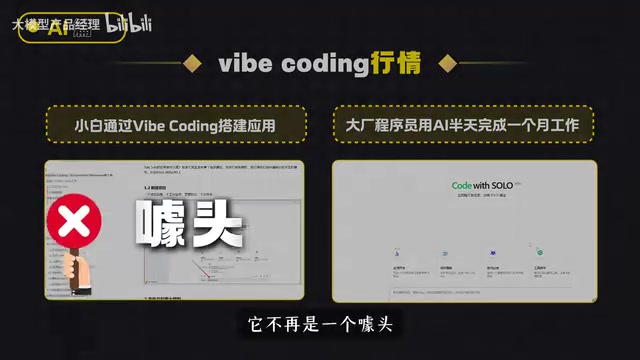
In other words, the core of Vibe Coding is no longer "writing code" — it's "expressing your intent." This shift has lowered the barrier to creating software to ground level. You no longer need to memorize syntax rules or understand complex framework internals. As long as you can clearly describe the functionality you want, AI can make it a reality.
Why Vibe Coding Is Worth Learning
From Gimmick to Genuine Productivity
Over the past two years, AI programming assistants have made a quantum leap from "autocomplete helpers" to "autonomous code writers." Behind this is a fundamental advancement in Large Language Model (LLM) architecture. Early code completion tools (like the first version of GitHub Copilot) were based on the older Codex model and essentially predicted the next line of code from context — a sophisticated form of autocomplete. Between 2024 and 2025, models with stronger reasoning capabilities (such as GPT-4 and the Claude 3.5/4 series) emerged, giving AI the ability to perform multi-step reasoning, self-correct errors, and understand code across multiple files. This shift from "token prediction" to "task planning and execution" is the technological foundation that took Vibe Coding from concept to practical reality.
Tools like Codex and Claude Code can now understand relatively complex requirements and autonomously complete the full loop of code writing, debugging, and execution. This means Vibe Coding is no longer a demo-level gimmick — it has genuinely entered the practical stage.
The Productivity Dividend of the AI Era
Why should everyone learn Vibe Coding? The logic is straightforward: AI large language models deliver real productivity gains, and Vibe Coding is the key skill for harnessing that new productivity.
Here's an analogy: producing videos and content used to require professional camera crews and editing teams. Today, with smartphones and various tools, anyone can become a content creator. Software development is undergoing the same democratization — building software will no longer be an exclusive skill for programmers but something ordinary people can master, much like creating social media content. Those who master Vibe Coding first will be the ones to capture the earliest dividends of the AI era.
Comparing the Leading Vibe Coding Tools: Codex vs Claude Code
The Vibe Coding ecosystem has already produced several mature tools, with the most prominent being OpenAI's Codex and Anthropic's Claude Code.
-
Codex: As OpenAI's code generation engine, it excels at understanding natural language instructions and generating code in multiple programming languages, making it well-suited for rapid prototyping and feature implementation. Notably, OpenAI's Codex has gone through several major iterations. The original Codex was a fine-tuned version of GPT-3, specifically trained on public GitHub code repositories. The new generation of Codex released in 2025 is no longer a simple code generation model — it's a full-fledged coding agent. It can autonomously run code in a cloud sandbox environment, read terminal output, install dependencies, fix errors, and form a complete automated loop of "write-run-debug." This agent-based workflow is what makes it capable of supporting true Vibe Coding.
-
Claude Code: Anthropic's programming assistant is known for its powerful contextual understanding and codebase-level operation capabilities, particularly excelling at medium-to-large projects requiring multi-file collaboration. One standout feature of Claude Code is its ultra-long context window (supporting up to 200K tokens), meaning it can "read" an entire project's codebase at once and understand the dependency relationships and architectural design across files. By contrast, many earlier AI programming tools could only handle individual files or code snippets. Additionally, Anthropic emphasizes its "Constitutional AI" safety framework — Claude Code tends to follow secure coding practices when generating code, reducing potential vulnerabilities. This codebase-level global comprehension makes it particularly effective in complex scenarios like refactoring and cross-module modifications.
For complete beginners, both tools offer relatively user-friendly interaction models. You don't need to understand their underlying technical principles right away. Instead, you can start with a specific, small goal you want to achieve — like building a to-do app or a personal blog page — and let the AI guide you through the development process as you learn by doing.
How to Get Started with Vibe Coding from Scratch
Shift Your Mindset: From Writing Code to Expressing Requirements
With traditional programming, beginners are often intimidated by complex syntax and abstract concepts. Vibe Coding takes a completely different approach: you don't need to learn to write code first — you need to learn how to clearly express your requirements. The core skill you need to develop is breaking down the vague ideas in your head into specific instructions that AI can understand.
This actually involves a specialized skill area — Prompt Engineering. In the context of Vibe Coding, a good prompt should include several key elements: a clear functional goal, technology stack preferences (e.g., whether you want to build the frontend with React or Vue), specific input/output formats, and boundary conditions with error-handling logic. Research shows that structured prompts (such as step-by-step requirement descriptions and concrete examples) produce code output that is several times higher in quality compared to vague one-liner descriptions. This is why, even though Vibe Coding lowers the coding barrier, "knowing how to ask the right questions" has become the new core competitive advantage.
From Imitation to Creation: Building an Iterative Collaboration Rhythm
Beginners are encouraged to follow a "nod and shake" collaboration rhythm: describe what you want to build to the AI, observe the generated result, run it to see the effect, and then provide feedback to adjust based on what you see.
This collaboration model is fundamentally aligned with "Agile Development" and "Rapid Prototyping" in software engineering. Traditional waterfall development requires completing a full requirements document before coding begins, while agile development advocates for small, fast steps and continuous iteration. Vibe Coding compresses this iteration cycle to its extreme — from the traditional agile "two-week Sprint" down to "a few minutes per iteration." Each time you give the AI feedback, observe the result, and adjust again, you're completing a full micro-iteration cycle.
Through this continuous iteration process, you'll gradually build intuition about software structure and functional logic. This high-frequency feedback mechanism not only accelerates development efficiency but also allows complete beginners to develop an intuitive understanding of software development through massive amounts of "trial-and-error" in an extremely short time — far more effective than grinding through textbooks.
Conclusion: Ride the AI Wave with Vibe Coding
From "chatbot toy" to "productivity tool," AI has undergone a fundamental transformation, and Vibe Coding is the most accessible manifestation of this revolution for everyday people. It has turned "creating software" — once a high-barrier endeavor — into an activity anyone can participate in.
Whether you're looking to switch careers, start a side hustle, or simply want to catch the AI wave, starting with Vibe Coding is a pragmatic choice. Master it, and you hold the key to actively creating value in the AI era — in the future, everyone will be able to develop software, just as today everyone can be a content creator.
Key Takeaways
Related articles

Chain of Thought Isn't Just for AI: How Humans Can Use CoT to Improve Thinking Quality
Chain of Thought isn't just a prompt trick for large models. Starting from a Hacker News discussion, this article analyzes why CoT works for human thinking too, breaks down actionable ways to transfer it, and highlights the key differences between human CoT and machine CoT.
Cloudflare Teams Up with OpenAI: Closi…
Cloudflare Teams Up with OpenAI: Closing the Loop from Vulnerability Discovery to Defense with AI
Cloudflare uses OpenAI Daybreak to investigate security vulnerabilities and generate reviewable remediation plans, while developers use Codex to boost coding efficiency and quality.

Orca Multi-Agent Orchestration in Practice: A Guide to Parallel Collaboration with Claude and Codex
Orca is Stable AI's free open-source agent workbench supporting 34 agents like Claude Code and Codex in parallel. Learn its Git worktree isolation, multi-model orchestration, and mobile management.