A Classic Port on PalmOS: Aaron Ardiri and the Legend of Lemmings

A look back at Aaron Ardiri's legendary early mobile port of Lemmings to PalmOS.
The article reviews the history of Aaron Ardiri porting the classic puzzle game Lemmings to PalmOS handhelds, a topic recently revived on Hacker News. PalmOS was known for simplicity and efficiency but was extremely resource-constrained; the port was not a simple transfer but involved deep adaptation and low-level optimization for stylus input, limited memory, and low-performance hardware. Ardiri, an active developer in the PalmOS community, exemplified early independent developers' platform understanding, passion for games, and perseverance without commercial returns. HN discussions evoke nostalgia among veteran players and reveal the technical value of such ports in real-time state management, framebuffers, and input mapping, offering lessons for today's embedded and resource-constrained development.
In an era before mobile gaming took shape, a remarkable port was born on PalmOS devices—Aaron Ardiri brought the classic puzzle game Lemmings to Palm handhelds. This history recently resurfaced in discussion on Hacker News, allowing us to look back at the geek spirit of early mobile development.
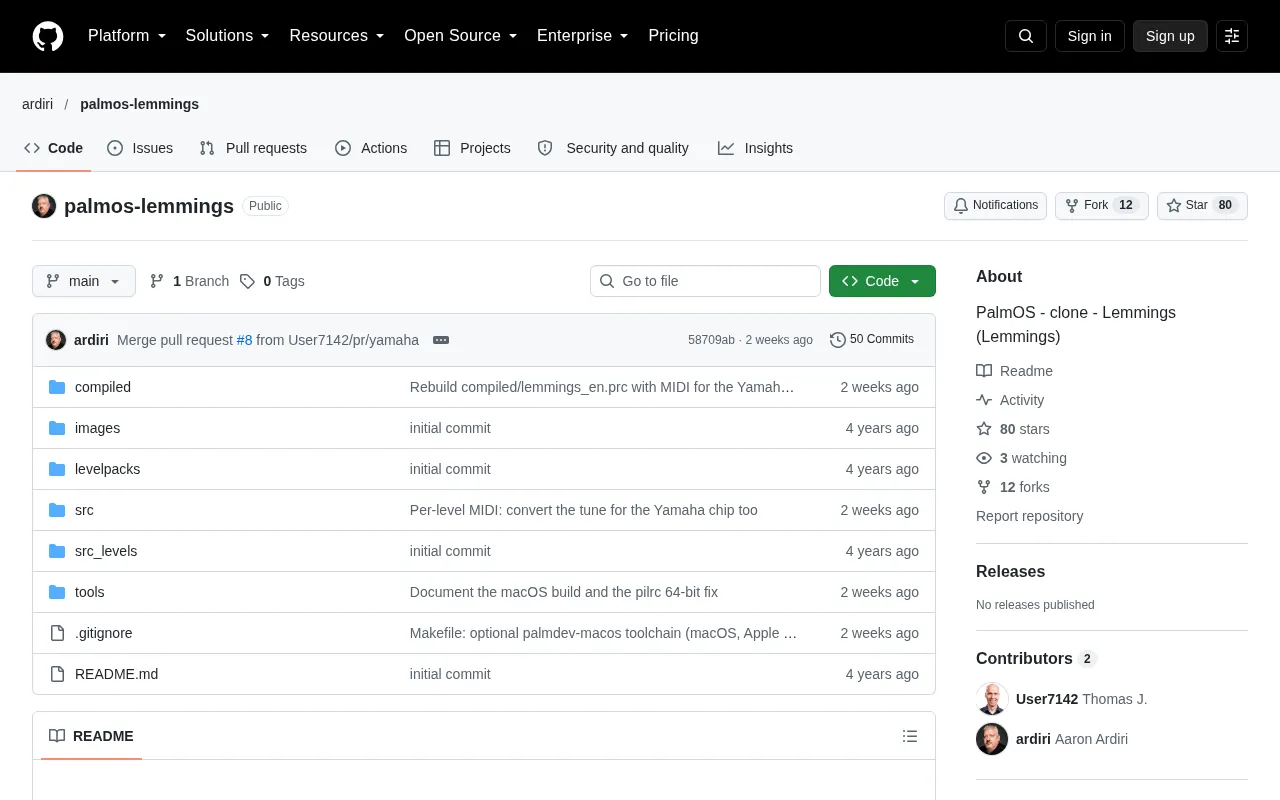
A Memory of an Era: PalmOS and Lemmings
PalmOS was the mainstream operating system for handheld computers from the late 1990s to the early 2000s, known for its simplicity and efficiency. Running a game like Lemmings, which requires precise operation and graphics processing, on such a resource-constrained platform was itself a technical challenge. Aaron Ardiri, an active developer at the time, completed this port, allowing countless Palm users to experience the joy of saving little lemmings on black-and-white or low-resolution screens.
According to discussions in the Hacker News community, this port was not a simple code transfer but involved deep adaptation to PalmOS hardware characteristics. The original Lemmings was developed by DMA Design (later Rockstar North) and first appeared in 1991, becoming popular for its unique strategy-puzzle gameplay. Ardiri's port retained the core gameplay while accommodating the stylus operation and limited memory of Palm devices.
Lemmings is a puzzle-strategy game released in 1991 by the British studio DMA Design (later merged into Rockstar North). Players do not control the lemmings directly; instead, they assign one of eight skills—such as digging, building bridges, climbing, or exploding—to these automatically walking creatures, guiding them safely to the exit. The game's levels rely on precise timing and spatial planning, with many independently acting entities on screen at once, placing high demands on real-time CPU scheduling and sprite rendering. The original was initially released for platforms such as the Amiga and DOS, and was subsequently ported to dozens of systems, making it one of the most widely ported games of the 1990s. Understanding this is necessary to appreciate the trade-offs required to reproduce its core gameplay on low-clock-speed, small-memory devices like PalmOS.
Aaron Ardiri: A Pioneer of Early Mobile Development
Aaron Ardiri was no unknown figure in the PalmOS community. He not only ported Lemmings but also participated in developing Palm versions of other classic games. From a technical perspective, in an environment lacking modern development tools and extensive documentation, reverse engineering and manual optimization were commonplace. Ardiri's work exemplifies the typical traits of early independent developers: a deep understanding of the platform, a passion for games, and perseverance without guaranteed commercial returns.
Discussions on HN also mentioned that such ports often required handling low-level issues such as audio emulation, framebuffer management, and input mapping. PalmOS's API was relatively simple, but hardware performance was limited, forcing developers to trade off between smoothness and feature completeness. Ardiri's Lemmings port is regarded by many veteran players as a gem in the PalmOS game library.
PalmOS Hardware and Development Environment: Typical Palm devices used Motorola DragonBall series processors (clock speeds around 16–33 MHz), with memory ranging from hundreds of KB to a few MB, screens of 160×160 monochrome or low color depth, and input primarily via stylus and Graffiti handwriting recognition. The development toolchain was far less complete than today's, the official SDK had limited functionality, debugging methods were scarce, and many effects required developers to directly manipulate the framebuffer and manage memory blocks themselves. On the audio side, early models had only simple beeps or limited sound channels, so ports often required rewriting or emulating the original's sound logic. These constraints made porting a state-intensive, graphically complex game like Lemmings an engineering effort requiring extensive manual optimization.
The Enduring Appeal of Retro Computing as Seen in HN Buzz
Although the Hacker News post was brief, it sparked nostalgia and discussion about retro mobile development in the tech community. Participants shared their experiences of playing games on Palm devices back in the day, and some explored the technical details of such ports. This attention reflects that, in today's era of cloud gaming and AAA titles, the creativity of early mobile development and innovation under constraints still hold appeal.
For modern developers, Ardiri's work provides a window: how to implement complex interaction logic under extreme resource constraints. Lemmings gameplay involves extensive real-time state management and pathfinding, and PalmOS's low-power processors and limited memory forced developers to adopt ingenious data structures and algorithms. This experience still offers lessons for today's embedded development and edge computing.
Retrocomputing refers to the study, preservation, and redevelopment of software and hardware for early computers, game consoles, and handheld devices, encompassing practices such as emulators, firmware reverse engineering, ports to old platforms, and community archival work. It is not merely nostalgia but also has value for technical history and engineering education: the extreme resource constraints of old platforms force developers to understand low-level mechanisms such as memory layout, interrupt handling, and input latency. Sustained attention to such projects from communities like Hacker News often leads to the public release of source code, development notes, and hardware documentation, transforming early works from personal memories into public technical heritage that can be studied and reused.
Conclusion
Aaron Ardiri's PalmOS Lemmings port is a memorable fragment in the history of mobile gaming. It reminds us that the boundaries of technology are often defined by developers' passion and creativity, not hardware specifications. As interest in retrocomputing revives, the value of such early works is being rediscovered.
Related articles

Last Week Tonight Exposé: The Dangerous Ties Between Politicians and White Supremacy
Last Week Tonight investigates Georgia Senate candidate Mike Collins and Florida candidate Marshall Rawson, exposing their multiple ties to white supremacists and the Republican Party's silent response.

AI Buzz Weekly: GPT-6.5 Leak, New Claude Model, and MiniMax's Cost-Effectiveness
This week's AI buzz roundup: suspected GPT-6.5 leak, Microsoft configs showing GPT-6.1 Tera, Anthropic's new model that can identify entire classes of bugs, disappointing early Gemini 4 Carbon results, and MiniMax M3.1 Flash beating Claude Opus 5 and GPT-5.6 Sol in benchmarks at extremely low cost.

AI Briefing: Gemini 4 Carbon Released, Ant Open-Sources Ling-3.1
AI Briefing: Google releases Gemini 4 Carbon qubit model, claiming to surpass Opus 5.5 with half-price tokens; Ant open-sources Ling-3.1-1019 for real-task Personal Agents; domestic AI drug discovery succeeds in 18 of 19 projects, hitting all 6 GPCR targets; zero-revenue company valued at $20B raises another $1B; Sichuan convenience store robot sales fail.