A Complete Breakdown of the Agent Development Learning Path: From Theory to Enterprise-Level Practice

Agent development is replacing simple API calls as the most hardcore competitiveness in the LLM field, and this four-stage path takes you from entry to deployment.
The article notes that as LLM application development shifts, only knowing how to call APIs and build Q&A bots is rapidly depreciating. The real core competitiveness is being able to independently develop intelligent Agents that plan autonomously, call tools, and solve complex tasks in a closed loop. It presents a four-stage learning path: laying a foundation with core components like planning, memory, and tool calling; mastering principles and classic paradigms such as ReAct and CoT; optimizing output through reinforcement learning, multi-agent collaboration, and prompt tuning; and deploying 2-3 real projects with a full development cycle. This path connects concepts, principles, optimization, and deployment, making it suitable for zero-foundation learners who are serious about this direction.
Why Agent Development Has Become the Core Competitiveness in the LLM Field
The winds of LLM application development have shifted. Two years ago, knowing how to call an API and build a simple Q&A bot was enough to count as entry-level. Today, that skill set is rapidly depreciating. What truly sets people apart is the ability to independently build an intelligent Agent—one that can plan its own steps, call tools, and solve complex tasks in a closed loop.
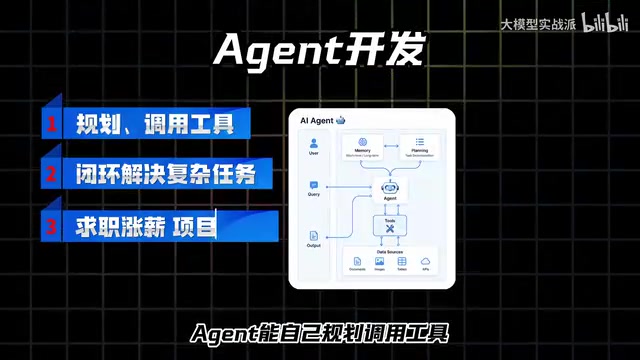
The logic behind this judgment isn't complicated. An Agent is essentially an "organizer" of LLM capabilities: it strings together language understanding, task planning, memory management, and tool calling into a complete execution chain. What enterprises need isn't "an AI that can chat"—it's "an AI that can get things done." Whether you're job hunting, taking on projects for income, or building intelligent products, Agent development is one of the most hardcore skills right now. The earlier you learn it systematically, the more of a head start you have.
The four-stage learning path below breaks down Agent development from entry to deployment fairly clearly. It's suitable for people with zero foundation who want to seriously pursue this path.
Stage One: Lay the Foundation—Understand the Core Components of an Agent
Many people rush to write code right away, only to find they can't even clearly explain what an Agent is made of. The task of this stage is to build a conceptual framework.
The core components you need to master include: the planning module, the memory module, and tool calling. The planning module determines how an Agent breaks down tasks and orders its steps; the memory module addresses context retention and experience reuse; tool calling is the channel through which an Agent interacts with the outside world.
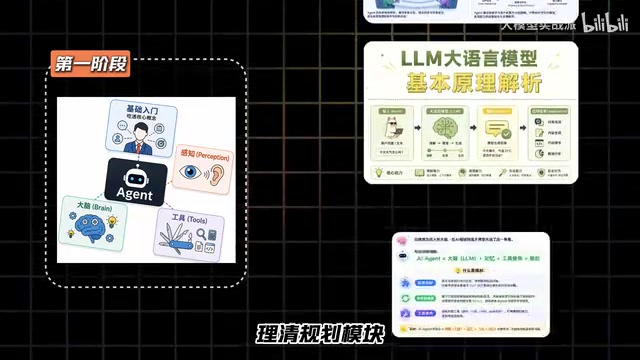
At the same time, you need to understand the role large language models play within an Agent—they are the reasoning engine, but they are not the Agent itself. Once these concepts are clear, subsequent advanced learning won't be built on air. This step may seem slow, but it actually saves time.
Context Window refers to the maximum number of tokens a large model can process in a single inference, including all content such as system prompts, conversation history, and tool return results. It is one of the most practical constraints in Agent development: the longer the task, the more likely the accumulated context will exceed the window, causing information to be truncated or costs to soar. Common coping strategies include: using a sliding window or summary compression for short-term memory, using a vector database for retrieval-augmented generation (RAG) for long-term memory, and externalizing intermediate states to files or databases, backfilling as needed. Understanding the limitations of the context window is a prerequisite for designing stable and reliable Agents.
Stage Two: Master the Principles and Classic Paradigms
Once the concepts are clear, move on to the principle level. The goal of this stage is to upgrade from "knowing these things exist" to "knowing how they operate."
Key points include: thoroughly understanding how Agents work, understanding common pain points in development, and expanding your learning to classic Agent paradigms such as ReAct and CoT. ReAct alternates between reasoning and acting, while CoT emphasizes making chain-of-thought explicit—these are the underlying logic for designing complex Agents later on.
At this stage, you should also start encountering pitfalls you'll face in real development: handling tool calling failures, limitations of the context window, and error accumulation in multi-turn planning. Understanding the causes of these problems is far more useful than memorizing concepts.
ReAct (Reasoning + Acting) was proposed by Shunyu Yao et al. in 2022. Its core idea is to let a large model advance alternately in a "thought—action—observation" loop: first output a piece of reasoning (Thought), then decide which tool to call (Action), and after receiving the tool's return result (Observation), continue to the next round of reasoning until the task is complete. This alternating mechanism combines pure "thinking" with blind "doing," significantly reducing hallucinations and improving interpretability.
CoT (Chain-of-Thought) originates from research by Wei et al. in 2022. By having the model explicitly write out intermediate reasoning steps rather than giving an answer directly, it greatly improves accuracy on complex tasks such as math and logic. CoT is the conceptual basis for the "Thought" part of ReAct, while ReAct adds interaction with the external environment on top of it. In actual development, the two are often used together: CoT ensures reasoning quality, while ReAct connects to tools and the environment, forming a deployable, debuggable Agent paradigm.
Stage Three: Strengthen and Improve—Optimize Output Quality
Once you can get an Agent running, the next step is to make it run better. This stage involves three directions.
Reinforcement learning is one of them, used to optimize an Agent's decision-making policy so it can find better action paths through multiple attempts.

Multi-agent collaboration is another key focus. How multiple Agents divide work, communicate, and avoid conflicts directly determines how complex a task the system can handle.
Prompt tuning also cannot be skipped. With the same model and tools, whether the prompt is well written makes a huge difference in output quality. By mastering tuning techniques, an Agent can more precisely produce the results you want, and its practicality will improve noticeably.
In the context of Agents, reinforcement learning (RL) is mainly used to optimize the "decision policy": given the current state (conversation history, tool return results), which action should the Agent choose (which tool to call, what content to generate) to maximize long-term reward. Common methods include reinforcement learning from human feedback (RLHF) for aligning preferences, as well as alternatives that have emerged in recent years such as DPO (Direct Preference Optimization). In Agent tasks, there are also practices that use trajectory-level rewards to train policies. Compared with supervised fine-tuning, RL can explore better paths through trial and error, but it also faces challenges such as difficult reward design, low sample efficiency, and unstable training, so it is usually an advanced direction after you have some foundation.
Multi-agent collaboration (Multi-Agent) refers to multiple Agents with independent roles and capabilities jointly completing a task. Typical patterns include: division-of-labor style (e.g., a "planner" breaks down tasks, an "executor" calls tools, a "reviewer" verifies results), debate style (multiple Agents propose solutions to the same problem and critique each other to converge), and pipeline style (passing intermediate outputs in sequence). Key technical issues include communication protocol design (how Agents exchange structured information), role and goal definition, conflict resolution, and termination condition judgment. Mainstream frameworks such as AutoGen, CrewAI, and LangGraph all provide multi-agent orchestration capabilities. It is suitable for handling complex, multi-step business scenarios that require parallel processing and are difficult for a single Agent to cover.
Stage Four: Real-World Deployment—Connect with Actual Business
The knowledge accumulated in the first three stages ultimately needs to be validated in projects. This stage requires hands-on deployment of two to three practical projects, such as an intelligent decision assistant, an automated office Agent, or a multi-agent collaboration system.
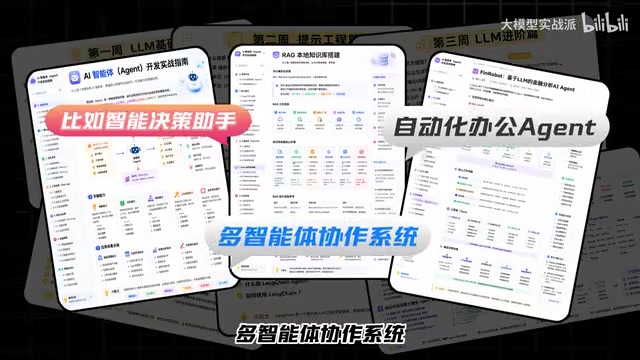
The key is not the number of projects, but fully completing the entire process of development, debugging, and optimization. Only after going through the full cycle from requirements to launch to iteration does theoretical knowledge truly transform into demonstrable results. These results directly strengthen your resume and are the most convincing proof of competitiveness when job hunting or taking on projects.
Who This Path Is For
Frankly speaking, this path is not easy. Going through all four stages requires sustained investment. But it solves a common problem: most tutorials on the market either only discuss concepts without deployment, or jump straight into practice without principle support. This path strings together "understanding concepts—understanding principles—knowing how to optimize—being able to deploy" into one line.
For zero-foundation learners who want to enter the field of Agent development, this is a roadmap worth referencing. As for the accompanying learning materials and project source code, the original video creator has a sharing channel in the comments section, which you can look into if you're interested.
One-line Summary
Agent development is replacing simple API calls as the most hardcore competitiveness in the LLM field, and this four-stage path takes you from entry to deployment.
Paragraph Summary
The article points out that as the direction of LLM application development shifts, only knowing how to call APIs and build Q&A bots is rapidly depreciating. The real core competitiveness is being able to independently develop intelligent Agents that plan autonomously, call tools, and solve complex tasks in a closed loop. The article presents a four-stage learning path: Stage one lays the foundation by understanding core components such as planning, memory, and tool calling, as well as the LLM's role as the reasoning engine; Stage two masters principles and classic paradigms such as ReAct and CoT, and understands practical problems such as tool calling failures and context limitations; Stage three optimizes output quality through reinforcement learning, multi-agent collaboration, and prompt tuning; Stage four deploys 2-3 practical projects, fully completing the entire process of development, debugging, and optimization. This path strings together "understanding concepts—understanding principles—knowing how to optimize—being able to deploy" into one line, suitable for zero-foundation learners who want to seriously pursue this path.
Related articles

Chain of Thought Isn't Just for AI: How Humans Can Use CoT to Improve Thinking Quality
Chain of Thought isn't just a prompt trick for large models. Starting from a Hacker News discussion, this article analyzes why CoT works for human thinking too, breaks down actionable ways to transfer it, and highlights the key differences between human CoT and machine CoT.
Cloudflare Teams Up with OpenAI: Closi…
Cloudflare Teams Up with OpenAI: Closing the Loop from Vulnerability Discovery to Defense with AI
Cloudflare uses OpenAI Daybreak to investigate security vulnerabilities and generate reviewable remediation plans, while developers use Codex to boost coding efficiency and quality.

Orca Multi-Agent Orchestration in Practice: A Guide to Parallel Collaboration with Claude and Codex
Orca is Stable AI's free open-source agent workbench supporting 34 agents like Claude Code and Codex in parallel. Learn its Git worktree isolation, multi-model orchestration, and mobile management.